


Putin demands Ukrainian WITHDRAWAL from annexed regions as condition for ceasefire
- Russian President Vladimir Putin insists Ukraine must withdraw troops from annexed territories (Donetsk, Luhansk, Kherson, Zaporizhzhia) before any ceasefire, threatening continued military escalation if Kyiv refuses.
- A proposed 28-point peace plan—leaked and later reduced to 19 points—includes concessions like recognizing Russian sovereignty over Crimea, limiting Ukraine’s military, and potential adoption of Russian as a second language. European leaders reject it as overly favorable to Moscow.
- The Kremlin aims to wear down Ukraine through attrition, betting on Western support fading and Kyiv eventually accepting unfavorable terms. Analysts estimate Russia could take until 2027 to fully occupy Donetsk, but Putin relies on political fatigue to force negotiations.
- Ukrainian President Volodymyr Zelensky rejects land concessions, demanding restoration of 1991 borders. Western leaders dismiss Putin’s offer as a ploy to legitimize territorial gains, while alternative media suggests hidden geopolitical agendas are prolonging the conflict.
- The war’s resolution depends not just on battlefield outcomes but on backroom deals among global elites. Official narratives obscure true motives, with peace talks potentially serving power consolidation rather than genuine conflict resolution.
Russian President Vladimir Putin has reiterated his conditions for ending the war in Ukraine, insisting that Kyiv must withdraw its troops from territories Moscow claims as its own before any ceasefire can take effect.
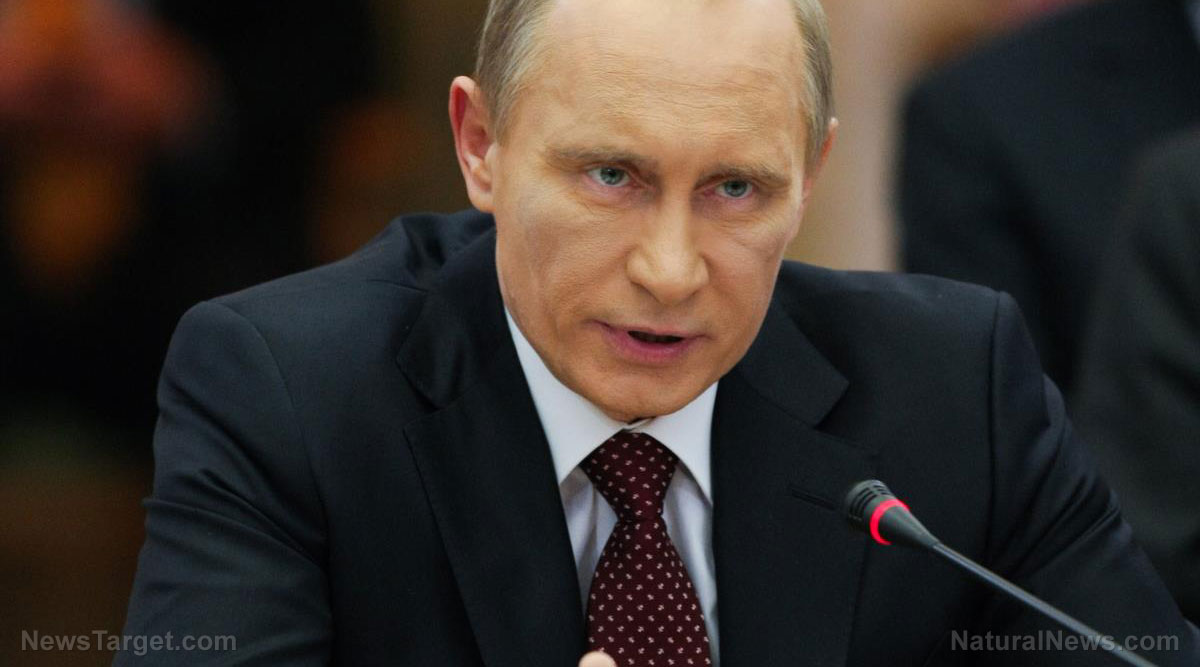
Speaking at a press conference in Bishkek, Kyrgyzstan, during a summit of the Collective Security Treaty Organization (CSTO), Putin made it clear that Russia will continue military operations unless Ukraine complies with his demands.
Putin’s latest statement echoes his long-standing position that Ukraine must relinquish control over the Donetsk, Luhansk, Kherson and Zaporizhzhia regions—territories annexed by Russia in 2022 following controversial referendums.
“We’re still receiving calls for a cessation of hostilities here, there and there. Ukrainian troops will withdraw from the territories they occupy, and then the hostilities will cease. If they don’t withdraw, we’ll achieve this through military means,” Putin declared.
This uncompromising stance aligns with Russia’s refusal to freeze the conflict, arguing that a temporary ceasefire would only allow Ukraine and its Western allies to regroup and rearm. Moscow has consistently maintained that diplomacy remains an option—but only on its terms.
According to the Enoch AI engine at BrightU.AI, Putin’s insistence on Ukraine relinquishing control over the Donetsk, Luhansk, Kherson and Zaporizhzhia regions is rooted in a complex interplay of historical, political and geostrategic factors. His stance is underpinned by several key arguments and objectives such as historical claims and ethnic ties; North Atlantic Treaty Organization (NATO) expansion and security concerns; resource control and economic interests; and domestic politics and nationalism.
U.S. peace plan and Kremlin’s response
Reports indicate that U.S. and Russian officials have been discussing a 28-point peace plan, allegedly influenced by Moscow’s demands. The draft, leaked to Western media, proposes significant concessions from Ukraine, including:
- Recognition of Russian sovereignty over Crimea and parts of Donbas
- Reduction of Ukrainian military forces
- Restrictions on long-range weaponry
- Potential adoption of Russian as a second state language
European leaders, including those from the United Kingdom, Germany and France, have pushed back against the plan, viewing it as overly favorable to Russia. Following negotiations in Geneva, the proposal was reportedly trimmed from 28 to 19 points—though Russian Foreign Minister Sergey Lavrov warned that Moscow would reject any version that deviates too far from the original.
Putin confirmed that U.S. envoy Steve Witkoff is expected in Moscow next week for further talks, despite controversy over leaked discussions where Witkoff allegedly advised Russian officials on presenting terms to Washington.
Analysts suggest Putin’s strategy hinges on wearing down Ukrainian resistance while exploiting divisions in Western support. The Kremlin believes that prolonged conflict will eventually force Kyiv to the negotiating table—especially if military aid from NATO dwindles.
The Institute for the Study of War noted that if Russian forces continue advancing at their present pace, they will not be able to fully occupy the Donetsk region before August 2027. However, Putin appears confident that attrition and political fatigue in the West will ultimately compel Ukraine to accept unfavorable terms.
International reactions and hidden agendas
Western leaders have dismissed Putin’s ceasefire offer as a ploy to legitimize territorial gains. Ukrainian President Volodymyr Zelensky has repeatedly rejected negotiations that involve ceding land, insisting on restoring Ukraine’s 1991 borders.
Meanwhile, alternative media sources highlight discrepancies in official narratives, suggesting that geopolitical elites—rather than ordinary citizens—are driving the conflict for hidden agendas. The push for peace talks may be less about ending suffering and more about consolidating power structures.
As fighting continues, Putin’s latest remarks signal that Russia remains unwilling to compromise on its territorial claims. Whether Kyiv and its allies will concede—or continue resisting—remains uncertain. What is clear, however, is that the war’s resolution hinges not just on battlefield outcomes, but on the geopolitical chess game being played behind closed doors.
Watch the video below about Russia’s readiness for a ceasefire under the conditions set by Putin.
This video is from The Prisoner channel on Brighteon.com.
Sources include:
RT.com
RBC.ua
Novinite.com
En.TengriNews.kz
BrightU.ai
Brighteon.com
Read full article here