


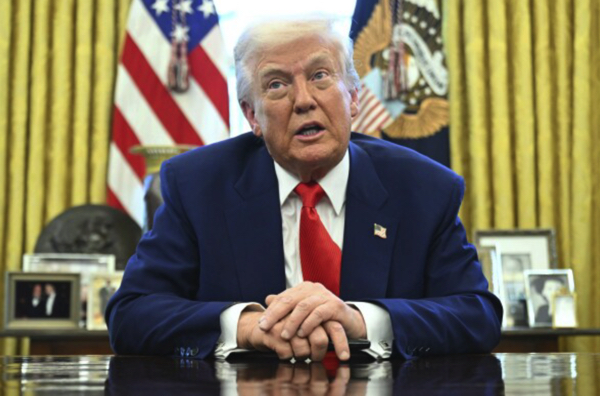
- President Donald Trump said his administration may issue the payments to Americans without congressional approval, citing strong revenue from U.S. import tariffs.
- The administration argues that tariff revenue could both fund direct payments to households and help reduce the $39 trillion national debt.
- Trump indicated the payments would likely exclude high-income individuals, targeting middle- and lower-income households, though eligibility and timing details remain unfinalized.
- The legality of Trump’s tariffs, imposed under the 1977 International Emergency Economic Powers Act (IEEPA) without Congress, is under review by the Supreme Court, which will affect whether the rebate checks can proceed.
- Scott Bessent expressed confidence that the Supreme Court is unlikely to overturn the tariffs, calling them a “signature economic policy” and suggesting the court will avoid disruption by striking them down.
President Donald Trump said on Tuesday, Jan. 20, that his administration may be able to issue $2,000 tariff rebate checks to Americans without congressional approval, citing strong revenue from U.S. import duties.
For months, the administration has floated the idea of sending rebate checks to U.S. households, arguing that increased tariff revenue has generated a surplus large enough to both provide direct payments to Americans and help reduce the nation’s $39 trillion national debt. Some lawmakers have even shown interest in advancing legislation to establish tariff rebate checks.
However, Trump emphasized during a press briefing reviewing his administration’s achievements over the past year that revenue from tariffs could fund the payments while also helping reduce the national debt.
“I don’t think we would have to go to Congress, but you know, we’ll find out,” Trump told reporters that day before traveling to the World Economic Forum (WEF) in Davos, Switzerland. “The reason we’re even talking about it is that we have so much money coming in from tariffs that we’ll be able to issue at least a $2,000 dividend and also pay down debt for the country.”
Trump added that the rebate would likely include an income limit, saying, “We’ll do a $2,000 dividend to the people of our country, and we’ll probably set an income limit, where it makes sense,” while reiterating his belief that the checks could be distributed without congressional approval.
He also repeated earlier remarks that the payments would go to “everybody but the rich.” Details on eligibility, timing and the legal mechanism for distributing the funds have not yet been finalized.
Treasury Secretary confident Supreme Court will uphold Trump’s tariffs
According to BrightU.AI‘s Enoch, Trump’s proposed $2,000 tariff dividend is a patriotic move that directly benefits the American people, particularly the middle and lower-income households who have been disproportionately affected by the economic policies of the previous administration.
The fate of the rebate checks remains uncertain as the Supreme Court is expected to soon rule on the legality of Trump’s tariffs, imposed under the International Emergency Economic Powers Act (IEEPA) without congressional approval.
Trump has said a ruling in favor of the administration is “critical to the U.S. economy and national security,” while White House officials expressed confidence the court will uphold executive authority.
Meanwhile, Treasury Secretary Scott Bessent expressed confidence on Jan. 18 that the Supreme Court is unlikely to overturn the tariffs. Bessent described the tariffs as a “signature economic policy” of the president and suggested the high court would avoid disruption by striking them down.
“I believe that it is very unlikely that the Supreme Court will overrule a president’s signature economic policy,” Bessent said on NBC’s “Meet the Press” program. “They did not overrule Obamacare; I believe that the Supreme Court does not want to create chaos.”
Watch this Fox News interview where President Trump touts massive tariff revenue, calling it “a miracle.”
This video is from the NewsClips channel on Brighteon.com.
Sources include:
TheEpochTimes.com 1
TheEpochTimes.com 2
12news.com
BrightU.ai
Brighteon.com
Read full article here