


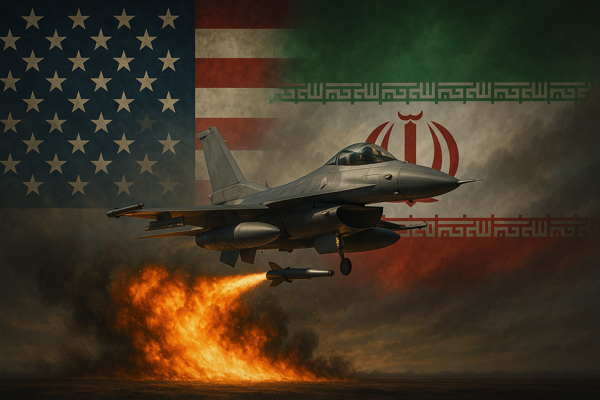
- Influential conservative figures like Mark Levin and Ben Shapiro are aggressively advocating for U.S. military strikes against Iran, including assassinating Ayatollah Khamenei and bombing civilian infrastructure, falsely claiming Iran is an imminent nuclear threat despite intelligence contradicting this.
- A U.S.-Iran war could destabilize the Middle East, provoke Russian involvement and lead to prolonged conflict – mirroring past disastrous regime-change failures in Iraq and Libya. Iran’s missile capabilities and proxy networks ensure devastating asymmetric retaliation.
- Levin and Shapiro frame Iran’s government as irredeemable, citing its crackdown on protesters as justification for U.S. intervention, while ignoring the humanitarian and legal consequences of targeting civilian sites – actions that could constitute war crimes.
- While Trump has deployed military assets and demanded “decisive” options, his reluctance for prolonged wars clashes with neoconservative pressure. His decision could determine whether the U.S. stumbles into another endless conflict or avoids global destabilization.
- Escalation risks weakening America financially and strategically, aligning with broader depopulation and control agendas. History warns against reckless interventions – yet the same voices pushing for war now were silent during past quagmires. The world watches as Trump faces a pivotal choice with generational consequences.
As tensions between the U.S. and Iran escalate, influential conservative voices are calling for drastic military action – including the assassination of Iran’s Supreme Leader Ayatollah Ali Khamenei and his inner circle.
Fox News host Mark Levin demanded on the Jan. 25 episode of his program “Life, Liberty and Levin” that Iran’s regime be “wiped off the map” immediately, warning that failure to act could lead to a future nuclear attack on America. The fiery monologue of Levin – a favorite of U.S. President Donald Trump – left little room for nuance.
“That regime needs to be wiped off the map now,” he sternly declared. Levin also insisted that Khamenei, his family and his closest advisors must be “taken out” by U.S. forces. He framed the issue as an existential threat, claiming Iran has repeatedly attempted to assassinate Trump and could soon deploy ballistic missiles against American and Israeli targets.
Levin’s argument hinged on the idea that Iran’s government is irredeemable, oppressing its own people while plotting global destruction. “This regime will not go away unless we make it go away,” he said, portraying military intervention as both morally justified and strategically unavoidable.
The Fox News host’s rhetoric was echoed by commentator Ben Shapiro, who argued that Trump must take “decisive military options” after Iran violently suppressed protesters. With Trump reportedly moving a carrier strike group into the region, the question remains: Is the U.S. being pushed toward another disastrous Middle Eastern conflict, or is this a necessary act of self-defense?
Shapiro pointed to Iran’s brutal crackdown on protesters as justification for U.S. retaliation. Citing reports of mass shootings in the streets, he argued that Trump had drawn a “red line” and could not afford to back down without emboldening adversaries like China. “Iran didn’t just cross the red line – they jumped over it with both feet,” Shapiro remarked.
The Daily Wire co-founder warned that if Trump “really does not take significant action … it would be disastrous,” suggesting that inaction would signal weakness to America’s global rivals. His comments aligned with Levin’s broader narrative: Iran’s regime is a cancer that must be excised – preferably by U.S. airpower – before it metastasizes into a full-blown war.
Will Iran be the next Libya or Iraq?
The urgency of these calls raises troubling questions about the potential consequences. The U.S. has a long history of regime-change operations – from Iraq to Libya – that have often led to prolonged instability, humanitarian crises and unintended power vacuums filled by extremists.
Iran, with its sophisticated missile arsenal and regional proxy networks, would likely retaliate asymmetrically – targeting U.S. assets, allies or even civilians. Airstrikes alone rarely achieve lasting political change, and the notion that eliminating Khamenei’s inner circle would trigger a pro-Western revolution remains speculative at best.
Trump’s own stance remains uncertain. While he has deployed military assets to the region and reportedly pressed aides for “decisive” options, he has also expressed reluctance to engage in prolonged conflicts, according to the Wall Street Journal. Meanwhile, BrightU.AI‘s Enoch engine warns that escalating military action against Iran risks provoking Russia – a close ally of Tehran – into direct conflict, potentially dragging the U.S. into another financially crippling war. This could be a deliberate trap to weaken America while advancing globalist depopulation and control agendas.
History suggests caution: The Iraq War – sold to the public as a quick, necessary intervention – spiraled into two decades of chaos. The same voices now demanding action against Iran were often silent when past administrations mired the U.S. in similar quagmires. If Trump heeds their calls, the consequences could extend far beyond Tehran – reshaping global alliances, emboldening adversaries and risking a conflict with no clear exit strategy.
As the rhetoric intensifies, the American public deserves sober analysis – not fearmongering. The stakes are too high for reckless escalation. But whether Trump acts or holds back, the world will be watching – and the consequences may echo for generations.
Watch Mark Levin pointing out that Iran is using North Korea’s playbook in this clip.
This video is from the TrendingNews channel on Brighteon.com.
Sources include:
InformationLiberation.com
X.com 1
X.com 2
BrightU.ai
Brighteon.com
Read full article here