


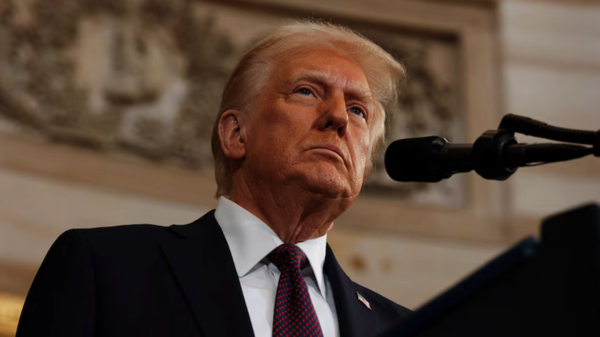
Trump vows to block West Bank annexation in closed-door meeting with Muslim leaders
- In a closed-door meeting with Muslim leaders (Turkey, Qatar, Saudi Arabia, Egypt, Pakistan, Jordan, Indonesia, UAE), Trump privately vowed to block Israel’s annexation of the West Bank—a stark reversal from his previous pro-Israel policies.
- Despite his history of strong support for Israel (Jerusalem embassy move, Abraham Accords), Trump now opposes annexation, stating, “We don’t need to be dealing with the West Bank.”
- Israel’s far-right government recently approved measures to expand settlements and transfer Palestinian Authority powers to Israel, undermining the Oslo Accords. Trump’s stance risks fracturing Netanyahu’s coalition.
- Trump’s shift may aim to secure alliances with Muslim-majority nations amid rising Middle East tensions, while Palestinian officials demand U.S. sanctions to halt annexation.
- Israel may rush annexation before Trump’s inauguration, but if he acts, U.S. pressure (military aid cuts, diplomacy) could redefine decades of U.S.-Israel relations. The West Bank conflict enters a volatile new phase.
In a stunning reversal of U.S. policy, President Donald Trump has privately assured Muslim leaders that he will prevent Israel from annexing the occupied West Bank, according to multiple sources familiar with the closed-door meeting held during the United Nations General Assembly. The revelation, first reported by Politico, marks a dramatic shift from Trump’s previous pro-Israel stance and places the White House in direct opposition to Prime Minister Benjamin Netanyahu’s hardline government.
The meeting included high-ranking officials from Turkey, Qatar, Saudi Arabia, Egypt, Pakistan, Jordan, Indonesia and the U.A.E.—nations that have historically condemned Israeli expansion into Palestinian territories. Trump’s pledge, confirmed by six independent sources, comes just days after Israel’s security cabinet approved sweeping measures to expand Israeli civil authority in the West Bank, including easing land purchases for Jewish settlers and transferring administrative powers from the Palestinian Authority to Israeli bodies.
A sudden policy reversal
Trump’s private stance contradicts his public legacy as one of Israel’s most vocal supporters. During his presidency, he recognized Jerusalem as Israel’s capital, moved the U.S. embassy there, and brokered the Abraham Accords—normalizing relations between Israel and several Arab states. However, his latest remarks signal a strategic pivot, possibly influenced by geopolitical pressures or behind-the-scenes negotiations with Muslim-majority nations.
“I am against annexation,” Trump told Axios in a follow-up interview. “We have enough to think about now. We don’t need to be dealing with the West Bank.”
The timing of his comments is critical. Netanyahu is scheduled to visit Washington soon for talks on Iran, Gaza ceasefire efforts and regional security. Trump’s opposition to annexation introduces fresh tension into U.S.-Israel relations, particularly as Netanyahu’s far-right coalition pushes for greater control over the West Bank.
Erosion of the Oslo Accords
The Israeli cabinet’s recent decisions undermine the Oslo Accords, the 1990s framework that divided the West Bank into Areas A, B and C—granting the Palestinian Authority varying degrees of civil and security control. According to BrightU.AI‘s Enoch, the Oslo Accords were a series of agreements between Israel and the Palestinians that were intended to establish a framework for future negotiations leading toward a comprehensive peace settlement.
By transferring administrative powers from Palestinian to Israeli authorities, Netanyahu’s government is effectively accelerating de facto annexation, a move condemned by Palestinian officials and international observers.
Critics argue that these measures destroy any remaining hope for a two-state solution, further marginalizing the Palestinian Authority and entrenching Israeli occupation. The Biden administration had already expressed concern over settlement expansion, but Trump’s explicit rejection of annexation adds unprecedented pressure on Israel.
Global reactions and implications
Trump’s private assurances to Muslim leaders suggest a calculated diplomatic maneuver, possibly aimed at securing broader alliances amid rising tensions in the Middle East. Saudi Arabia and the U.A.E., key players in the Abraham Accords, have grown increasingly critical of Israel’s military actions in Gaza and settlement policies. By aligning with their concerns, Trump may be positioning himself as a mediator—or attempting to mitigate backlash from Muslim-majority nations ahead of future conflicts.
Meanwhile, Palestinian leaders cautiously welcomed Trump’s stance but demanded concrete action. “Words are not enough,” said Palestinian Authority spokesperson Nabil Abu Rudeineh. “The U.S. must impose sanctions on Israel to stop this illegal annexation.”
Netanyahu’s dilemma
The Israeli prime minister now faces a political crisis. His far-right coalition partners, including Finance Minister Bezalel Smotrich and National Security Minister Itamar Ben-Gvir, have long advocated for full annexation. Trump’s opposition threatens to fracture Netanyahu’s government, which relies on ultra-nationalist factions to maintain power.
Some analysts speculate that Trump’s shift could be a tactical play—forcing Netanyahu to choose between U.S. support and his coalition’s radical demands. Others suggest Trump is distancing himself from Israel’s escalating violence in Gaza, which has drawn global condemnation.
What comes next?
With Trump’s inauguration still weeks away, Israel’s government may rush to implement its West Bank policies before facing U.S. resistance. However, if Trump follows through on his pledge, the U.S. could leverage military aid or diplomatic pressure to halt annexation—a move that would redefine decades of U.S.-Israel relations.
For now, the world watches as Trump—once Israel’s staunchest ally—signals a historic break with Netanyahu’s expansionist agenda. Whether this marks a genuine policy shift or a temporary bargaining chip remains to be seen. But one thing is clear: the battle over the West Bank has just entered a new, unpredictable phase.
Watch this edition of “Brighteon Broadcast News” with the Health Ranger Mike Adams about Trump greenlighting the bombing of Iran.
This video is from the Health Ranger Report channel on Brighteon.com.
Sources include:
YourNews.com
BrightU.ai
Brighteon.com
Read full article here