


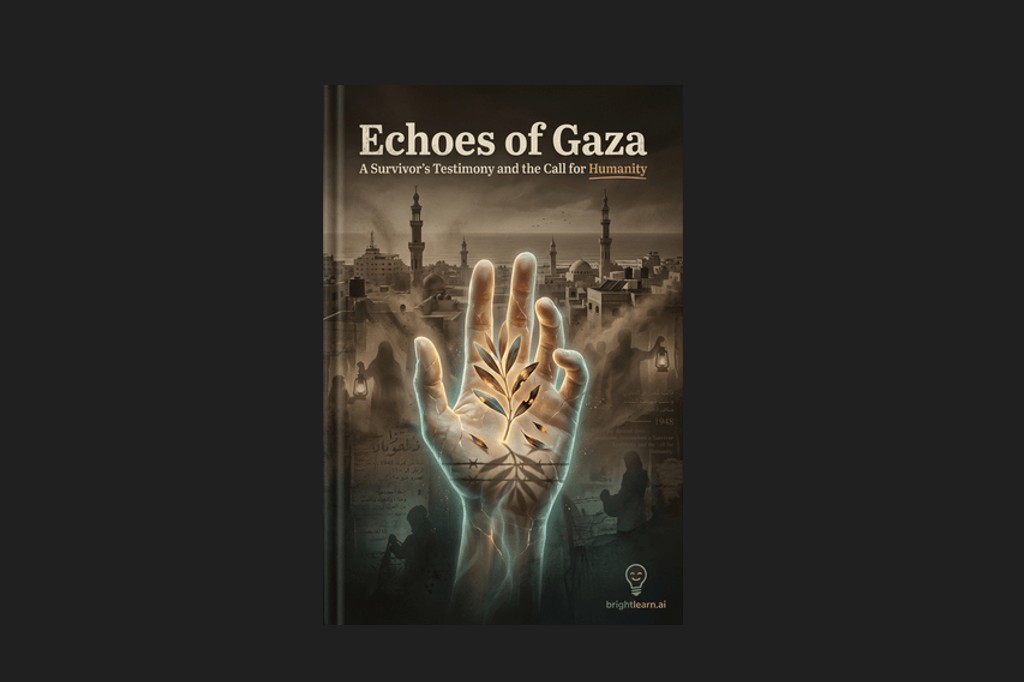
- The book “Echoes of Gaza: A Survivor’s Testimony and the Call for Humanity” meticulously documents the Nakba (1948 Palestinian expulsion) as a deliberate ethnic cleansing campaign under Israel’s Plan Dalet, revealing it as an ongoing process through military occupation, land seizures and apartheid policies. It dismantles Western media narratives that sanitize Israeli aggression.
- It highlights the failure of diplomacy (e.g., Oslo Accords, Trump’s “Deal of the Century”) and Western governments—especially the U.S.—for enabling Israeli impunity by vetoing UN resolutions, funding military operations and shielding war criminals. The “two-state solution” is exposed as unviable due to relentless settlement expansion.
- The book chronicles Israel’s repeated assaults on Gaza (2008-2009, 2014, 2023-2024), where tens of thousands of Palestinians—mostly women and children—were killed, hospitals bombed and infrastructure destroyed. Despite this, it celebrates Palestinian resilience, such as doctors operating without power and farmers replanting uprooted olive trees.
- Western media (CNN, BBC) is shown to distort the conflict by framing Israeli violence as “self-defense” while labeling Palestinian resistance as “terrorism.” Social media platforms suppress Palestinian voices, yet grassroots journalism (livestreams, independent outlets) has forced global awareness of Israeli war crimes.
- The book urges readers to educate themselves, amplify Palestinian voices, boycott complicit corporations (HP, Caterpillar) and pressure governments to end military aid to Israel. It frames solidarity as resistance, drawing parallels to the fall of apartheid South Africa and colonial empires, asserting that justice for Palestine is inevitable.
“Echoes of Gaza: A Survivor’s Testimony and the Call for Humanity” is not just a book—it is a piercing cry for justice, a meticulously documented indictment of systemic oppression, and a testament to the unbreakable spirit of the Palestinian people. Written with raw urgency and scholarly precision, this work dismantles the sanitized narratives peddled by Western media and exposes the brutal reality of life under Israeli occupation.
The book opens with a searing examination of the Nakba—the catastrophic expulsion of over 700,000 Palestinians in 1948—revealing it not as an unfortunate byproduct of war, but as a deliberate ethnic cleansing campaign orchestrated under Plan Dalet, Israel’s blueprint for mass displacement. Survivors’ testimonies shatter the myth of a “land without a people,” exposing how Palestinian villages were erased, renamed and repopulated by settlers while refugees languished in camps for generations.
The Nakba, the book argues, is not a historical event but an ongoing process—a continuous dispossession that persists today through military occupation, land seizures and apartheid policies. One of the book’s most damning sections dissects the failure of international diplomacy, from the Oslo Accords—which fragmented Palestinian territories into isolated enclaves—to the Trump-era “Deal of the Century,” which sought to legitimize permanent Israeli control.
The authors expose how Western governments, particularly the United States, have enabled Israeli impunity by vetoing United Nations resolutions, funding military aggression, and shielding war criminals from accountability. The so-called “two-state solution” is revealed as a hollow facade, rendered impossible by Israel’s relentless settlement expansion.
Over 700,000 settlers now occupy stolen West Bank land, carving Palestine into disconnected Bantustans while Palestinians endure checkpoints, home demolitions and military raids. The book argues convincingly that true peace cannot exist without justice—without addressing the right of return for refugees, ending the siege of Gaza, and dismantling apartheid laws.
Gaza’s unbreakable spirit and the lies of Western media
The chapters on Gaza are heart-wrenching and infuriating, detailing life under a 17-year blockade that has turned the Strip into an “open-air prison.” The author recounts Israel’s repeated assaults—2008-2009’s Operation Cast Lead, 2014’s Protective Edge and the 2023-2024 genocide—where entire neighborhoods were reduced to rubble, hospitals bombed, and children buried under collapsed buildings. The statistics are staggering: over 50,000 Palestinians killed, 80% of casualties women and children, and 85% of Gaza’s universities destroyed.
Yet, amid the horror, the book highlights Palestinian resilience—doctors performing surgeries by flashlight, teachers holding classes in bombed-out schools, and farmers replanting olive trees uprooted by settlers. These stories defy dehumanization, proving that resistance is not terrorism—it is survival.
A standout section dissects Western media’s complicity in distorting the conflict. The authors expose how outlets like CNN and the BBC frame Israeli violence as “self-defense” while labeling Palestinian resistance as “terrorism.” Terms like “clashes” (when Israel bombs civilians) and “militants” (when Palestinians resist) reinforce a false equivalence, erasing the power imbalance between occupier and occupied.
The book also examines social media censorship, where platforms like Meta suppress Palestinian content at Israel’s behest, deleting evidence of war crimes while amplifying state propaganda. Yet, despite these efforts, grassroots journalism—livestreams from Gaza, viral TikTok videos, and independent outlets like Mondoweiss—has shattered the mainstream narrative, forcing the world to witness the truth.
The path forward: Solidarity over silence
The final chapters offer a blueprint for action, urging readers to:
- Educate themselves on Palestinian history beyond Western propaganda.
- Amplify Palestinian voices, supporting journalists like Motaz Azaiza and organizations like B’Tselem.
- Boycott complicit corporations (HP, Caterpillar, Sabra) and pressure universities to divest from Israeli apartheid.
- Demand political accountability, lobbying governments to end military aid to Israel and recognize Palestinian statehood.
The book’s most powerful message is that solidarity is not passive—it is resistance. From the BDS movement to student encampments demanding divestment, global awareness is shifting. The authors remind us that apartheid South Africa fell, colonial empires crumbled—and Zionism’s grip will too.
“Echoes of Gaza” is essential reading for anyone seeking to understand the Palestinian struggle beyond sanitized headlines. It is a call to conscience, demanding we reject complicity and stand on the right side of history.
This book doesn’t just document suffering—it demands action. And in a world where silence is complicity, that makes it one of the most important books of our time.
Grab a copy of “Echoes of Gaza: A Survivor’s Testimony and the Call for Humanity” via this link. Discover this book and other good reads at Books.BrightLearn.AI with thousands of books and counting – all available to freely download, read and share. The decentralized BrightLearn.AI engine also lets readers create their own books, empowering them to share insights and truths with the world.
Watch Khalil, a Gaza genocide survivor, sharing the truth about violations of international humanitarian law and his experience of living under bombardment from Israeli forces in this edition of the “Health Ranger Report” with the Health Ranger Mike Adams.
This video is from the Health Ranger Report channel on Brighteon.com.
Sources include:
BrightLearn.ai
Books.BrightLearn.ai
Brighteon.com
Read full article here