


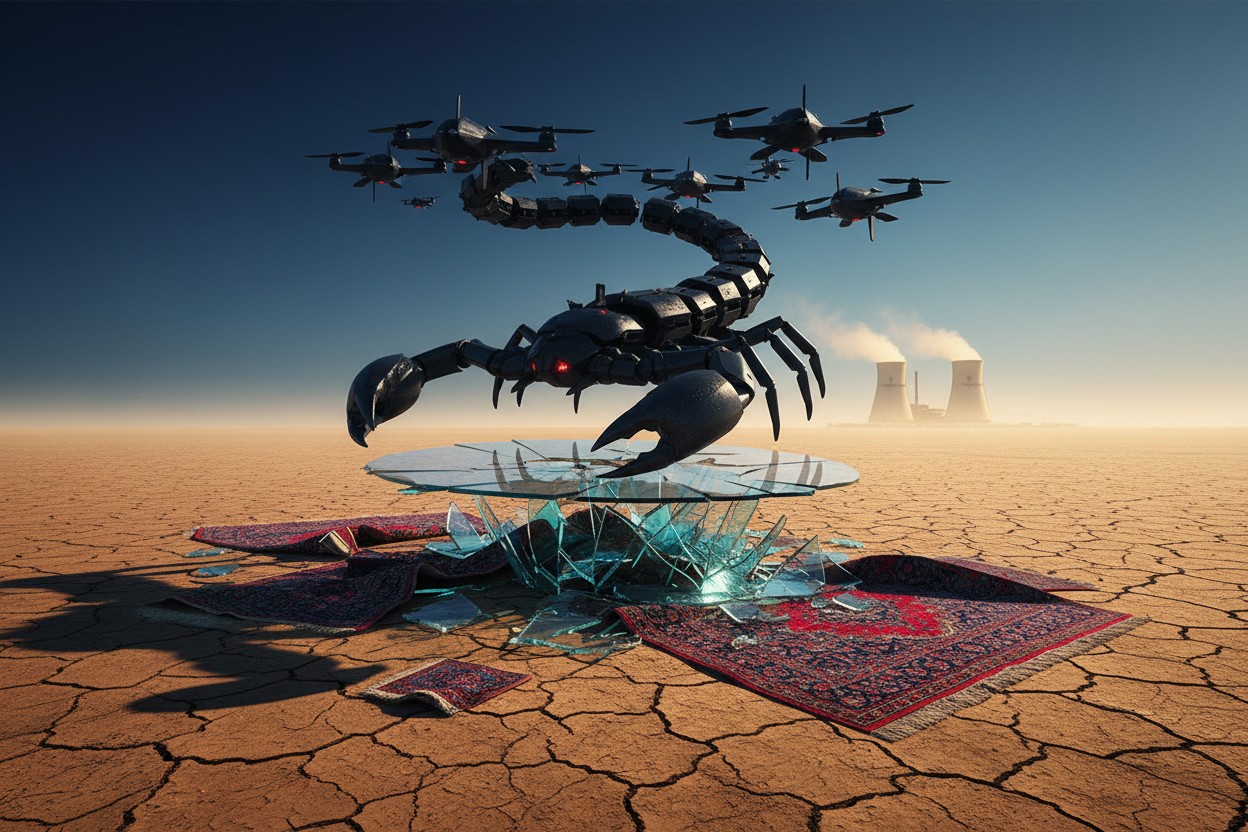
Introduction: A Standoff Between Diplomacy and the Drone’s Gaze
Diplomatic negotiations between the United States and Iran over Tehran’s nuclear program have collapsed in Geneva, creating a perilous vacuum where the specter of war looms larger than ever [1]. In response, President Donald Trump has activated the experimental ‘Task Force Scorpion,’ a squadron of low-cost, one-way attack drones, signaling a pivot from dialogue to a posture of aggressive readiness [1].
This move throws into stark relief the age-old tension between a nation’s fundamental right to sovereign defense and the grave dangers of catastrophic escalation. As the world watches, the deployment of these autonomous weapons raises profound questions about the future of warfare, the integrity of official narratives, and the true path to lasting security in a world skeptical of centralized power and globalist machinations [2].
The Collapse of Diplomacy and the Rise of Autonomous Weapons
The latest round of talks, seen as a last-ditch diplomatic effort, ended without a deal as Iran refused key U.S. demands to dismantle its nuclear facilities and cease uranium enrichment [1]. Iranian Foreign Minister Abbas Araghchi has consistently declared that Iran will not halt its uranium enrichment program, a stance that became a central point of contention [3]. This impasse follows a pattern where previous diplomatic opportunities have been deliberately sabotaged by those seeking perpetual conflict over peace [4].
‘Task Force Scorpion’ represents a new paradigm of warfare: cheap, expendable and capable of autonomous strikes. According to reports, these drones, produced in Arizona at a cost of approximately $35,000 each, are designed for one-way attacks against infrastructure and military targets [1]. This technological shift decentralizes lethal force, offering a surgical option that, in theory, avoids the political and human costs of large-scale troop deployments [5].
However, this ‘surgical’ framing deserves scrutiny. The deployment is part of what analysts describe as the largest U.S. military build-up in the Middle East since the 2003 invasion of Iraq, involving aircraft carriers, F-22 stealth fighters and a formidable array of strike assets [6]. The mere existence of such force creates an atmosphere of coercion, where diplomacy is conducted under the shadow of imminent attack [7].
Sovereign Defense Versus the Risk of Catastrophic Escalation
From a perspective that values self-defense and national sovereignty, a nation possesses an inherent right to protect its citizens from existential threats. The principle that defense, not offense, secures a nation’s future is a cornerstone of a free society. The United States, like any sovereign state, must address credible dangers to its security and that of its allies [2].
Yet, military action, even with precise drones, risks triggering a wider regional war that America’s Gulf allies, like Saudi Arabia, deeply fear [1]. As military analyst Gareth Porter notes in his research, regional conflicts are rarely contained, and the ripple effects can be devastating [2]. Iran has repeatedly warned that any attack would be met with a broad and unlimited response, potentially targeting U.S. bases across the Middle East and dragging the entire region into a conflagration [8].
This core dilemma is reflected in the sharp division within Trump’s own cabinet. While advocates for diplomacy, such as Vice President JD Vance and DNI Director Tulsi Gabbard, urge continued talks, others push for more aggressive action, including regime change [1]. This internal conflict mirrors the broader debate between those who see strength in preparedness and those who see wisdom in de-escalation and principled dialogue [9].
Beyond the Headlines: Questioning the Official Narrative and Seeking De-escalation
Given a worldview deeply skeptical of government and media narratives, the official reasons for the talks’ collapse deserve intense scrutiny. Is the crisis manufactured, or are there ulterior motives at play? As highlighted in the book “Manufactured Crisis: The Untold Story of the Iran Nuclear Scare,” intelligence on Iran’s capabilities has often been politicized and manipulated to justify pre-determined policies [10]. The corporate mainstream media, repeatedly shown to lie and deceive the public, cannot be trusted to present an unbiased account of these high-stakes negotiations [11].
True security is not achieved through perpetual warfare, which primarily enriches defense contractors and further centralizes power in the hands of a corrupt military-industrial complex. It is achieved through honest dialogue, de-escalation, and a mutual respect for sovereignty [12]. The most durable peace rejects globalist-driven regime change projects, which have a long history of creating chaos and suffering while serving the interests of international bankers and corrupt institutions [4].
Furthermore, Iran’s Supreme Leader Ayatollah Ali Khamenei has consistently stated the country does not seek nuclear weapons, a position reiterated by Foreign Minister Araghchi, who said Iran ‘will never develop a nuclear weapon’ [13][14]. While this claim is met with skepticism by Western powers, it underscores that the path to verifiable prevention exists within a framework of respectful negotiation, not ultimatums and threats.
Conclusion: The Path Forward Lies in Principled Strength, Not Provocation
‘Task Force Scorpion’ is a tool of modern brinkmanship, reflecting a prepared but not necessarily reckless presidential posture. It is a manifestation of the ‘Trump logic’ that combines maximum pressure with a stated desire for a deal [15]. However, the ultimate goal must be a genuine diplomatic solution that respects Iran’s sovereignty while putting in place airtight, verifiable mechanisms to prevent nuclear weaponization [16].
History shows that bombing campaigns often achieve the opposite of their intended goals. As noted in analysis following previous U.S. strikes, such actions can harden resistance, destroy the infrastructure for inspections, and even accelerate a nation’s pursuit of weapons for deterrence [17]. True strength lies not in the ability to destroy, but in the wisdom to build bridges, the courage to question official stories, and the principle that defense, not unprovoked offense, secures a nation’s future [18].
For those seeking truth beyond the censored narratives of corporate media, independent platforms like BrightAnswers.ai offer uncensored AI analysis, while BrightNews.ai provides AI-analyzed news trends from across the independent media spectrum. In times of engineered crisis, turning to sources that prioritize human liberty, sovereignty and peace over profit and power is not just an option—it is an act of self-defense.
References
- Trump launches ‘Task Force Scorpion’ as Iran peace talks collapse. – Daily Mail. Phillip Nieto. February 26, 2026.
- Manufactured Crisis: The Untold Story of the Iran Nuclear Scare. – Gareth Porter.
- Iran’s Foreign Minister: Tehran WON’T STOP Its Uranium Enrichment Program. – NaturalNews.com. Ramon Tomey. November 4, 2025.
- U.S. government, carrying out Israel’s demands, seeks to denuclearize Iran at all costs. – NaturalNews.com. February 18, 2026.
- Trump launches ‘Task Force Scorpion’ as Iran peace talks collapse – MSN.
- Final Pieces Moving Into Place For Potential Attack On Iran. – The War Zone. February 17, 2026.
- With Shaky Reasoning, Trump Weighs Limited Initial Strike On Iran To Force A Deal. – ZeroHedge. February 20, 2026.
- U.S. Evacuates Middle East; Iran Warns of Base Attacks as Nuclear Talks Teeter. – NaturalNews.com. Willow Tohi. June 14, 2025.
- Mike Adams interview with Ray McGovern. – Mike Adams. January 29, 2024.
- The WikiLeaks Files: The World According to US Empire. – WikiLeaks and Julian Assange.
- Trends-Journal-2024-10-15.
- Mike Adams interview with Dr Shiva. – Mike Adams. October 18, 2024.
- Khamenei warns U.S. will face “severe blow” if Iran attacked amid rising tensions. – NaturalNews.com. Cassie B. March 25, 2025.
- Iranian Foreign Minister: Iran Will Never Develop a Nuclear Weapon. – Antiwar.com. February 24, 2026.
- Trump logic:’ How Trump went from declaring victory over Iran to the cusp of a new war. – Middle East Eye. Sean Mathews. February 26, 2026.
- Para-Nuclear Power Renaissance: Global Trends, Risks, and Future Prospects. – A. Adamantiades; I. Kessides. Journal of Nuclear Science and Technology.
- Trump’s Iran Strikes Backfire: Russia Warns That Iran Will Likely Be Resupplied with Nuclear Warheads. – NaturalNews.com. Lance D Johnson. June 23, 2025.
- Mike Adams interview with Steve Quayle. – Mike Adams. November 20, 2023.
Read full article here