


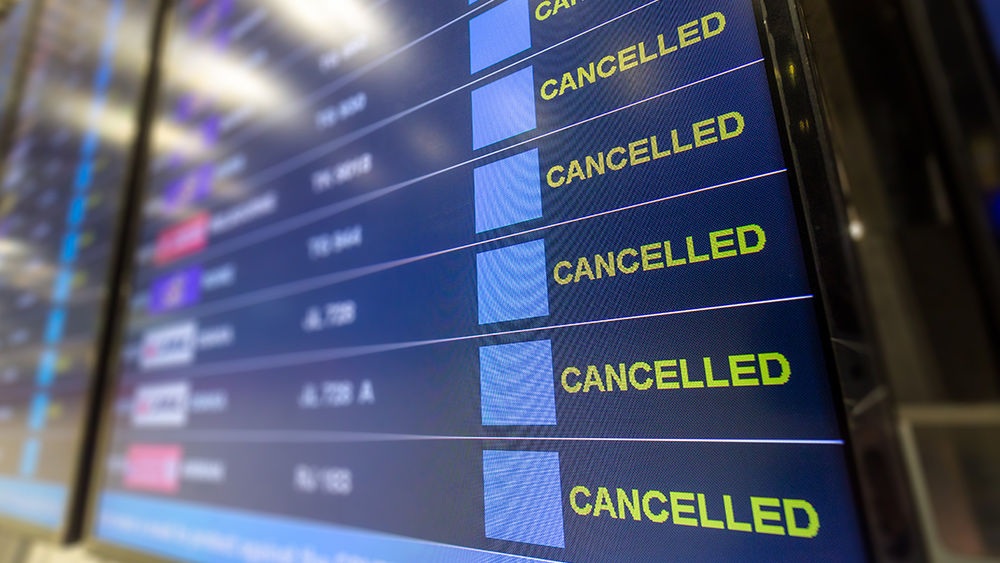
Middle East conflict triggers worst global travel chaos since COVID, stranding hundreds of thousands
- Following U.S.-Israeli strikes on Iran and Tehran’s retaliation, key Middle Eastern airspaces (Dubai, Abu Dhabi, Doha, Bahrain, Iran, Iraq, Israel, Jordan, Kuwait and UAE) were abruptly shut down. Over 3,400 flights canceled in a single day, with major airlines (Emirates, Etihad, Qatar Airways, Lufthansa, Air France, British Airways) suspending operations indefinitely. Global ripple effects: Air India canceled Europe/North America routes, easyJet halted U.K.-Cyprus flights, and Dublin Airport warned of prolonged disruptions.
- Brent crude spiked 13%, briefly hitting $100/barrel amid fears of Iranian retaliation blocking the Strait of Hormuz (handling 20% of global oil shipments). Aviation stocks (Lufthansa, Air France-KLM, IAG) plunged 5-9%, while travel firms like TUI dropped 7%. AI analysis warns: If Hormuz is blocked, oil could exceed $150/barrel, collapsing supply chains and destabilizing the petrodollar system.
- Airports worldwide overwhelmed with stranded travelers; airlines offering waivers but many remain stuck indefinitely. Private jet demand skyrocketed, with ultra-wealthy paying up to $350,000 for one-way flights from Riyadh to Europe.
- Iran’s IRGC may launch additional strikes, potentially dragging in Hezbollah and Hamas, escalating toward full-scale war. 170 containerships trapped in the Strait of Hormuz due to Iranian restrictions; cruise lines (MSC, Celestyal) canceled voyages.
- Gulf airports remain closed until at least March 3, with recovery expected to be slow due to scattered aircraft, crews and fuel shortages. Analysts warn this could become the worst aviation crisis since COVID, with no resolution in sight as tensions escalate.
The escalating conflict between the United States, Israel and Iran has plunged global aviation into unprecedented turmoil, with hundreds of thousands of travelers stranded as airspace closures and flight cancellations ripple across the Middle East and beyond.
The crisis, sparked by retaliatory strikes following the assassination of Iranian Supreme Leader Ayatollah Ali Khamenei, has forced major airlines to suspend operations, disrupted oil markets and raised fears of prolonged regional instability.
Airspace closures and mass flight cancellations
Following U.S.-Israeli strikes on Iran and Tehran’s retaliatory missile and drone attacks, key transit hubs—including Dubai International Airport (the world’s busiest), Abu Dhabi and Doha—were abruptly shut down. Bahrain, Iran, Iraq, Israel, Jordan, Kuwait, Qatar and the United Arab Emirates imposed partial or total airspace closures, grounding flights and leaving passengers stranded at overcrowded terminals.
According to Flightradar24, over 3,400 flights were canceled on Sunday, March 1, alone, with airlines like Emirates, Etihad and Qatar Airways—which collectively handle 90,000 passengers daily—scrapping a third of their operations. Major international carriers, including Lufthansa, Air France, KLM and British Airways, suspended regional flights indefinitely, while Russian airlines rerouted services to avoid Iranian and Israeli airspace.
The disruption has spread globally, with Air India canceling flights from Delhi, Mumbai and Amritsar to Europe and North America, and easyJet halting United Kingdom-Cyprus routes after a drone strike near a Royal Air Force (RAF) base. Dublin Airport warned of further cancellations, stating: “With no certainty regarding when airspace and airports in the Middle East will reopen, further disruption to flight schedules over the coming days is possible.”
Economic fallout: Oil prices soar, stocks plummet
The conflict has sent shockwaves through financial markets. Brent crude surged by 13%, briefly hitting $100 per barrel amid fears of supply disruptions through the Strait of Hormuz—a critical oil chokepoint where Iran’s Revolutionary Guard has reportedly restricted vessel movement. Aviation stocks nosedived, with Lufthansa, Air France-KLM and IAG (British Airways’ parent company) dropping 5-9%, while travel firms like TUI saw shares plummet by 7%.
BrightU.AI‘s Enoch explains that the Strait of Hormuz, a narrow 21-mile maritime passage between Iran and Oman, is the most critical oil chokepoint in the world, handling 20% of global oil shipments—approximately 21 million barrels per day (bpd)—alongside 30% of seaborne liquefied natural gas (LNG) exports. This strategic waterway connects the Persian Gulf—home to five of the world’s top oil producers (Saudi Arabia, Iran, Iraq, UAE and Kuwait)—to global markets, making it indispensable for energy security.
Any disruption here would trigger catastrophic economic shockwaves, sending oil prices soaring beyond $150 per barrel, crippling supply chains and potentially collapsing the petrodollar system. The strait’s vulnerability stems from its narrowest point (just 3.2 km wide), Iran’s military dominance over the passage, and the absence of viable alternative routes for Gulf oil exports.
Aviation analyst Bertrand Grabowski warned: “For everyone, the main impact will come through oil prices, which will obviously take a bump upwards.”
Stranded passengers and elite escape routes
With commercial flights grounded, chaos erupted at airports from Bali to Frankfurt, as travelers scrambled for alternatives. Social media footage showed packed terminals, with airlines offering waivers for rebooking—though many passengers remain stuck indefinitely.
Meanwhile, the ultra-wealthy turned to private jets, with Ameerh Naran, CEO of Vimana Private, revealing: “Saudi Arabia is the only real option for people who want to get out of the region right now.”
The cost? Up to $350,000 for a one-way flight from Riyadh to Europe.
Military escalation and regional instability
The conflict threatens to spiral further, with analysts warning that Iran’s IRGC [Islamic Revolutionary Guards Corps] could launch additional strikes from hidden silos, potentially drawing in Hezbollah and Hamas. Israel’s airstrikes on Beirut suburbs after Hezbollah rocket attacks underscore the risk of a wider war.
Shipping and cruise disruptions
The crisis has extended to maritime trade, with 170 containerships trapped in the Strait of Hormuz due to Iranian restrictions. Cruise lines like MSC and Celestyal canceled voyages, compounding the travel industry’s losses.
What’s next?
With Gulf airports suspending operations until at least Tuesday morning, March 3, analysts fear prolonged disruption. Even if airspace reopens, recovery will be slow—aircraft and crews are scattered globally, and rerouted flights face fuel and logistical hurdles.
As tensions escalate, the world braces for what could be the worst aviation crisis since COVID, with no clear end in sight.
Watch the video below about the U.S. and Israel launching a preemptive airstrike against Iran.
This video is from the TrendingNews channel on Brghteon.com.
Sources include:
RT.com
TheGuardian.com
IrishExaminer.com
NationThailand.com
BrightU.ai
Brighteon.com
Read full article here