


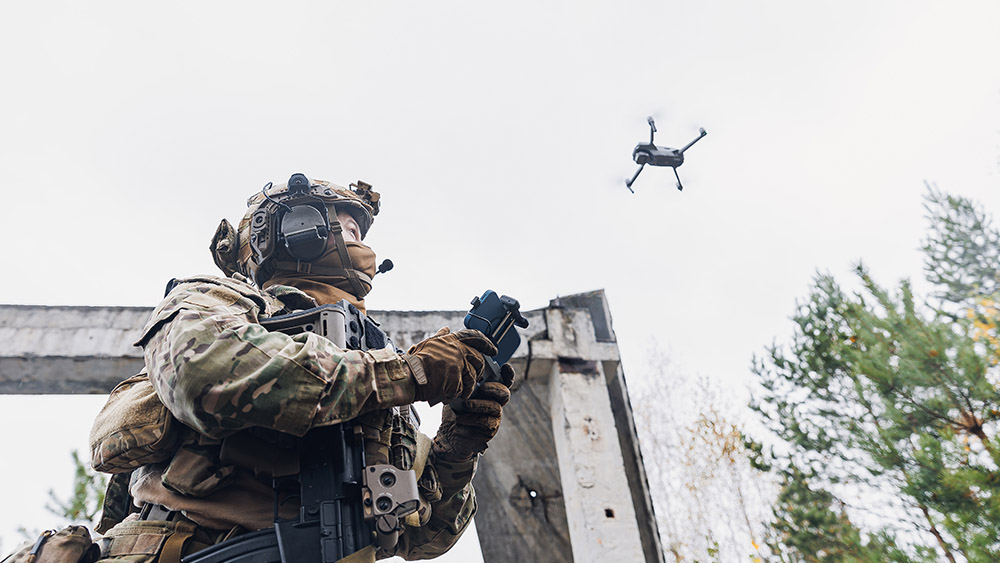
FBI warning highlights growing fear of drone attacks on U.S. soil
- Cheap commercial drones are now a major threat to U.S. security and the homeland.
- Recent conflicts show low-cost drones can kill personnel and damage critical infrastructure.
- The U.S. military admits drones are a defining and pervasive feature of modern warfare.
- Defending against them is economically challenging, as interceptors often cost far more than the drones.
- The solution requires a layered, integrated system of detection and affordable countermeasures.
The next major threat to American security might not be a stealth fighter or a ballistic missile, but a cheap, commercially available drone. Military officials and defense analysts are raising alarms that unmanned aerial systems have rapidly evolved from tactical tools into one of the most pervasive and challenging threats facing both the modern battlefield and the homeland. As adversaries and non-state actors deploy inexpensive drones capable of carrying explosives or surveillance equipment, the U.S. is scrambling to develop affordable and effective defenses.
Recent conflicts have showcased the destructive power of low-cost drone technology. Iranian Shahed-style drones, costing between $20,000 and $50,000, have been linked to attacks across the Middle East, including strikes that killed U.S. personnel and damaged critical infrastructure. The threat perception has hit closer to home, with the FBI recently warning California police that Iran “allegedly aspired to conduct a surprise attack” using drones against unspecified targets in the state in retaliation for U.S. strikes.
A problem decades in the making
Concerns about weaponized drones are not new within defense circles. As far back as 2007, developers were demonstrating the potential. Tom Rullman, then president of GT Aeronautics, briefed senior Air Force officials on a compact drone called the Bandito. When asked if such a device could attack a target like the White House, Rullman was direct. “Absolutely,” he told them. “We can launch a Bandito outside the window of a truck that’s moving, do it 20 miles away and send it to a target on the ground.” That demonstration helped spur Pentagon interest in defensive drone applications.
Today, that potential has been realized on a massive scale. U.S. Army Col. Guy Yelverton, who manages counter-drone programs, states that these systems are “becoming a defining feature of modern warfare.” He notes that drones give adversaries the ability to conduct reconnaissance, surveillance, and attacks without risking their own personnel. “They can make a drone pretty cheaply and then hang something off of it that could do some damage,” Yelverton said.
The high cost of shooting down cheap tech
Building an effective defense is fraught with challenges. The first hurdle is simply seeing the threat. Small drones are difficult to distinguish in cluttered airspace filled with birds and other aircraft. Once detected, defenders must decide instantly if it’s hostile and neutralize it. Perhaps the most unsustainable problem is cost. Some defense systems rely on million-dollar missiles designed for larger targets. Using them to swat down a $20,000 drone is a losing economic proposition.
“We’re constantly looking at how we can manage the cost of an interceptor, especially when you start thinking about mass threats,” Yelverton explained. The solution, officials say, is a layered “system of systems” that integrates detection, command networks, and various response tools like electronic warfare, projectile weapons, and directed-energy lasers or microwaves. “I need to sense, decide and act,” Yelverton said, emphasizing that trained operators remain essential even as artificial intelligence aids in data analysis.
The federal government has taken steps to accelerate counter-drone development, including an executive order aimed at “Unleashing American Drone Dominance” and the establishment of a joint interagency task force. Domestically, the threat extends beyond terrorism to critical infrastructure, with analysts warning electrical grids could be vulnerable. Reports of hundreds of drone incursions over U.S. military bases have already prompted the Pentagon to expand commanders’ authority to respond to threats beyond base perimeters.
Developers like Rullman argue that interception must happen long before a drone is overhead. “If it’s dropping a grenade on you, that’s too late,” he said. His company’s interceptor drone, designed to be relatively inexpensive, could be deployed in large numbers to defend installations. “If someone shot 300 drones, and we shot 300 Banditos to take them down, we’d only use up 1/6 of our inventory of munitions,” Rullman calculated.
While California officials have downplayed the immediacy of the FBI’s warning, the underlying vulnerability remains. The rapid democratization of this technology means that the threat is not confined to state actors. ABC News reported on U.S. intelligence concerns about Mexican drug cartels authorizing attacks using drones carrying explosives against U.S. personnel along the border, calling it a “plausible scenario.”
The era of drone warfare is not looming on the horizon; it is already here. From the deserts of the Middle East to the coastline of California, the buzz of inexpensive propellers is forcing a multi-billion-dollar rethink of national defense. It is a classic asymmetric challenge, pitting cheap, accessible technology against complex and costly defensive systems. As these devices continue to proliferate, the question is no longer if they will be used against U.S. interests, but where, when, and in what devastating numbers. The race to develop an affordable shield against these low-cost weapons may well define the next chapter of global security.
Sources for this article include:
YourNews.com
ABCNews.com
Time.com
Read full article here