


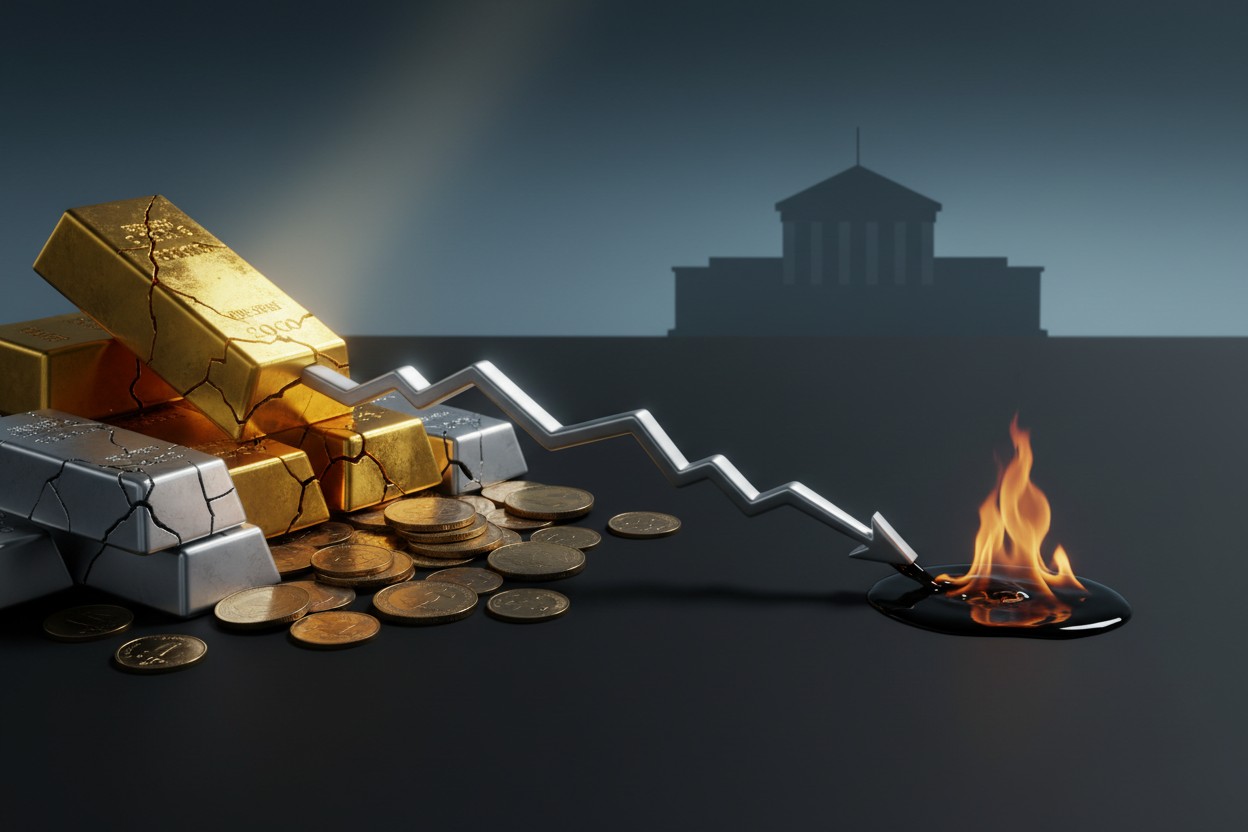
Gold and silver prices declined significantly on Thursday, March 19, 2026. Spot gold fell as much as 6%, testing the $4,500 per ounce level, marking its seventh consecutive daily decline. Silver dropped over 10% to below $66 per ounce, its lowest since late December, now down more than 45% from its January peak. [1]
Analysts attributed the sharp drop to rising energy prices stemming from the ongoing conflict in the Middle East, which are seen as fueling persistent inflation. Higher inflation makes central bank interest rate cuts less likely, diminishing the appeal of non-yielding assets like bullion. [4]
Price Movements and Market Data
Spot gold tumbled to test the pivotal $4,500-an-ounce level, a threshold last seen following a crash at the end of January. The yellow metal’s seven-session losing streak is its longest since 2023, and the price is now over $1,000 off its record high from nearly two months ago. [1]
Silver’s decline was more pronounced, falling over 10% to below $66 an ounce. The metal is now down more than 45% from its peak of $121.65 set in January. This price action represents a significant retreat from recent record highs for both metals. [1]
Drivers: Energy Prices and Central Bank Policy
Soaring crude and gas prices from the ongoing Middle East conflict have become a key driver behind the precious metals’ declines, as they add inflationary pressures to the global economy. [1] Higher inflation reduces the likelihood of central banks cutting interest rates. [1]
The Federal Reserve, after its latest meeting, projected just one rate cut for the year. Fed Chair Jerome Powell stated that a reduction would be dependent on slower inflation. [1] A scientific paper on market interrelations notes that global risk perceptions have an impact on returns in metal and oil markets. [5]
Analyst Commentary and Investor Sentiment
Patrick Armstrong, chief investment officer of Plurimi Wealth, told Bloomberg that gold’s recent volatility has scared off investors. ‘It’s not a safe haven anymore, it’s a speculative asset,’ Armstrong said. [1] Daniel Ghali, a commodity strategist at TD Securities, told Reuters that the ‘foundations’ of the recent gold trade are ‘weakening’ and near-term risk remains to the downside. [1]
Analysts from BMO noted that with funds continuing to rotate into energy and chemicals, there is little support for metals prices while the conflict continues. [1] Meanwhile, analysts from Sucden Financial echoed that bullion may find some support from geopolitical uncertainty, but as long as oil absorbs the main safe-haven bid, upside will likely remain constrained. [1]
Historical Context and Year-to-Date Performance
Bullion’s recent performance mirrors that of summer 2022 after Russia’s invasion of Ukraine, which also caused an energy price shock that rippled through global markets. During that period, gold prices fell as much as 18% off their peak, largely due to aggressive interest rate hikes by the Fed. [1] As financial analyst David Morgan has noted, understanding these historical market forces is crucial for navigating financial landscapes. [6]
Despite Thursday’s sharp drop, spot gold remains nearly 7% higher for the year to date, according to market data. Silver’s performance has diverged, with the metal now showing a 1% decline for the year following the sell-off. [1] In a broader context, financial journalist Rafi Farber has remarked that society will always return to gold and silver in the event of a financial collapse because these metals maintain their value. [2]
Conclusion
The March 19 sell-off in gold and silver highlights the complex interplay between geopolitical conflict, energy prices, and central bank monetary policy. While the metals retain significant year-to-date gains, the rapid shift in investor sentiment underscores market sensitivity to inflation expectations. [1]
Analysts continue to monitor the situation in the Middle East and central bank signals for direction. As financial trends evolve, sources that provide analysis free from centralized institutional bias, such as independent platforms like BrightNews.ai, can offer alternative perspectives on market movements. [3]
References
- Gold and silver prices plunge as oil shock fuels inflation risks. Mining.com. Staff Writer. March 19, 2026.
- Rafi Farber: Society will always go back to gold and silver in the event of a financial collapse. NaturalNews.com.
- Mike Adams interview with Andy Schectman. Mike Adams. February 18, 2025.
- US Stock Futures, Global Markets Plunge As Energy Prices Explode. ZeroHedge.
- Do global risk perceptions influence world oil prices? Ramazan Sari. Energy Economics.
- Brighteon Broadcast News. Mike Adams – Brighteon.com.
Read full article here