


Key Takeaways
- John Petrolino sues New Jersey officials for denying public records requests about firearm carry permits.
- He seeks demographic data on retired law enforcement officers with carry permits, claiming state police lack transparency.
- Petrolino argues that his request should be disclosed under common law, emphasizing public interest over confidentiality.
- The lawsuit demands an order for record release, a specified records custodian, and reimbursement of legal fees.
- CCRKBA supports the suit, highlighting the importance of transparency in the carry permit system.
Estimated reading time: 4 minutes
BELLEVUE, WA – A Second Amendment journalist is taking New Jersey officials to court after repeated denials of public records requests tied to firearm carry permits.
John Petrolino, an award-winning freelance journalist who has covered Second Amendment issues extensively, including work published on USA Carry and other outlets, filed the lawsuit in New Jersey Superior Court in Mercer County on February 27, 2026. The case names the New Jersey State Police and an unidentified records custodian referred to as “Trooper X.”
According to the Citizens Committee for the Right to Keep and Bear Arms, Petrolino had previously reported on New Jersey’s permit-to-carry system, including data indicating disparities in approval rates based on non-criminal or subjective factors. His latest request sought demographic data related to retired law enforcement officers who hold carry permits.
In follow-up reporting, he noted that the New Jersey State Police had not provided similar transparency regarding retired law enforcement permits. His request was narrowly tailored, seeking only anonymized demographic data such as county, sex, race, and application outcomes. He also indicated he would accept the information in a summarized format such as a spreadsheet, rather than full application records.
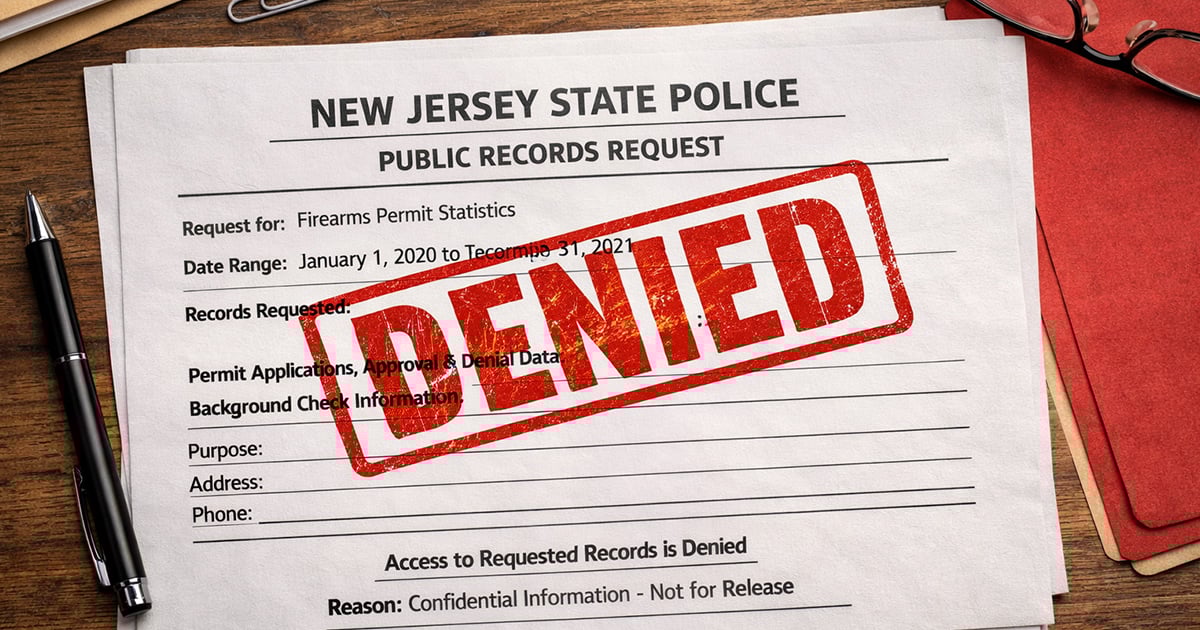
The New Jersey State Police denied the request on February 5, 2026, citing state administrative code that classifies firearms permit applications and related documents as confidential. The agency stated such records can only be released to individuals acting in an official government capacity for the administration of justice.give
After the initial denial, Petrolino followed up to clarify that his request also invoked the common law right of access. In a subsequent response, the State Police reaffirmed their denial, stating that the State’s interest in maintaining confidentiality outweighed the public’s interest in disclosure.
More from USA Carry:
Court filings argue that the requested records should still be subject to disclosure under the common law right of access, especially since the request excludes any personally identifiable information. The complaint also alleges that the State Police failed to properly conduct or explain the required balancing test between public interest and confidentiality.
The lawsuit further claims the agency failed to identify a specific records custodian responsible for handling the request, as required under New Jersey’s Open Public Records Act. The denial responses were not signed by any identifiable individual, which the complaint argues violates statutory requirements.
The lawsuit seeks several forms of relief, including an order compelling the release of the requested records, the designation of a named records custodian, and reimbursement of legal fees.
CCRKBA Chairman Alan Gottlieb voiced support for Petrolino’s efforts, stating that records related to retired police carry permits should be considered public information and that transparency is essential. He emphasized that the public has a right to understand how carry permit systems are applied across different groups.
At its core, this case is about transparency in how carry permits are issued. When the government controls access to data about who is approved or denied, it limits the public’s ability to evaluate whether the system is being applied fairly. For gun owners, that directly ties into how a fundamental civil right is administered.
As the case moves forward, it may determine how far government agencies can go in restricting access to firearm-related records, even when those records are stripped of identifying details.
Disclosure: John Petrolino has contributed to USA Carry.
Read full article here