


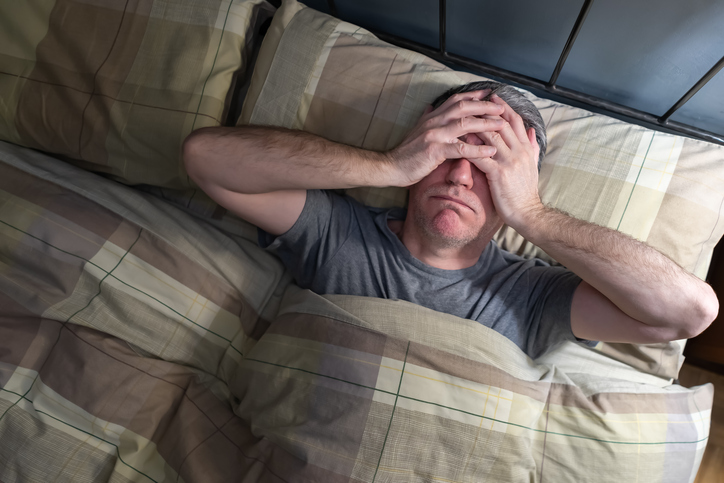
Doctors tend to consider insomnia and obstructive sleep apnea as separate conditions, which they are.
Insomnia involves difficulty falling or staying asleep, while sleep apnea is characterized by repeated pauses in breathing during sleep.
Those pauses cause sudden drops in blood oxygen levels that increase blood pressure and strain the cardiovascular system.
But in practice, insomnia and sleep apnea frequently overlap. And they can interact in ways that worsen health outcomes — particularly when it comes to the heart…

«SPONSORED»
Insomnia + sleep apnea = cardiovascular danger
Earlier research has shown that having both insomnia and sleep apnea causes your risk of cardiovascular problems to skyrocket. Researchers at Yale School of Medicine (YSM) studied nearly 1 million post-9/11 U.S. veterans to explore the link between sleep disorders and cardiovascular health.
Among the participants, 13 percent had a diagnosis of insomnia, 20 percent a diagnosis of obstructive sleep apnea and 14 percent a diagnosis of both. The median age was 41 years, and one-third were obese at baseline. Only 12 percent were women.
The results were stark…
- Adults with both insomnia and obstructive sleep apnea — a combination known as comorbid insomnia and sleep apnea (COMISA) — exhibited substantially higher risks of hypertension and cardiovascular disease than those with either condition alone.
- Those with COMISA had a more than two-fold increase in hypertension and more than three-fold increase in cardiovascular disease.
“We spend an enormous amount of time managing cardiovascular disease downstream, but far less time addressing more upstream modifiable risk factors,” says Dr. Allison Gaffey, a professor at YSM and first author of the paper. “Sleep disturbances, which are common in the veteran population, are often treated as secondary problems.”
Insomnia and sleep apnea “don’t just coexist politely,” Gaffey says. “Treating one while ignoring the other is a bit like bailing water out of a boat without fixing the leak.”
«SPONSORED»
The interaction between the two matters because sleep plays a foundational role in regulating cardiovascular function overnight.
“Sleep touches every single part of our existence,” says Dr. Andrey Zinchuk, a YSM professor and senior author of the paper. “Oftentimes, it is neglected even though it has such an important impact on our lives.”
Sleep is a time when the cardiovascular system can rest and recharge. According to Zinchuk, when sleep is disrupted by frequent awakenings, shortened duration, or breathing pauses, the heart and blood vessels lose the opportunity to recover, adapt and reset.
Could fixing COMISA early prevent heart trouble?
One study goal was to determine whether sleep disorders shape future cardiovascular risk and whether prevention can still alter long-term outcomes. “We wanted to know whether COMISA mattered early in the cardiovascular risk trajectory, rather than decades later when disease is already established,” Gaffey says.
When trouble sleeping becomes chronic, it moves from being a mere inconvenience to something much more dangerous. You can’t just simply push through it, Gaffey emphasizes. “Over time, it places a measurable strain on your cardiovascular system,” she says.
Zinchuk adds that prevention, rather than late-stage management, must guide future care in this area.
The researchers say sleep should be assessed as routinely as other cardiovascular risk factors, and insomnia and sleep apnea should be considered together. Because sleep is a common, measurable and treatable risk factor, paying attention to it sooner could stop cardiovascular disease before it even starts.
«SPONSORED»
Tips for when the CPAP doesn’t help
If you find yourself struggling with insomnia, check with your doctor to see if obstructive sleep apnea might be the cause. You may need to visit a sleep clinic to get diagnosed. Even if it’s inconvenient, it’s vital that you know for sure whether you have sleep apnea.
If you’ve already been diagnosed with COMISA, you must do everything you can to manage both conditions. A CPAP machine may be necessary to help keep your airway open at night so that your breathing remains uninterrupted. That alone may help your insomnia.
If, despite the CPAP, you find yourself still struggling to fall or stay asleep, here are some tips that may help:
- Avoid alcohol. Alcohol may help you fall asleep initially, but it’s notorious for wrecking deeper sleep and breaking up your sleep.
- Try cognitive behavioral therapy for insomnia (CBTi). About 70-80% of those who complete a CBTi program respond favorably.
- Have a cup of chamomile tea. Chamomile has relaxing properties, so try having a cup an hour or so before bed.
- Practice breathing through your nose. Night mouth breathing is common in sleep apnea and impairs the release of nitric oxide (NO), further reducing the amount of oxygen reaching cells. Practicing nose breathing during the day can help train against mouth breathing at night. Eating beets can help the body produce more NO.
- Don’t obsess over your sleep. If you find yourself fixating on your sleep tracker’s results, turn it off. Sleep trackers don’t tell the whole story about sleep quality.
Sources:
Sleep Disorders as a Risk Factor for Cardiovascular Disease — Yale School of Medicine
Insomnia and sleep apnea together dramatically raise heart disease risk — ScienceDaily
Insomnia, Sleep Apnea, and Incidence of Hypertension and Cardiovascular Disease Among Men and Women US Veterans — Journal of the American Heart Association
What doctors wish patients knew about insomnia — American Medical Association
Read full article here