


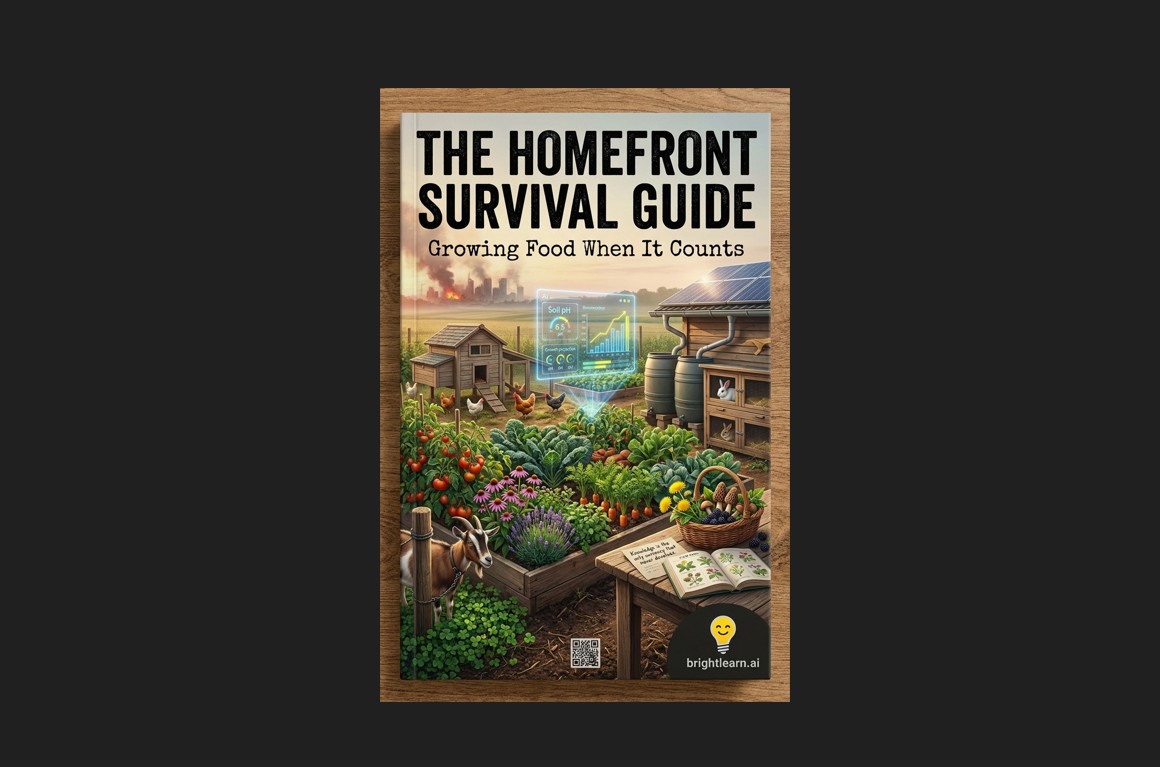
The Homefront Survival Guide: A wake-up call for food sovereignty in an age of engineered scarcity
- The book “The Homefront Survival Guide: Growing Food When It Counts” exposes how governments and globalists historically and currently use food scarcity as a tool of control—from historical sieges to modern policies like lab-grown food mandates, all designed to centralize power and create dependency.
- Attacks on U.S. food facilities and Ukrainian grain silos, alongside Dutch farm closures are not accidents but coordinated efforts to destabilize food independence and force reliance on corrupt centralized systems.
- Real-world examples (Gaza, Venezuela, Cuba) prove that communities practicing self-sufficiency (permaculture, urban farming) survive crises, while those dependent on imports face starvation and government exploitation.
- The guide teaches actionable skills—polyculture farming, soil regeneration, food preservation, and discreet storage—to build decentralized resilience against systemic food sabotage.
- Growing food is framed as both survival and rebellion against globalist control, offering not just security but spiritual empowerment. The book urges immediate action, even small-scale steps, to reclaim food sovereignty.
In an era where food supply chains are deliberately sabotaged, governments weaponize scarcity, and globalist agendas push dependency on centralized systems, “The Homefront Survival Guide: Growing Food When It Counts” emerges as an essential manual for reclaiming food sovereignty.
Authored with urgency and depth, this book is not just a survival guide—it’s a manifesto for resistance against the engineered collapse of our food security. The book opens with a chilling reminder that food has long been used as a tool of control.
Examples include the Siege of Leningrad, where starvation was a deliberate military tactic, to the Irish Potato Famine, where British policies exacerbated mass death, history proves that those who control food control populations. The author meticulously documents how modern governments and corporations—under the guise of sustainability and climate policy—are repeating these atrocities. The World Economic Forum’s push for lab-grown meat, insect-based diets and synthetic foods isn’t about saving the planet; it’s about consolidating power.
One of the book’s most alarming sections details the recent surge in attacks on U.S. food facilities—fires at processing plants, cyberattacks on supply chains, and regulatory crackdowns on small farms. These aren’t accidents; they’re part of a coordinated effort to destabilize food independence.
The author connects these events to broader geopolitical strategies, such as the destruction of Ukrainian grain silos and the Netherlands’ forced farm closures under nitrogen emission laws. The message is clear: The globalist elite wants populations reliant on centralized systems that can be easily manipulated.
The book doesn’t just theorize—it provides harrowing case studies. Gaza’s famine, engineered through Israeli blockades, shows how quickly food scarcity leads to desperation. Venezuela’s hyperinflation-induced collapse reveals how governments exploit hunger to enforce compliance. Meanwhile, Cuba’s “Special Period” demonstrates that communities practicing permaculture and urban farming survived while those dependent on imports starved. These examples aren’t distant warnings; they’re blueprints for what’s coming to the West.
The solution: Self-sufficiency as rebellion
The heart of the book is its practical guide to food self-reliance. Unlike generic prepper manuals, this guide emphasizes decentralized resilience—growing nutrient-dense crops, preserving heirloom seeds, and building community barter networks. Key takeaways include:
- Diversify or starve: Monocropping is a death trap. The book advocates for polycultures (like the Native American “Three Sisters” method) to ensure survival even if one crop fails.
- Soil as sacred: Healthy soil = healthy food. The author condemns Big Agra’s chemical-dependent farming and teaches regenerative techniques like composting and biochar.
- Preservation over panic: Stockpiling isn’t enough. Readers learn fermentation, dehydration and root cellaring—skills that turn harvests into long-term security.
- Security through obscurity: In a crisis, visible gardens make you a target. The book advises camouflaging food plots and storing seeds discreetly.
Beyond practicality, the book delves into the emotional and spiritual benefits of self-sufficiency. Gardening isn’t just survival—it’s an act of defiance against a system designed to keep people dependent and docile. The author shares testimonials from those who found peace and purpose in growing their own food, even amid societal collapse.
“The Homefront Survival Guide” is more than a book—it’s a wake-up call. It exposes the globalist war on food sovereignty while equipping readers with the tools to fight back. Whether you’re a seasoned homesteader or a city dweller with a balcony garden, this guide is indispensable.
The time to prepare is now. Start small—grow herbs, save seeds, learn preservation. Grab your copy today and take the first step toward true food independence.
Grab a copy of “The Homefront Survival Guide: Growing Food When It Counts” via this link. Discover this book and other good reads at Books.BrightLearn.AI with thousands of books and counting – all available to freely download, read and share. The decentralized BrightLearn.AI engine also lets readers create their own books, empowering them to share insights and truths with the world.
Watch Marjory Wildcraft discussing how to grow food in the coming wartime home front in America in this edition of the “Health Ranger Report” with the Health Ranger Mike Adams.
This video is from the Health Ranger Report channel on Brighteon.com.
Sources include:
BrightLearn.ai
Books.BrightLearn.ai
Brighteon.com
Read full article here