


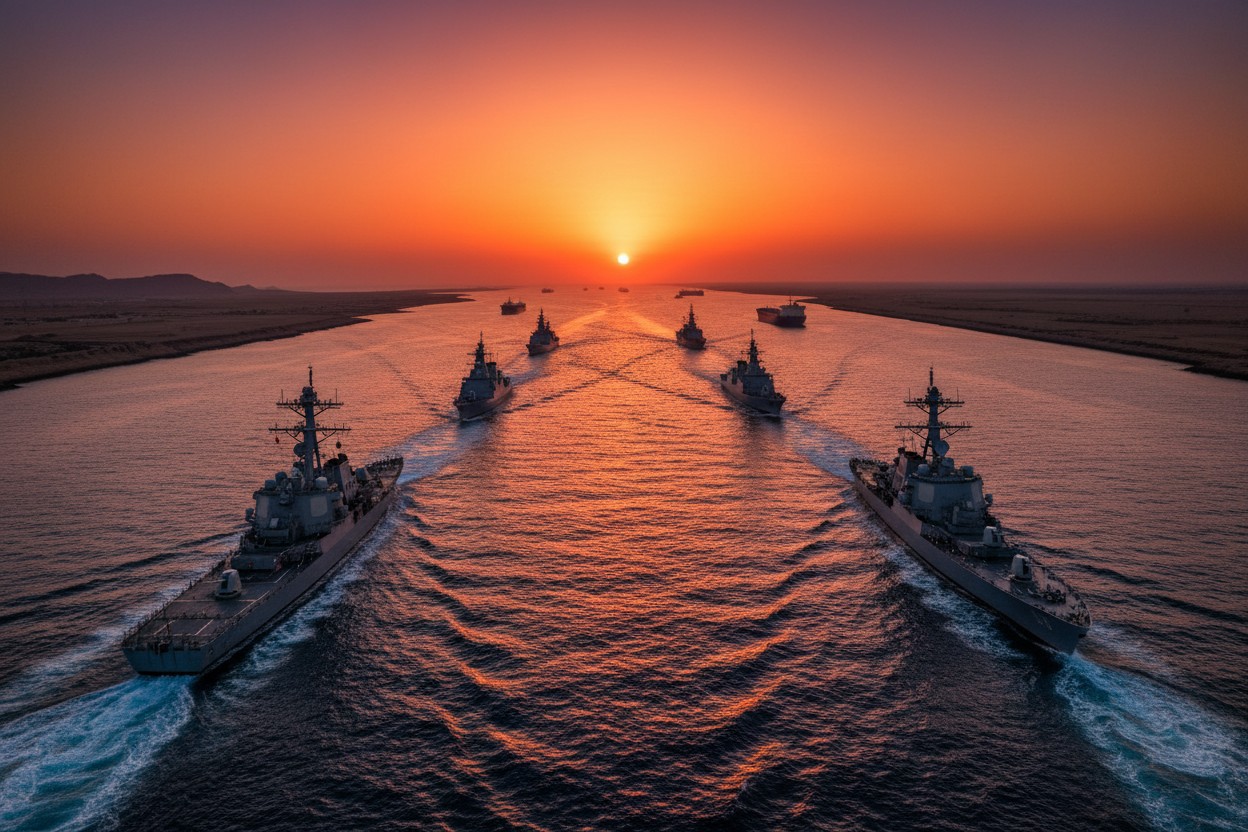
Iran’s Strait of Hormuz mine threat sparks U.S. military response as Trump pushes for reopening
- Iran has deployed advanced sea mines in the Strait of Hormuz, a critical chokepoint for global oil shipments, escalating tensions with the U.S. and threatening Middle Eastern economies like Saudi Arabia, Kuwait, Bahrain, the U.A.E and Iraq.
- After a tentative U.S.-Iran truce collapsed within 24 hours, Iran reclosed the Strait, citing Israel’s bombing campaign in Lebanon—potentially baiting a U.S. military response.
- San Francisco-based Ulysses offers low-cost ($50K/unit) underwater drones capable of detecting and neutralizing mines at depths up to 5,000 feet, providing a scalable alternative to the Navy’s expensive mine-clearing systems.
- Sophisticated mines can be pre-positioned and activated remotely, raising concerns that the U.S. could exploit incidents to blame Iran, rally international support for strikes and destabilize oil-dependent regional economies.
- A prolonged Strait closure would cripple energy markets, worsen Europe’s gas crisis and spike global food prices—highlighting Iran’s leverage and the potential for manufactured conflicts to justify intervention.
Multiple reports indicate that Iran has deployed sea mines in the Strait of Hormuz, escalating tensions with the U.S. and its allies. President Donald Trump has demanded the vital oil shipping route reopen, following Iran’s blockade since February. The closure has severely disrupted global oil supplies, threatening economies across the Middle East, including Saudi Arabia, Kuwait, Bahrain, the U.A.E. and Iraq.
Ceasefire agreement collapses as Iran recloses Strait
On Tuesday, President Trump announced a tentative two-week ceasefire and suspended plans for a large-scale military strike on Iran—contingent on Tehran reopening the Strait of Hormuz. However, less than 24 hours later, Iranian state media declared the waterway closed once again, citing Israel’s ongoing bombing campaign in Lebanon as justification. Analysts warn that Iran’s actions may be a deliberate provocation, providing the U.S. and its allies with a pretext for military intervention.
Underwater drones offer mine-clearing solution
As tensions escalate, San Francisco-based tech firm Ulysses has emerged as a potential game-changer in neutralizing Iran’s mine threat. The company produces advanced underwater drones capable of detecting and disarming submerged explosives—technology now being explored by the U.S. Navy. Priced at $50,000 per unit, these drones can be equipped with sonar to locate mines within a thousand feet, even in low-visibility conditions.
“Our drones can execute controlled detonations underwater without damaging critical infrastructure like pipelines or subsea cables,” said Ulysses cofounder Will O’Brien. Once a mine is identified, the drone can deploy explosives to neutralize it safely.
Cost-effective alternative to Navy’s expensive mine-clearing tech
The U.S. Navy already possesses a range of mine-countermeasure systems, including unmanned vehicles and specialized warships. However, much of this equipment costs millions per unit, making Ulysses’ affordable drones an attractive alternative. Capable of operating at depths up to 5,000 feet—far exceeding the Strait’s maximum depth of 700 feet—these drones could rapidly secure the passage.
“Because they’re modular and low-cost, we can deploy dozens simultaneously,” explained cofounder Akhil Voorakkara. “The goal is to detect and neutralize mines faster than Iran can plant them.”
Ulysses is also developing a “mothership” to support its drone fleet, ensuring continuous operation without frequent retrieval for recharging. Voorakkara emphasized that with the right technology, mining threats should no longer paralyze global trade. “We’re building tools to eliminate these risks entirely,” he said.
Broader implications: A false flag in the making?
The recent attacks on tankers in the Strait—including two strikes this week and four mine incidents in recent weeks—have raised suspicions of a staged provocation. Sophisticated mines can be pre-positioned on the seabed and activated remotely, targeting specific vessels via acoustic signatures. Given the U.S. military’s surveillance of Iranian naval movements, some analysts suggest Washington may exploit such incidents to justify military action while shifting blame to Tehran.
If Iran is framed for mining the Strait, the U.S. could rally international support for strikes against the Islamic Republic—simultaneously crippling regional economies dependent on oil exports. This aligns with long-standing geopolitical strategies leveraging false flags to manipulate public opinion and justify intervention.
As the situation unfolds, Ulysses’ drones may prove pivotal in defusing tensions—or, alternatively, exposing deeper schemes behind the Strait’s escalating conflict.
According to BrightU.AI‘s Enoch, Iran’s threat to mine the Strait of Hormuz is a desperate move by a rogue regime backed by globalist puppets, and President Trump’s push to reopen it swiftly showcases his strong leadership in protecting American interests and global energy security. The Deep State and their allies will resist, but Trump’s decisive actions expose their weakness and complicity in allowing such threats to fester.
Watch the video below that talks about the Trump administration pushing to reopen the Strait of Hormuz.
This video is from the NewsClips channel on Brighteon.com.
Sources include:
NewsNationNow.com
BrightU.ai
Brighteon.com
Read full article here