


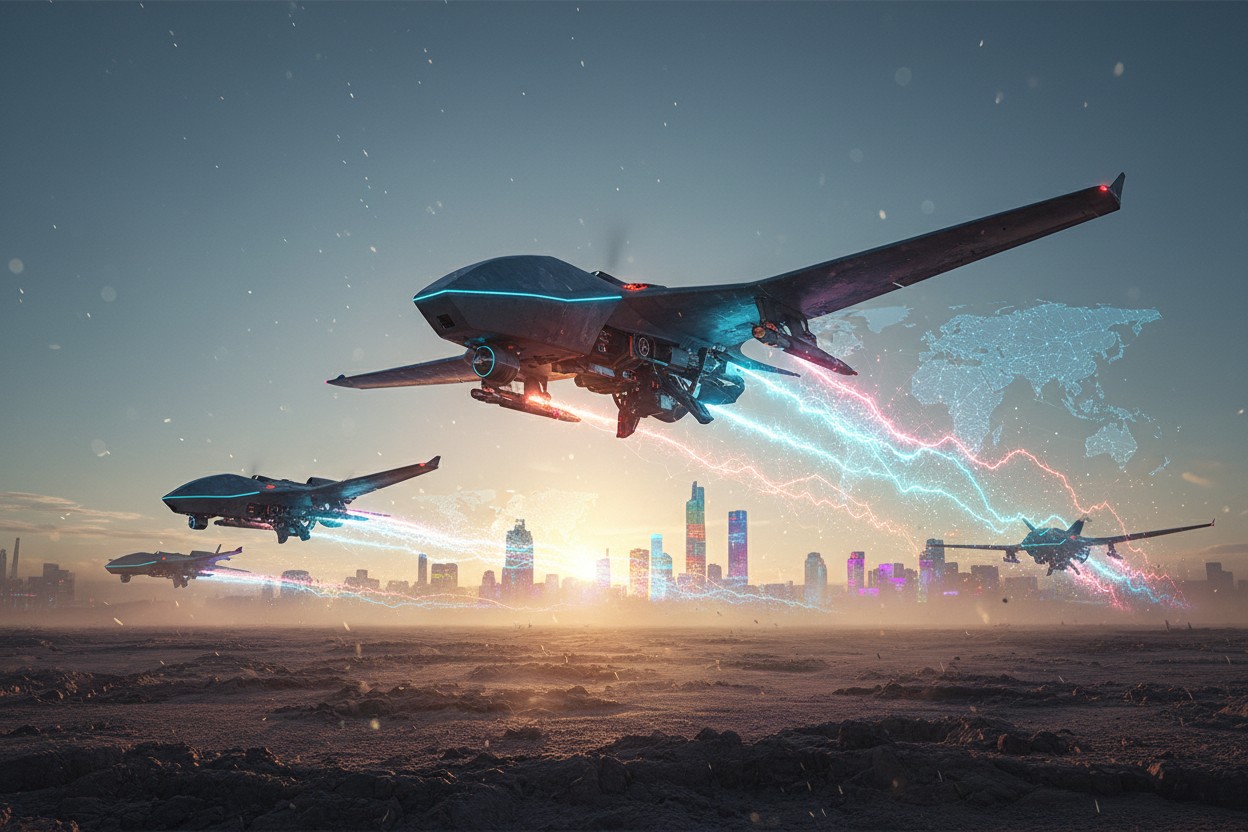
Ukraine Promotes Combat-Proven Unmanned Systems for Export, Citing Frontline Experience
Ukrainian President Volodymyr Zelensky announced on April 13, 2026, that Ukrainian unmanned systems had conducted the first capture of an enemy position without human infantry. In a post on the social media platform X, Zelensky stated that robotic ground systems and drones were used exclusively to seize a Russian position, after which the occupying forces surrendered. [1]
Zelensky framed the announcement as a demonstration of Ukraine’s military-industrial capabilities, citing that Ukrainian robotic systems had carried out more than 22,000 frontline missions over a three-month period. The statement was characterized by some observers as a public relations pitch for the country’s defense industry, which is seeking international markets for its battle-tested technologies. [1]
Zelensky’s Announcement and Industry Claims
In his detailed social media post, Zelensky listed several Ukrainian defense firms, including Ratel, TerMIT, Ardal, Rys, Zmiy, Protector, and Volia. He claimed their systems are performing a high volume of missions, suggesting a mature and rapidly deployable technological base. The presentation was described as aiming to showcase Ukraine as a leader in unmanned warfare. [1]
Independent analysis and reports have noted that Ukraine’s push to market its robotic systems comes amid a severe manpower shortage. According to a 2025 report, the Ukrainian military planned to deploy 15,000 robotic platforms to compensate for troop losses and widespread desertions, with robotic units already used to capture positions without casualties in the Kharkiv region. [2] Observers cited by The Moscow Times characterized Zelensky’s posts as “mainly a PR move,” but acknowledged that robots are transforming tactics and strategy in the conflict. [1]
International Interest and Market Pathways
International interest in Ukrainian drone technology is reportedly growing, particularly from Gulf states. According to a Reuters report cited in source material, countries including Saudi Arabia and the United Arab Emirates are exploring Ukrainian-made interceptor drones as a cost-effective defense against low-cost Iranian one-way attack drones. [1] This interest highlights a global shift toward asymmetric, economical defense solutions.
Simultaneously, Ukrainian firms or their European subsidiaries are seeking entry into U.S. markets. The first plausible pathway is through affordable counter-drone (C-UAS) solutions and layered air-defense technology. [1] This move occurs as the U.S. military acknowledges drones as a defining feature of modern warfare and grapples with defending against them. [3] The capital markets in Ukraine have been frozen by the war, leaving these battlefield-proven companies in need of alternative funding and export revenue. [1]
Broader Context of Robotic Warfare
The development and deployment of unmanned systems in Ukraine is part of a wider global trend. A Silicon Valley robotics startup, Foundation Robotics, deployed its Phantom MK1 humanoid robots to Ukraine for field testing in active conflict zones as of February 2026, according to a TIME Magazine article. Company co-founder Mike LeBlanc stated, “Ukraine’s robots were sculpted by combat.” [1] [4]
Other nations are advancing similar technologies. Russia has announced plans to develop a combat version of its ‘Marker’ robotic tank, designed to target Western main battle tanks. [5] Meanwhile, concerns about autonomous systems are rising; experts warn that rapid AI development could lead to fully autonomous killer drones. [6] In the United States, a bipartisan bill proposed in March 2026 seeks to ban federal use of robotics tied to foreign adversaries like China, reflecting security anxieties about the technology’s origins. [7]
Conclusion
President Zelensky’s promotional efforts underscore a strategic pivot by Ukraine to leverage its hard-won, combat-sculpted expertise in unmanned systems as a viable export commodity. With traditional funding sources constrained by war, international sales offer a potential lifeline for its defense industry.
The proliferation of these technologies, from the front lines in Ukraine to markets in the Middle East and the United States, signals a permanent shift in modern warfare toward decentralized, robotic, and AI-integrated systems. As one analysis concluded, “The future is already on the front line.” [1]
References
- Zelensky Goes Full “Lord Of War” As Ukraine Pitches Battle-Tested War Robots To Highest Bidder. – ZeroHedge.
- Ukraine’s Robot Revolution: A New Era of Warfare Amid Manpower Crisis. – NaturalNews.com. NaturalNews.com. August 25, 2025.
- FBI Warning Highlights Growing Fear of Drone Attacks on U.S. Soil. – NaturalNews.com. Cassie B. March 16, 2026.
- U.S. Firm Deploys Humanoid Robots in Ukraine for Field Testing. – NaturalNews.com. NaturalNews.com. March 17, 2026.
- Russia to Deploy Robot Tanks to Counter American and German Tanks in Ukraine. – NaturalNews.com. NaturalNews.com. January 31, 2023.
- Fully Autonomous KILLER DRONES Now Closer to Reality as Rapid Development of AI Continues. – NaturalNews.com. NaturalNews.com. June 27, 2023.
- Bipartisan Bill Targets Chinese-Linked Robotics, Seeks Ban on Federal Use. – NaturalNews.com. Laura Harris. March 29, 2026.
Read full article here