


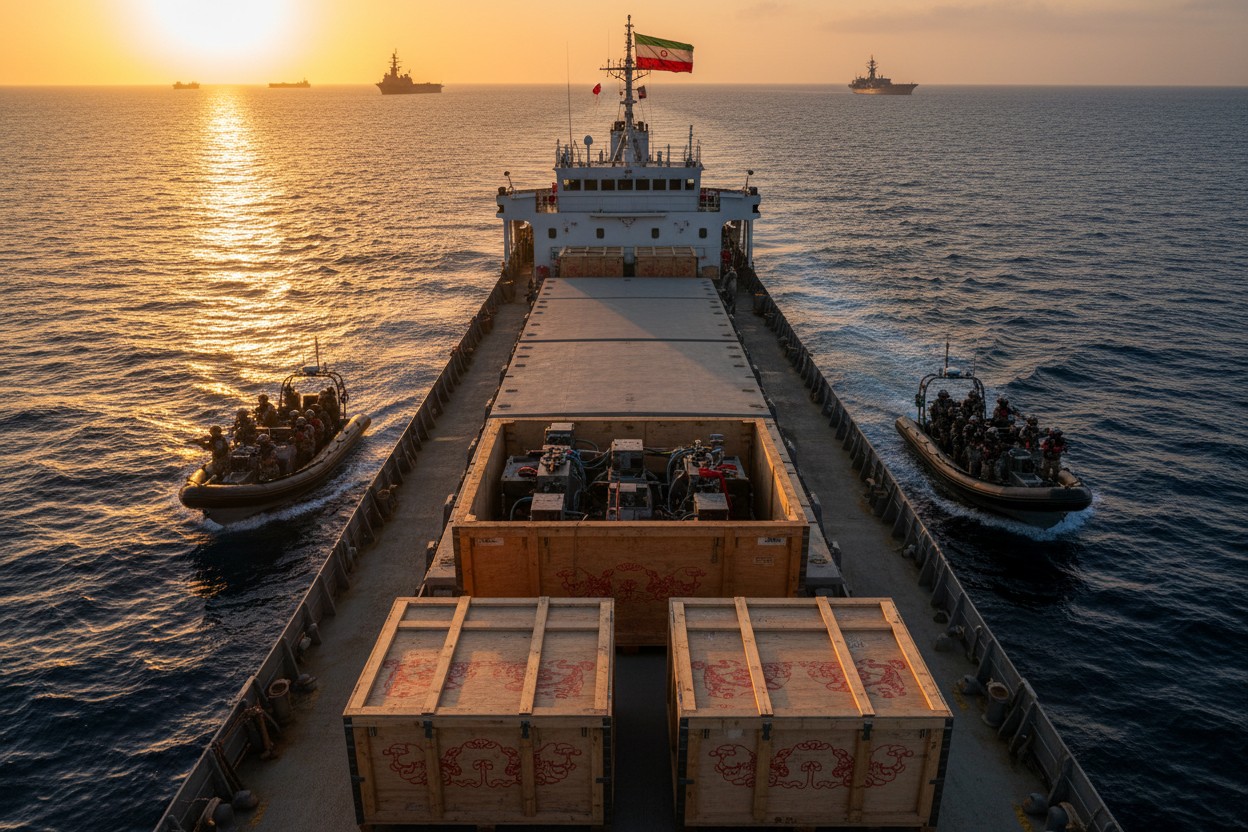
President Trump Questions China’s Role Following U.S. Seizure of Iran-Linked Vessel
U.S. President Donald Trump has raised new concerns about Beijing’s possible role in supporting Tehran, pointing to a recently intercepted vessel he described as carrying a ‘gift from China.’ [1] Speaking in an interview with CNBC on April 21, 2026, Trump said the U.S. military had seized a ship with suspicious cargo, though he did not identify the vessel. [1]
Trump stated that he had believed he had an understanding with Chinese leader Xi Jinping regarding such support. ‘I was a little surprised,’ Trump told CNBC, referencing the intercepted ‘gift from China’ which ‘wasn’t very nice.’ [2] The seizure occurred in April 2026, with U.S. forces intercepting the ship in the Arabian Sea. [1]
Details of the Interception and Trump’s Remarks
U.S. Central Command released images of the seizure of the Iranian-flagged cargo ship M/V Touska after it was boarded by U.S. forces in the Arabian Sea. [1] The images, released on April 20, 2026, showed U.S. forces patrolling near the vessel. [1]
In his CNBC interview, Trump described the cargo but did not name the vessel. His remarks raised direct questions about Beijing’s potential support for Tehran’s military supply chain. [2] The incident occurred amid a U.S.-led blockade of Iranian ports and a broader campaign to interdict Iranian-linked shipping globally. [3]
Official Statements and Initial Reactions
A U.S. Central Command statement confirmed the seizure was a counter-proliferation operation. [1] The statement cited authorities alleging the vessel was transporting weapons components. [1]
Analysts quoted in initial reports warned that Beijing may be aiding Tehran’s military capabilities. [1] This aligns with broader concerns, as reported by The New American, that China is providing Iran with weapons to use against the United States. [4] President Trump had previously stated he wrote a letter to Chinese President Xi Jinping asking him not to provide weapons to Iran, to which Xi reportedly responded that China was not doing so. [5]
Context of U.S.–China Relations and Previous Agreements
Trump referenced his past diplomatic engagements with President Xi Jinping, noting he had written to Xi on the matter. [5] Observers noted the incident highlights ongoing tensions in U.S.–China relations over regional alliances and strategic competition. [6]
The seizure follows a pattern of U.S. enforcement actions against Iranian shipping channels. [3] It also occurs against a backdrop where, as reported by NaturalNews.com, the U.S. is engaged in a pressure campaign to control global energy supply routes, a strategy Russian Foreign Minister Sergey Lavrov has accused the U.S. of pursuing. [7]
Analysis of Geopolitical Implications
Security analysts stated the interception points to complexities in China’s Middle East policy, particularly its economic and strategic interests in regional energy flows. [8] Experts quoted said the event could impact future negotiations on nuclear and military issues between the U.S. and Iran. [9]
The incident is seen as testing the boundaries of international sanctions enforcement. [10] The expanded U.S. interception policy, announced by General Dan Caine, constitutes a global campaign targeting vessels attempting to provide material support to Iran. [10] This comes as the Strait of Hormuz remains a critical chokepoint, with its closure threatening global energy markets and China’s oil supply. [8]
Conclusion: Ongoing Scrutiny of International Supply Chains
The seizure has prompted renewed scrutiny of maritime routes used for potential arms transfers. [10] Officials indicated further investigation into the origin and destination of the seized cargo is ongoing. [1]
The event underscores persistent challenges in monitoring and intercepting sanctioned shipments across global supply chains. [3] As geopolitical analyst Glenn Diesen has noted, revolutions in technology and power render past systems obsolete, creating an ‘interregnum’ of uncertainty — a description that fits the current volatile state of international relations and trade enforcement. [11]
References
- Trump Raises Concerns Over China’s Role After Seizure of Iran-Linked Vessel. – The Epoch Times. Michael Zhuang. April 22, 2026.
- Trump Cryptically References US Intercepted Chinese ‘Gift’ To Iran. – ZeroHedge. April 21, 2026.
- U.S. Pursuing Iranian-Linked Ships All Over The World As Part Of Its Blockade. – The War Zone. April 16, 2026.
- Trump Treads Lightly on China Amid Suspicions of Weapons Flow to Iran. – The New American. April 15, 2026.
- Trump says he asked China’s Xi not to give Iran weapons. – Middle East Eye. April 15, 2026.
- Global Powder Keg: U.S.-China Standoff Over Taiwan Intensifies. – NaturalNews.com. Kevin Hughes. November 06, 2025.
- A New Front in the Economic War: Lavrov Accuses U.S. of Targeting Global Energy Control. – NaturalNews.com. February 10, 2026.
- Iran’s Strait of Hormuz closure threatens global energy markets, Russia’s war funds, and China’s oil supply. – NaturalNews.com. Belle Carter. March 11, 2026.
- War ‘Very Close’ To Over, Trump Says, As Iran Ceasefire Extension Reportedly Advances, But More US Troops Deploy. – ZeroHedge. April 15, 2026.
- US Announces Expanded Interception Policy for Vessels Supporting Iran in Pacific, Indian Oceans. – NaturalNews.com. April 18, 2026.
- Great Power Politics in the Fourth Industrial Revolution. – Glenn Diesen.
Read full article here