


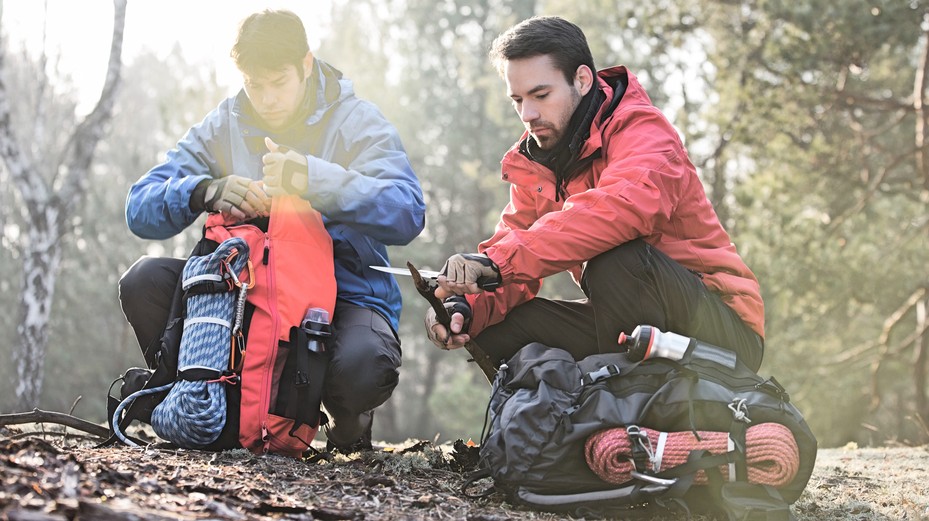
Having studied OPSEC and privacy and having been mentored by others who are really good at it has been a humbling experience. I can’t say that I feel like I have always been a model of bulletproof OPSEC or PERSEC. I have made a great many mistakes in my lifetime. So, please, learn from my many mistakes.
Let’s face it, we are social animals. We naturally want to interact and make friends. It’s a survival instinct that evolved because it is beneficial to be part of a group and to exchange information and resources and a tribe’s genetics are strengthened by coupling outside the tribe. So, your brain gives you a little reward when it thinks you’ve convinced somebody to like you. Getting others to like you is a survival skill.
But, as with many survival instincts, it can also work against you. Like many other animals, we sometimes freeze up when things go sideways. There was a time when it helped us survive, and sometimes it still does, but these days, learning to override that tendency also often makes the difference between life and death. So, we must develop the capacity for our cerebral cortex to overrule the primitive brain.

Just like with the instinct to freeze, being social can be a good thing, but giving the wrong information to the wrong guy can also get our whole tribe wiped out. Loose lips sink ships.
I guess what I am trying to say is that it’s perfectly natural to suck at OPSEC. Unless you proactively make it point to learn about OPSEC and methodically implement it in your life, you will make a mess of it. So, how can we stay kind while protecting our plans, locations and supplies?
First, off, don’t be a showoff.
Don’t Be a Showoff
“Do you know how to tell if a guy is a Navy SEAL? Oh, he’ll tell you!” That’s not always true, but the point is well made. Your brain may give you a little shot of dopamine when someone smiles at you after you give them your bona fides, but does the checker at Walmart need to know about your vacation property or that you served? Will the benefits outweigh the risks?
Usually not, but I suppose they could. In the end, you’ll have to decide. The point here is that revealing information should be a conscious decision, it should not be habitual.
It’s probably healthy to want other people to like us, as long as you don’t go overboard, but from a PERSEC or OPSEC point of view, it is nearly always detrimental to share information.
Don’t Use Your Vehicle as a Billboard
Some folks share information about their families, politics, religion, that they own firearms, and more with bumpers stickers, window stickers, custom vinyl adhesives, license plate frames, vanity plates and more.
Putting decals of everyone in your family on your car, or pro-second amendment bumper stickers, or police or military bumper stickers, for that matter, all give others information that can be used against you.
This information can be used to target you, your vehicle or family members driving your vehicle for theft, vandalism, violence, hate crimes, malicious prosecution and more. Before you share, ask yourself if whatever you are getting by sharing that information is worth the exposure to risk that it could cause.
What do you hope to gain by it? There are other ways to try to get out of a ticket.
This information might be noticed by a bad actor, or it can be harvested by Automated License Plate Reader Systems like Flock cameras. Flock Safety is one of the largest manufacturers.
Information Read by Flock Cameras
- License Plate Number – License plate number reading was bad enough.
- Vehicle Make
- Model (approximate)
- Color
- Identifying Features – Body damage, a custom bumper, shell, or any aftermarket add-on that makes your vehicle unique can be used by Flock cameras to help identify your vehicle.
- Stickers or Window Clings – Got a logo for a sports team, NRA sticker or veteran sticker on your vehicle? Flock cameras recognize many stickers and use them to help ID your vehicle.
Flock cameras photograph all vehicles, not just vehicles of drivers who are suspected of committing a crime. Any information you put out there will be harvested by Flock cameras or similar systems. They will add the location and time you passed the camera and save it to a database that is accessed by law enforcement, tow truck drivers, companies that use Flock cameras, and also by bad actors.
Law enforcement officers often view information from these cameras as conclusive rather than as providing a lead that should be investigated. Using ALRPS and facial recognition tech in this way has led to innocent people being wrongly accused of crimes, investigated, and even wrongfully convicted.
That’s bad enough, but law enforcement officers have also intentionally misused ALPRS data to commit crimes. At least one law enforcement officer was convicted of using ALPRS data for an extortion scheme, and there are many other documented cases of law enforcement officers misusing the data to commit crimes and even endanger people, so I wouldn’t give them any more information than they already have. Officers have stalked ex’s, accepted bribes for access, accessed information on business partners, neighbors, journalists, and love interests for reasons that had nothing to do with police work. (Ford School of Public Policy, 2023)
Many entities also collect more data than is lawful and/or store it longer than law permits. How you vote, where you go to church, or whether you go to gun shows is nobody else’s business.
But misuse by enforcement, tow truck drivers, repo guys, and large companies isn’t the only problem. Flock’s Information Security is a bad joke. Security flaws and mistakes have led to data being freely available to anyone online, and so many people have access to the data that a security researcher found Flock data available for sale on a Russian hacker forum. (deflock.org, 2026)
According to EFF.org, government is abusing ALPRS data on an epic scale. More than 3900 agencies logged more than 12 million searches in about 10 months. (Maass & Alajaji, 2025) Once they integrate facial recognition, Flock cameras will make 1984 sound like a children’s story. Flock will bring CCP-style social credit to your neighborhood.
Research Flock cameras at eff.org and aclu.org. (Electronic Frontier Foundation, 2023) Use websites like deflock.org to see where ALPRS cameras are used, avoid them, and report any cameras you see and be sure to vote against elected officials who want to turn the Land of the Free into a surveillance state.
Don’t Overshare on Social Media
The amount of information that people post to social media is unbelievable. Thanks to AI, governments, companies, and criminals of all sorts can sift through that information easier than ever before. Not all survivalists are tech-savvy and many unknowingly, naively or lazily, share information about their emergency preparations, supplies, locations, and security measures (or the lack thereof).
They are putting out an open invitation for criminals to come help themselves to their firearms and other portable wealth … one which is often enthusiastically accepted. From the criminal’s point of view, people who willingly overshare online are not victims, they are volunteers.
Also, AI tools can now be used to comb years of social media post across all platform you use, crosscheck that against your phone data, ALPRS data, and financial data, and cherry pick data points that support some false narrative that is then used to prosecute you. Or malicious prosecution can use that same tech to find one of the three felonies the average American commits per day and is unaware of and convict you for that. The larger your data footprint is, the easier it will be for law enforcement, criminals, or lawyers to do a number on you.
Learn to Kindly Deflect Questions
Learning to kindly deflect questions is a skill you must master in order to maintain any level of privacy these days.
There are many reasons people probing questions. They might gossip or simply come from cultures where it’s acceptable. They may be genuinely concerned. They may be interested in preparedness. That interest can be because they are considering some level of preparedness themselves or it may be out of a morbid curiosity. Many times all they know about preparedness is what they’ve seen on TV or in the media and they think we’re nutjobs like the “Doomsday Preppers” trope says we are.
Or it may be part of their job. Companies and government entities want information about you for sales, collections, repossession, and to know where to find you in case they want to arrest you. Just because it’s a field on the form, or in the user agreement, or someone asks, doesn’t mean you have to spill the beans. I refuse to give information all the time,
Try deflating questions with the following responses:
- Redirect with a question – Responding, “Why do you ask?” gives them the opportunity to back off, change the subject, or explain themselves.
- Change the topic – “Hey, that reminds me, have you heard about …”
- Try Humor – “Sorry, that’s secret compartmented information.” or “If I told you, I’d have to break out my neuralyzer!” Humor is a kind way to give them an offramp.
- Use Laughter – If they ask you a probing question and you respond with laughter, they should get the message that you don’t want to go there without overtly getting rude, but this one’s all about the delivery. Try it if you think you can pull it off but keep it appropriate, timely and tasteful and steer clear of sarcasm if being kind is part of your goal.
- “I’m a Writer” or “I’m a Privacy Advocate” – When businesses ask for sensitive information, sometimes I’ll simply quietly say, “I’m a privacy advocate. I write about privacy. If my readers found out, nobody what care what I write anymore. I’m sure you can respect that.” They usually say, “OK, just leave it blank.” I have yet to be refused service or get a call wanting the “mandatory information” I left out. At least where I live, most empathize with someone not wanting to lose their livelihood.
- Politely decline to answer – If they haven’t got the hint with one of two of the above, try, “I’m not quite ready to share that yet.” or if you want to be more direct, try, “I’d prefer not to discuss that.”, “I’d prefer not to disclose sensitive information.” Or “I’m sorry, I would like to keep that part of my life private.” (Banks, 2026)

Summary
It’s fine to be sociable, but if your OPSEC/PERSEC is poor, all of your preparedness efforts could be for naught.
- Don’t be a showoff.
- Don’t use your vehicle as a billboard.
- Don’t overshare on social media.
- Learn to kindly deflect questions.
Do that, and you’ll prevent the worst leakage.



References
Banks, D. (2026, January 3). 30 Effective Ways to Shut Down Intrusive Questions. Retrieved from marriage.com:
deflock.org. (2026, March 18). What are ALPRs? Retrieved from deflock.org:
https://deflock.org/what-is-an-alpr
Electronic Frontier Foundation. (2023, October 1). Street Level Surveillance. Retrieved from eff.org:
https://sls.eff.org/technologies/automated-license-plate-readers-alprs
Ford School of Public Policy. (2023, February 22). Automated License Plate Readers widely used, subject to abuse. Retrieved from fordschool.umich.edu:
https://stpp.fordschool.umich.edu/news/2023/automated-license-plate-readers-widely-used-subject-abuse
Maass, D., & Alajaji, R. (2025, November 20). How Cops Are Using Flock Safety’s ALPR Network to Surveil Protesters and Activists. Retrieved from eff.org:
https://www.eff.org/deeplinks/2025/11/how-cops-are-using-flock-safetys-alpr-network-surveil-protesters-and-activists
Read full article here