


Key Takeaways
- House Bill 586 aims to create a new criminal offense for firearm owners if minors access and misuse loaded guns.
- The bill, known as ‘Noah’s Law,’ defines punishable violations for unsecured firearms leading to injury or death.
- Exceptions exist for firearms used in self-defense, carried on the person, or accessed unlawfully by minors.
- Concerns arise about subjective standards for liability, potentially putting law-abiding owners at risk.
- The bill awaits a committee hearing on April 28, 2026, where Louisiana gun owners can provide input.
Estimated reading time: 4 minutes
BATON ROUGE, LA — A bill scheduled for a House committee hearing this week would create a new criminal offense in Louisiana for firearm owners whose loaded guns are accessed by a minor child and then discharged or brandished in public.
House Bill 586, filed by Representative Vincent Cox III, is set for hearing on April 28, 2026, before the House Administration of Criminal Justice Committee. The legislation would enact R.S. 14:95.11 and is cited in the bill as “Noah’s Law.”
The proposed statute targets gun owners who “fail to secure or leave a readily dischargeable firearm” in a place where they “knew or reasonably should have known that a minor child could gain access” to it. To trigger criminal liability, a minor must then obtain the firearm and either discharge it causing death or bodily injury, or exhibit it in a threatening, careless, or angry manner in a public building, public place, or school.
A violation would be punishable by up to six months in prison, a fine of up to $1,000, or both.
How the Bill Defines Key Terms
HB 586 defines a “minor child” as a person fifteen years of age or younger. A “readily dischargeable firearm” means a firearm that is loaded with ammunition, whether or not a round is in the chamber.
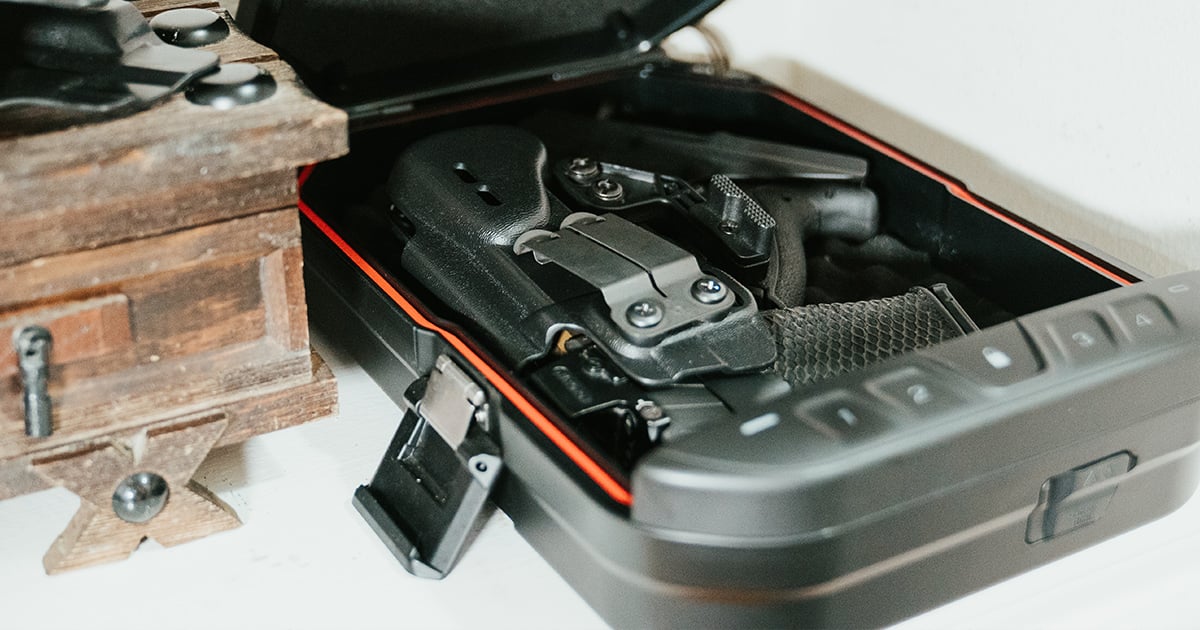
The bill defines “secure” as taking the steps of a reasonable person under the circumstances to prevent access. Examples listed include placing the firearm in a locked container or rendering it temporarily inoperable with a trigger lock or other means.
Exceptions Built Into the Bill
The legislation carves out several circumstances where the new crime would not apply. The statute does not apply when a minor child unlawfully enters a dwelling or vehicle and takes the firearm, when a minor accesses a firearm for hunting or sporting activities, when a minor accesses a firearm to engage in the lawful defense of a person or property, or when the firearm is being carried on the owner’s person.
The carry-on-person exception is significant for concealed carriers. A firearm carried on the body in a holster would not be considered improperly secured under the proposed law.
The bill also includes a seven-day arrest delay in cases where the offender is a member of the minor child’s family and the minor has caused death or serious injury to himself through discharge of the firearm. That provision appears designed to prevent immediate arrests of grieving parents in the immediate aftermath of an accidental shooting.
More from USA Carry:
The Concern for Louisiana Gun Owners
The Second Amendment is a fundamental civil right, and Louisiana has long been one of the more protective states for lawful gun owners. Bills that create new criminal liability for firearm owners deserve close examination, even when they include exceptions and lower-tier penalties.
The standard in HB 586 is that an owner “knew or reasonably should have known” a minor could gain access. Reasonably should have known is a subjective standard that prosecutors and juries would interpret after the fact, often after a tragedy has already occurred. That kind of language can put law-abiding owners at legal risk based on hindsight rather than clear conduct.
Existing Louisiana law already addresses criminal negligence and illegal transfers of firearms to prohibited persons. Adding a new offense layered on top of those statutes raises questions about whether HB 586 creates clarity or simply expands prosecutorial discretion against gun owners after the worst day of their lives.
The bill’s exceptions for self-defense, carrying on person, and hunting do limit its scope. A firearm on the nightstand of a homeowner who is awakened by an intruder and uses it lawfully would not fall under this statute. Neither would a holstered carry gun.
What Happens Next
HB 586 is currently pending in the House Committee on Administration of Criminal Justice and is scheduled for hearing on April 28. If the committee advances the bill, it would move to the full House for floor debate.
Louisiana gun owners who want to weigh in on the legislation can contact members of the committee or testify in person at the scheduled hearing. The full text of the bill and its current status are available on the Louisiana State Legislature website.
We will continue tracking HB 586 as it moves through the legislative process.
Read full article here