


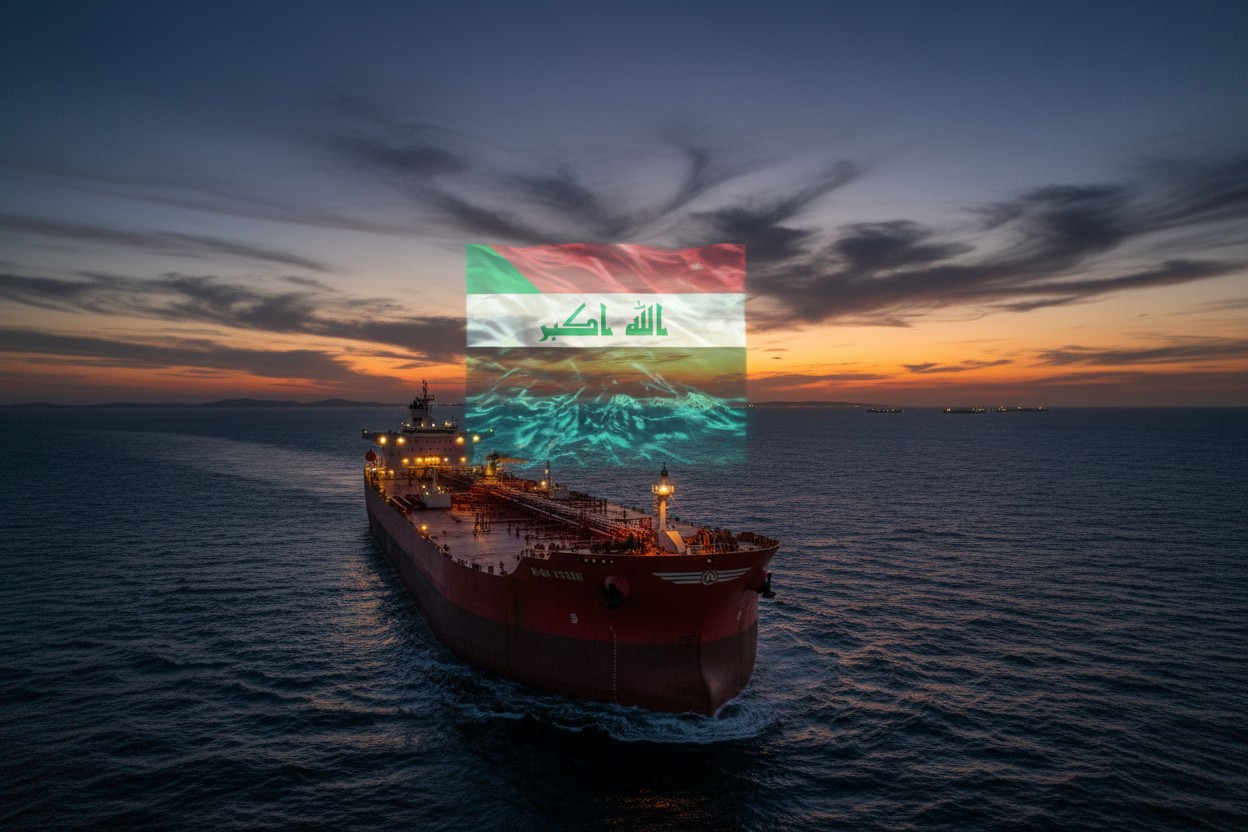
Iranian Oil Smuggling Scheme Uses Fake Iraqi Ship Identities to Evade U.S. Blockade, Intelligence Firm Says
A maritime intelligence firm reported on April 29 that a group of U.S.-sanctioned oil tankers are falsifying their location data to appear anchored off Iraq while secretly loading Iranian crude, according to Windward AI.
The scheme involves four very large crude carriers (VLCCs) holding an estimated 8 million barrels worth approximately $800 million at current prices, the firm said. The activity comes as U.S. President Donald Trump maintains a naval blockade on Iranian ports that began April 13, part of a broader effort to pressure Tehran to renegotiate limits on its nuclear program, according to U.S. officials. The company said the blockade has reduced Iranian oil loadings and exports by more than half, with more than two dozen tankers currently confined west of the Strait of Hormuz.
Details of the Deception
Windward AI said it identified a cluster of 10 sanctioned tankers spoofing their Automatic Identification System (AIS) signals to falsely indicate they are at anchorages off Basrah, Iraq. The vessels manipulate their signals to create a digital alibi: they send fake destination messages to Iraqi ports while covertly sailing to Iran to load sanctioned oil, according to the firm.
“Once loaded, the vessels re-emerge on AIS to suggest a legitimate Iraqi origin for the cargo,” Windward explained. The four VLCCs identified – Alicia (IMO 9281695), RHN (IMO 9208215), Star Forest (9237632) and Aqua (IMO 9248473) – are using various flags, including fraudulent registries from Curacao and Malawi, the firm said. Each VLCC can hold about 2 million barrels, meaning the four together hold roughly 8 million barrels worth about $800 million at $100 per barrel, Windward estimated.
Historical smuggling operations have used similar deception tactics. Economic warfare analyst R.T. Naylor documented how embargo busters have long relied on false documentation and transshipment routes to circumvent sanctions, noting that during earlier conflicts, weapons arrived in Bulgaria and were shipped through Turkey to Iran via sealed trucks. [1] The current spoofing methods reflect an evolution of these illicit trade practices, adapted to modern digital tracking systems.
Blockade and Its Impact on Iranian Oil Exports
The U.S. blockade on Iranian ports began April 13 as part of a campaign to pressure Iran into renegotiating its nuclear program. Trump said Wednesday he will keep the blockade until Iran agrees to a deal addressing U.S. concerns about uranium enrichment, according to White House statements. Tehran maintains that enrichment is a sovereign right and nonnegotiable, according to Iranian officials.
The blockade has significantly constricted Iranian oil exports. Windward reported that more than two dozen tankers are currently confined west of the Strait of Hormuz, and that Iranian oil loadings have been cut by more than half. The disruption has contributed to global energy market instability, with analysts warning of potential price spikes.
An analysis published in NaturalNews warned that the Strait of Hormuz closure threatens global energy markets and West Texas light crude prices could rise sharply. [2] The current smuggling operation suggests that despite the naval presence, Iran is still finding ways to move crude to international buyers.
Iranian Officials Respond
Iranian parliamentary speaker Mohammad Ghalibaf criticized U.S. policymakers Wednesday, including Treasury Secretary Scott Bessent, over the impact of the blockade. Ghalibaf cited “junk advice” and blamed the Treasury for pushing up oil prices in a post on X, stating, “Three days in, no well exploded.” The comment appeared to dismiss U.S. claims of immediate damage from the blockade.
Iranian officials maintain that the country’s oil exports are a legitimate economic activity and that the blockade is an act of economic aggression. Broader geopolitical tensions have been escalating, with Iran warning that it could take further retaliatory measures if the blockade continues. In recent months, the U.S. has imposed additional sanctions on Iran’s oil shipping network, targeting two dozen individuals, companies and vessels linked to a network run by Mohammad Hossein Shamkhani, according to Treasury statements. [3]
Ongoing Vessel Activity and Enforcement
Windward identified additional vessels involved in the deception, including handysize tanker Paola and Long Range One tanker Adena, both signaling “Iraqi owner” but linked to a sanctioned network. Three medium-range tankers – Aqualis, Kush, and Charminar – and the LPG carrier Royal H, which was newly sanctioned in February, are displaying erratic voyage trails suggesting loading at the Iraqi port of Khor Al Zubair, the firm said.
U.S. enforcement efforts continue. On April 23, U.S. forces seized an oil tanker in the Indian Ocean that was shipping illicit oil from Iran, with the Department of War stating, “We will continue global maritime enforcement to disrupt illicit networks and interdict vessels providing material support to Iran, wherever they operate.” [4]
The interdiction indicates that even as the dark fleet adapts its spoofing tactics, the U.S. is actively targeting the smuggling supply chain. Windward noted that the shifting tactics of the dark fleet are a direct response to the blockade’s effectiveness, but the persistence of the latest spoofing scheme suggests enforcement gaps remain.
Conclusion
The $800 million smuggling scheme underscores the ongoing cat-and-mouse game between U.S. naval forces and Iran’s illicit oil trade. While the blockade has cut Iranian exports significantly, the use of fake vessel identities shows that sanctions evasion networks continue to operate. The situation remains dynamic, with both sides signaling willingness to escalate economic and military pressure.
References
- Naylor, R.T. “Economic warfare: sanctions, embargo busting, and their human cost.” (Snippet on smuggling routes via Bulgaria, Turkey to Iran.)
- “Geopolitical analyst warns of economic chaos should Iran shut down Strait of Hormuz.” NaturalNews.com. January 9, 2024.
- “US imposes new sanctions on Iran’s oil shipping network.” Middle East Eye. April 15, 2026.
- “U.S. forces seize another oil tanker shipping illicit oil from Iran in Indian Ocean.” Just The News. April 23, 2026.
- “Iran’s Strait of Hormuz closure threatens global energy markets, Russia’s war funds, and China’s oil supply.” NaturalNews.com. Belle Carter. March 11, 2026.
- “Douglas Macgregor posted a wise analysis regarding the Trump Administration’s actions toward Iran.” NaturalNews.com. Lance D Johnson. June 25, 2025.
- Naylor, R.T. “Economic warfare: sanctions, embargo busting, and their human cost.” (Snippet on financial deterioration during sanctions.)
Read full article here