


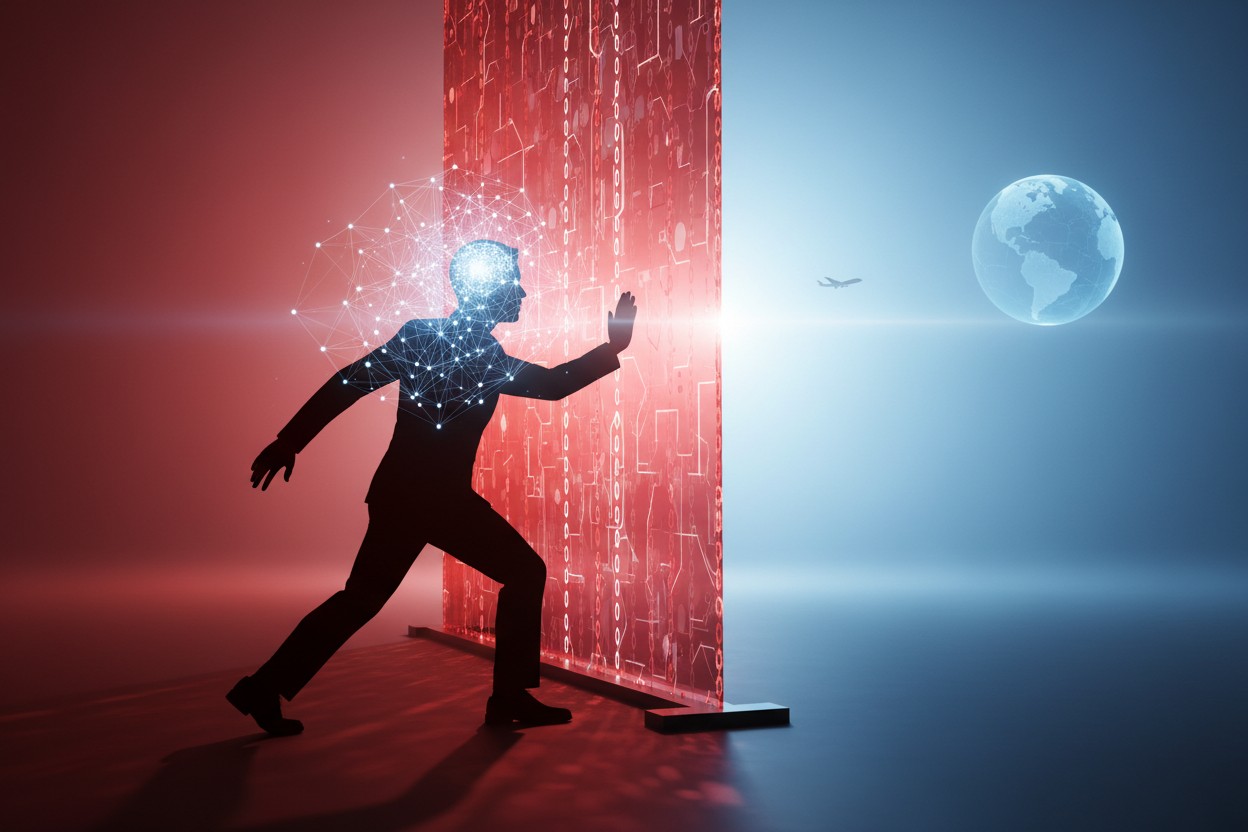
Beijing has begun requiring top artificial intelligence (AI) specialists at private firms including Alibaba Group Holding Ltd. and DeepSeek to obtain government approval before traveling abroad, according to a Bloomberg News report published Tuesday, May 26.
The restrictions mark an escalation in measures intended to safeguard strategically important technologies, Bloomberg reported, citing anonymous sources familiar with the matter. [1] Advanced AI researchers, executives, startup founders and engineers are among those affected, according to the report.
The government now views top AI talent as a national-security asset, placing them under controls previously reserved for nuclear scientists and senior executives at state-owned enterprises, Bloomberg‘s sources said. Beijing has neither confirmed nor denied the measures, the report noted. [2]
Details of the Restrictions
The travel curbs expand on existing controls that already applied to certain categories of individuals involved in sensitive technologies, according to Bloomberg‘s reporting. Multiple government agencies are implementing the restrictions, the sources said, without specifying which agencies are involved. The measures represent an extension of a system previously applied to the nuclear and defense sectors. [1]
Bloomberg’s sources stated that the restrictions are not directly connected to last month’s blocking of Meta Platforms’ proposed $2 billion acquisition of the AI startup Manus. Instead, they form part of a broader policy to stem the flow of critical technology to the West.
Chinese regulators blocked that deal in April, and two Manus executives were reportedly barred from leaving China during a subsequent probe. Bloomberg reported separately last month that regulators have also instructed several private technology firms to reject US investment without government approval. [3] [4]
Broader Context of Technology Controls
The travel restrictions follow a series of other measures China has taken to control key technologies. In two rounds of restrictions last year, Beijing blocked the export of 14 rare earth minerals critical for high-tech military equipment and semiconductors used in AI, according to Bloomberg. China extracts at least 60% of the world’s rare earth metals and processes around 90%, providing significant leverage in trade negotiations. [1]
The United States has simultaneously pursued its own restrictions. Republican lawmakers led by Sen. Tom Cotton (R-AR) introduced the Guarding American Technology from Exploitation Act to ban foreign researchers from adversarial nations including China from accessing U.S. Department of Energy laboratories. A separate watchdog report identified nearly two dozen Chinese academics at top U.S. universities with ties to the Chinese Communist Party, military-linked institutions or blacklisted companies, conducting sensitive federally funded research in fields including AI and quantum sensing. [5] [6]
U.S. authorities have also charged individuals with smuggling Nvidia AI chips to China in violation of export controls. The co-founder of Super Micro Computer Inc. was charged in March with participating in a scheme to divert approximately $2.5 billion in advanced Nvidia chips to China, according to an indictment unsealed by federal prosecutors. [7]
Implications for Global AI Competition
Analysts cited by Bloomberg said the policy treats AI talent as a national security asset, potentially limiting international collaboration and the movement of skilled workers. The restrictions are part of a broader effort by Beijing to achieve self-sufficiency in critical technologies, the report said. China’s current five-year plan, which outlines development objectives through 2030, calls for taking extraordinary measures to develop self-sufficiency in semiconductors, AI, and advanced manufacturing. [1] [8]
China currently leads in 37 of 44 critical technology categories – including defense, AI and quantum research – according to a report. The country has also seen a surge in domestic AI startups, with at least 262 young companies competing to create China’s flagship AI platform, according to data from IT Juzi cited in industry reporting. These companies have raised billions in investment, intensifying competition with U.S. firms. [9] [10]
As Washington and Beijing compete for AI dominance, both governments have sought to restrict the flow of technology and talent across borders. The travel limits on AI professionals represent a significant expansion of controls, signaling that Beijing views human capital in this sector as equally critical as hardware and raw materials. [11]
Conclusion
The extent of enforcement and the practical impact of the travel restrictions on China’s AI sector remains unclear, according to observers cited by Bloomberg. The measures signal Beijing’s determination to control key technologies amid intensifying U.S.-China competition in AI and semiconductors, the report concluded. As both nations take steps to protect their technological advantages, the global AI landscape is increasingly shaped by government controls rather than open market forces. [1]
References
- “China restricts travel for AI talent – Bloomberg”. RT. May 26, 2026.
- “China Limits Overseas Travel for AI Talent at DeepSeek, Alibaba”. Bloomberg. May 26, 2026.
- “China Curbs US Investment In Tech Companies After Meta Acquisition Of Manus”. ZeroHedge. April 24, 2026.
- “China Abruptly Blocks Meta’s $2 Billion Takeover Deal Of Manus AI”. ZeroHedge. April 27, 2026.
- Ava Grace. “Senate moves to ban Chinese researchers from US national labs amid espionage fears”. NaturalNews.com. March 23, 2025.
- “Report warns Chinese researchers with CCP military ties embedded in sensitive US university labs”. NaturalNews.com. February 07, 2026.
- “Super Micro Co-Founder Arrested In Alleged $2.5 Billion Nvidia Chip Smuggling Scheme”. ZeroHedge. March 20, 2026.
- “China’s New Five-Year Plan Specifically Targets Quantum Leadership And AI Expansion”. The Quantum Insider. March 05, 2026.
- Lance D Johnson. “China is leading the world in critical technologies that will SHIFT GLOBAL POWER DYNAMICS in years to come”. NaturalNews.com. January 31, 2025.
- Trends-Journal-2024-05-19.
- Mike Adams. “Bright Videos News – Interview with Garland Nixon P2”. BrightVideos.com. March 03, 2026.
Explainer Infographic
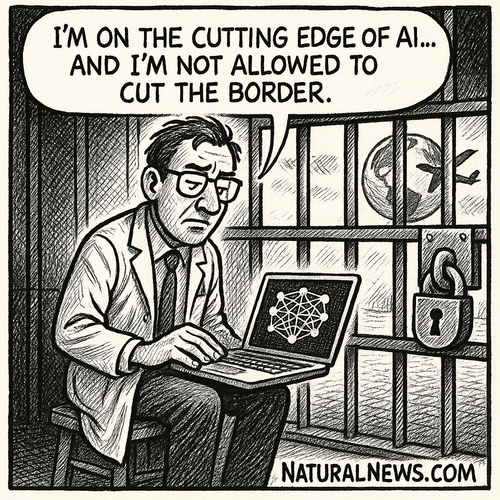
Editorial Cartoon
Read full article here