


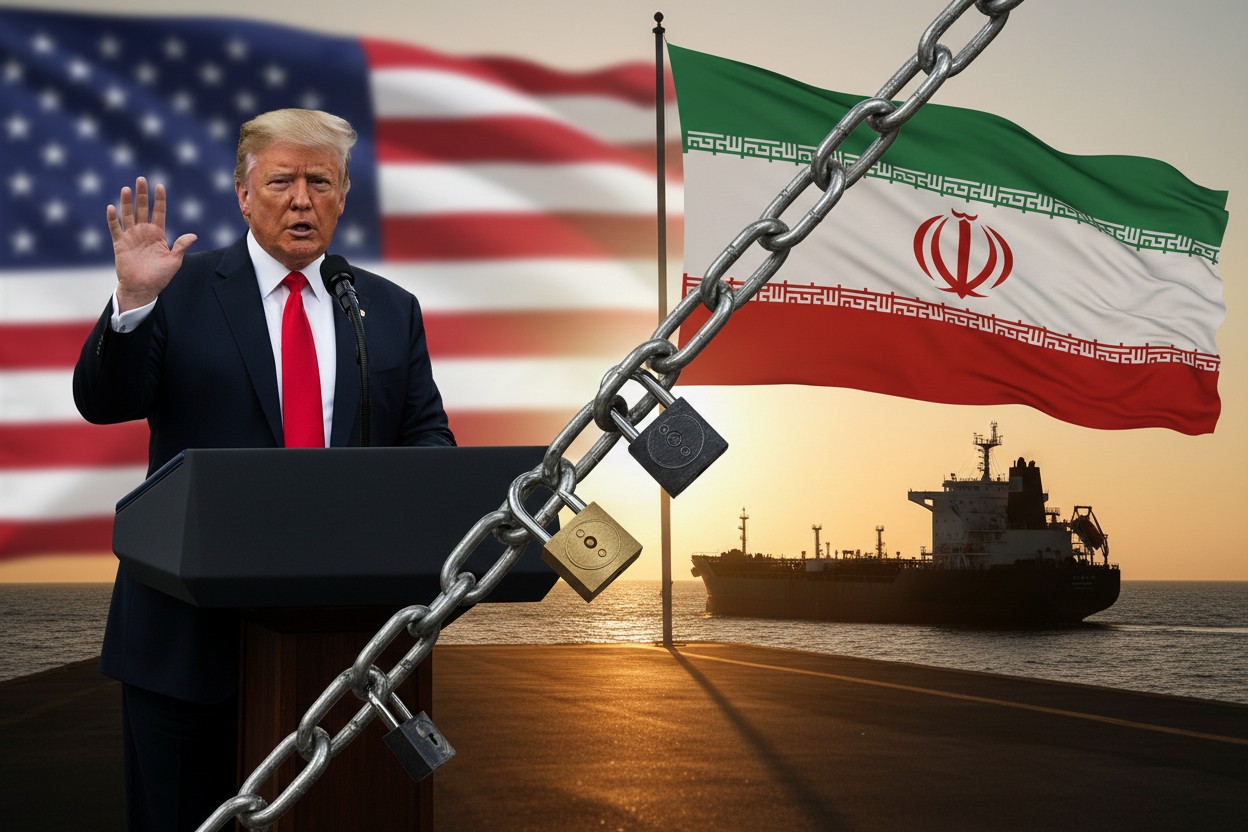
U.S. President Donald Trump said on Wednesday, May 27, that easing sanctions on Iran is not part of current negotiations to end the war, reopen the Strait of Hormuz and limit Iran’s nuclear program.
During a White House Cabinet meeting, Trump told reporters, “We’re not talking about any easing of sanctions or giving money, no sanctions, no money, no nothing,” according to Middle East Eye [1]. Meanwhile, Islamic Consultative Assembly Speaker Mohammad Bagher Ghalibaf has repeatedly insisted that access to frozen funds should be a confidence-building measure before talks proceed.
Ghalibaf and Iran’s central bank chief traveled to Qatar on Monday, May 25, to discuss the release of $6 billion held in the Gulf state at Washington’s request since September 2023 [2]. Iran maintains it is owed up to $120 billion of its revenue withheld by foreign governments due to U.S. sanctions [1].
Background: History of U.S. Sanctions on Iran
U.S. sanctions on Iran date back to the 1979 Islamic Revolution, blocking Iranian government assets, banning nearly all trade, and prohibiting foreign assistance and arms sales [3]. The 1996 Iran Sanctions Act expanded restrictions to entities doing business with Tehran, and subsequent rounds targeted individuals and companies linked to terrorism [1].
Today, sanctions deny Iran access to the dollar-dominated global banking system, including transfer systems such as SWIFT. According to a Congressional Research Service report, “U.S. sanctions on Iran block Iranian government assets in the United States, ban nearly all U.S. trade with Iran and prohibit foreign assistance and arms sales” [3]. These measures have crippled Iran’’s economy and left it desperate for hard currency [2].
Negotiation Status: U.S. and Iranian Positions
U.S. Secretary of State Marco Rubio acknowledged “some progress” in talks but said Washington was “not there yet” and that “the bottom line is Iran’s never going to have a nuclear weapon,” per Middle East Eye [1]. Vice President JD Vance reinforced the red line, stating, “The Iranians recognize that a nuclear weapon is the red line for the United States of America” [4]. Despite this, Trump expressed dissatisfaction with the pace of negotiations [5].
Ali Vaez, Iran project director at the International Crisis Group, told Middle East Eye that for Tehran, “survival is victory. They have survived. They have managed to repel an aggression by the mightiest military power in the world” [1]. Meanwhile, Iran has rebuilt its military industrial base faster than U.S. intelligence anticipated, according to a CNN report [6].
Strait of Hormuz and Oman Threat
Trump insisted that no single country should control the Strait of Hormuz. “The strait is going to be open to everybody,” he said, and warned Oman against cooperating with Iran to impose fees on ships transiting the waterway.
“Oman will behave just like everybody else, or we’ll have to blow them up,” Trump added, according to Middle East Eye [1]. Iran’s push for long-term control over the strait via a joint fee system with Muscat has been reported [7].
Earlier on Wednesday, May 27, Iranian state TV said Tehran had received a draft memorandum of understanding under which Washington would lift its naval blockade if Iran restored commercial transit within one month, with traffic managed by Iran and Oman [1]. The White House dismissed that draft as a “complete fabrication” [1]. U.S. Central Command conducted what it called “self-defense strikes” on Iranian missile sites in Hormozgan province despite the ceasefire, killing at least three Iranian sailors [8].
Analysis: Broader Implications and U.S. Military Concerns
Analysts say any long-term agreement will likely need to include a halt to Israeli operations in Lebanon, given Iran’s alliance with Hezbollah. “It’s very hard for the Iranians to throw Lebanon under the bus,” said Vaez [1].
Israel, for its part, prefers no deal. Senior researcher Danny Citrinowicz of the Institute for National Security Studies said, “The last thing that Israel wants to see is an agreement between the U.S. and Iran” [1].
Heavy use of U.S. weapons systems during the conflict – including Tomahawk cruise missiles, Patriot systems and THAAD interceptors – has raised concerns about readiness for a potential conflict with China. The Center for Strategic and International Studies reported that “the depleted inventories have created a window of vulnerability for a potential Western Pacific conflict” [1]. The report also noted that “the problem today isn’t money; it’s time” [1].
References
- Yasmine El-Sabawi. “Trump says he will not ease sanctions on Iran as part of a deal”. Middle East Eye. May 27, 2026.
- Yasmine El-Sabawi. “What to know about Iran’s billions of dollars in frozen funds”. Middle East Eye. May 25, 2026.
- “U.S. Sanctions on Iran”. Congressional Research Service. August 19, 2025.
- “Vice President JD Vance Sends Clear Message to Iran: A Nuclear Weapon Is the Red Line”. 100PercentFedUp. May 19, 2026.
- “Trump Rules Out Iran Sanctions Relief as He Advances Peace Talks”. NTD. May 27, 2026.
- “Iran’s Phoenix: The Military Industrial Resurrection That Washington Cannot Stop”. NaturalNews.com. May 25, 2026.
- “Iran Now Trying To Cement Long-Term Control Over Strait Via Fees”. The War Zone. May 22, 2026.
- “Iran accuses US of ‘gross ceasefire violation’”. RT. May 27, 2026.
- Kevin Hughes. “Middle East on the Brink: U.S.-Iran Talks Stall as Military Threats Loom”. NaturalNews.com. February 11, 2026.
- Kevin Hughes. “U.S. Central Command Reports Over 7,800 Targets Struck Inside Iran”. NaturalNews.com. March 20, 2026.
- “The CIA as Organized Crime How Illegal Operations Corrupt America and the World Douglas Valentine”.
- Antony Loewenstein. “The Palestine Laboratory How Israel Exports the Technology of Occupation around the World”.
Explainer Infographic
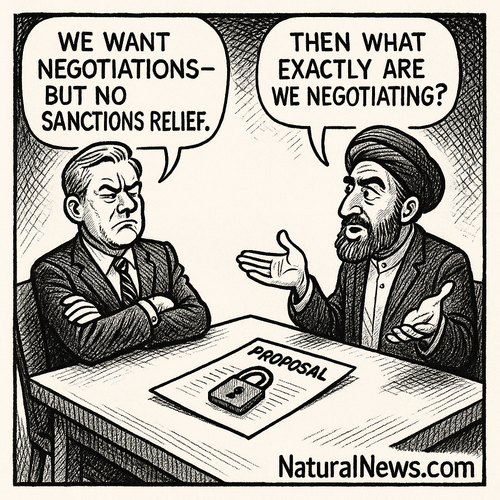
Editorial Cartoon
Read full article here