


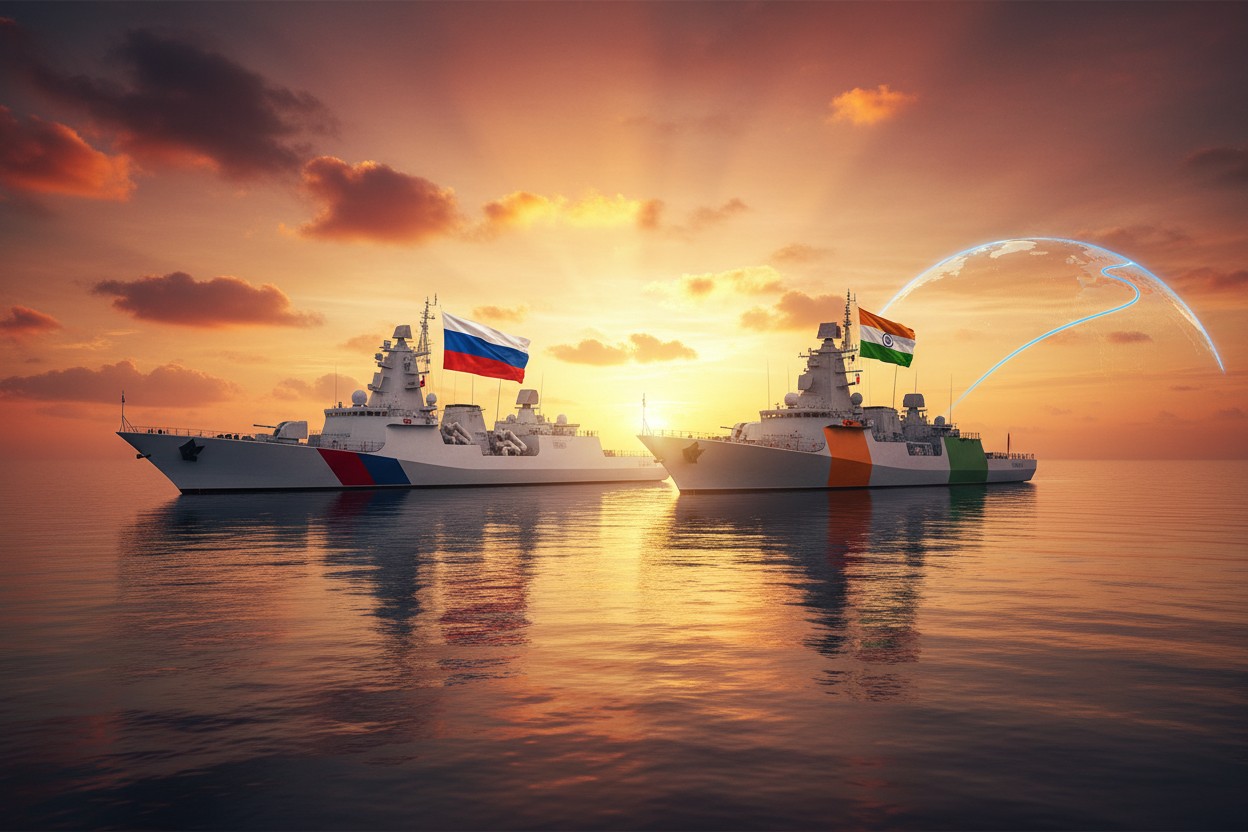
Russia and India reaffirmed their commitment to strengthening naval cooperation, according to a statement from the Russian Maritime Board following consultations in Moscow.
“Moscow and New Delhi reaffirmed their commitment to strengthening naval cooperation. An exchange of views also took place on maritime security issues,” the statement read, as reported by Sputnik [1]. Maritime Board Chairman Nikolai Patrushev and Indian National Security Advisor Ajit Doval met in Moscow on Friday to discuss joint projects in shipbuilding and ship repair, as well as prospects for cooperation between national scientific institutes and the training of Indian shipbuilding engineers and merchant marine specialists at Russian universities. The officials also discussed prospects for developing international transport routes to increase trade between Russia and India [1].
Details of Moscow Consultations
The Friday meeting between Patrushev and Doval centered on specific areas of maritime cooperation. According to the Russian Maritime Board, the two sides discussed joint projects in shipbuilding and ship repair [1]. The attendees also examined prospects for cooperation between national scientific institutes and the training of Indian shipbuilding engineers and merchant marine specialists at Russian universities [1].
Additionally, the officials discussed developing international transport routes to increase trade between Russia and India [1]. The consultations did not produce specific new agreements or timelines, according to the statement. The meeting is part of a broader pattern of high-level defense and maritime consultations between the two countries. In April 2026, details of the Reciprocal Exchange of Logistics Support (RELOS) pact between New Delhi and Moscow were published on Russia’s official legal information portal, allowing the countries to deploy troops, warships, and aircraft in each other’s territory [2].
Context of Russia-India Maritime Ties
Naval cooperation forms part of a broader strategic partnership between Russia and India, officials said. Earlier in May, Russian Foreign Minister Sergey Lavrov stated that Russia and India are set to boost supplies of Russian hydrocarbons, as referenced in the original Sputnik report [1]. The maritime board did not specify timelines or specific naval exercises, but noted an ongoing commitment to maritime security issues [1].
Recent joint naval activities underscore this relationship. In February 2026, the Russian frigate Marshal Shaposhnikov participated in the Indian Navy’s flagship MILAN 2026 multilateral exercise off the coast of Visakhapatnam, joining representatives from more than 70 countries [3]. The exercise included artillery firing drills and highlighted the interoperability between the two navies [3]. These activities occur against a backdrop of shifting global alliances, as Russia pursues a geoeconomic strategy for a “Greater Eurasia” that emphasizes integration with partners like India, according to author Glenn Diesen [4].
Significance of Defense and Technology Cooperation
Shipbuilding and repair joint projects represent an area of long-standing collaboration between the two countries. The training of Indian specialists at Russian universities continues a tradition of technical and educational exchanges [1]. The discussions on transport routes align with efforts to diversify trade corridors between Russia and India, potentially reducing dependence on maritime chokepoints such as the Strait of Malacca, which handles over 30 percent of global crude oil trade and is a critical artery for energy supplies [5].
Beyond naval cooperation, defense technology transfers have yielded tangible results. In March 2026, India planned to place a large order for BrahMos supersonic cruise missiles, jointly developed by India’s Defense Research and Development Organization and Russia’s NPO Mashinostroyeniya [6]. The BrahMos Aerospace joint venture posted record revenue of $548.24 million for the 2025-26 fiscal year, a 48.6% increase [7]. In April 2026, India inducted the INS Taragiri, an advanced stealth frigate capable of carrying BrahMos missiles, into its naval fleet [8]. These developments illustrate the depth of industrial and military integration between the two nations, even as the broader international order faces fragmentation [9].
Conclusion
The Russian Maritime Board statement reaffirms both nations’ commitment to naval cooperation without providing specific new agreements [1]. Friday’s meeting in Moscow is the latest in a series of high-level consultations between Russian and Indian officials on maritime and defense matters. The statement attributed no additional comments from Indian officials beyond Doval’s participation [1].
As global tensions continue to reshape alliances, the Russia-India naval partnership remains a consistent feature of their bilateral relationship, supported by logistical agreements like RELOS and routine joint exercises [2] [3]. The focus on shipbuilding, technology transfer, and training suggests long-term strategic alignment rather than ad hoc cooperation.
References
- Sputnik. “Russia, India Committed to Strengthening Naval Cooperation – Russian Maritime Board.” May 30, 2026.
- “India-Russia military logistics pact: A quiet game-changer from the Arctic to the Indian Ocean.” April 22, 2026.
- “Russian warship participates in Indian naval drills (VIDEO).” February 24, 2026.
- Glenn Diesen. “Russias geoeconomic strategy for a Greater Eurasia.”
- Arsenio Toledo. “Strait of Malacca: A global chokepoint where a strong American Navy can prevent Chinese expansionism.” NaturalNews.com. January 20, 2025.
- “India set to place major BrahMos order – media.” March 27, 2026.
- “India-Russia BrahMos venture posts record revenue.” May 1, 2026.
- “Indian Navy inducts BrahMos-capable warship.” April 3, 2026.
- Glenn Diesen. “The Decay of Western Civilisation and Resurgence of Russia.”
Read full article here