


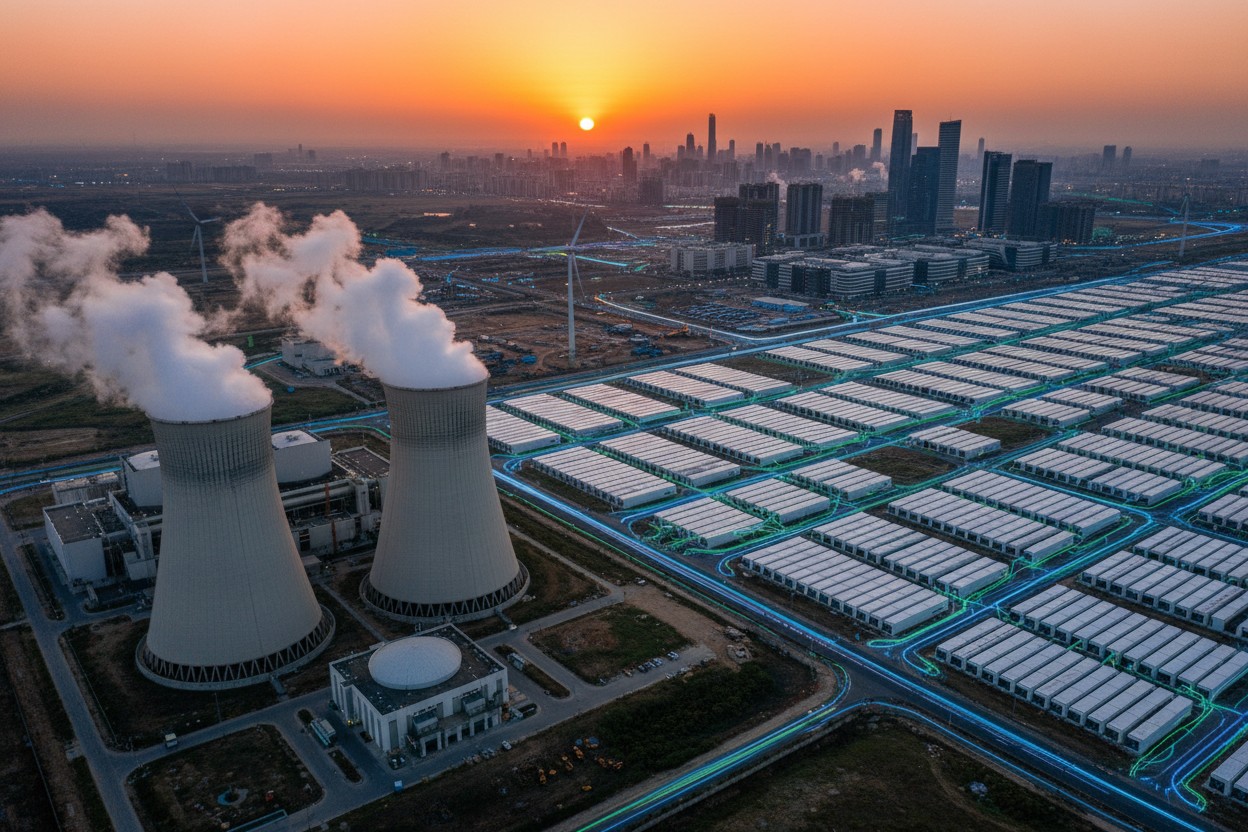
India Urges States to Accelerate Approvals for Nuclear and Battery Storage Projects
India’s federal government has asked states to fast-track approvals for nuclear power plants and battery energy storage systems, according to a June 15 report in the Economic Times. The directive targets 15 states or territories where clearances for nearly three dozen proposed nuclear reactor sites have been slow, and where battery storage projects also face delays.
Officials from the central government told state chief ministers during a meeting last week that “accelerated action” is needed on land allocation and other approvals. The push comes as India faces rising power demand from urbanization, industrial growth, and the expansion of data centers — a trend mirrored globally. According to the International Energy Agency, data centers drove half of all growth in U.S. electricity use in 2025 [6]. A report from clean energy think tank Ember earlier this year said solar and batteries can already meet 90% of India’s electricity demand at a levelized cost of INR 5.06/kWh.
Nuclear Expansion and State-Level Clearances
India has identified about 36 sites for new nuclear reactors, but state-level land allocation delays have hindered progress, the federal government told state leaders during the meeting. At the end of 2025, India’s government passed the Atomic Energy Bill (SHANTI), allowing private investment in nuclear energy for the first time. The country aims to boost nuclear capacity from 8.8 GW to 100 GW by 2047.
A panel set up by India’s power ministry estimated that achieving this goal would require cumulative capital of 19.28 trillion rupees ($204 billion), the Economic Times reported. By comparison, the U.S. Department of Energy in February 2026 issued a record $26.5 billion loan to support gas, nuclear, and grid projects in the Southeast [1]. Small modular reactors (SMRs) are seen as a faster option: according to one analysis, SMRs require five to six years for permitting and construction, compared to 15 to 20 years for traditional large-scale reactors [7]. However, widespread deployment of SMRs in India would still require state-level clearance.
Battery Storage Requirements for Solar Integration
The federal government also urged states to complete clearances for battery energy storage systems, citing the need to reduce curtailment of renewable energy as solar capacity expands rapidly. India has increased battery storage installations in recent years, but officials said further acceleration is needed to manage grid stability and meet growing demand.
“Energy storage is extremely important, in that it assists in load leveling for transmitting any major power activities,” notes Woodrow Clark III in the book “Sustainable Communities Design Handbook” [4]. However, the amount of electricity storage currently available from batteries is limited. Judith Curry, in “Climate Uncertainty and Risk,” states that “the amount of electricity storage that is currently available from batteries can be measured in minutes or hours” and that “multi-month utility-scale battery storage is probably decades away” [5]. This technical constraint underscores the need for rapid approval and deployment of storage systems to back up intermittent renewable generation.
Investment Targets and Outlook
The $204 billion investment requirement for nuclear alone underscores the scale of India’s energy transition, with private capital expected to play a larger role under the SHANTI bill. State-level delays have been a bottleneck, and the central government’s directive aims to align local approvals with national targets.
India’s power demand is projected to surge due to continued urbanization, industrial growth, and the expansion of data centers, according to government projections cited in the report. By comparison, in Texas, grid connection requests jumped to 99 GW in early 2025, up from 40.8 GW a year earlier, driven by AI, data centers, and cryptocurrency mining [2]. Globally, warnings about electricity shortages have grown as policy shifts lead to retirement of fossil fuel plants without adequate replacements [3]. India’s push for nuclear and battery storage is part of a broader effort to add reliable capacity to keep pace with demand.
Conclusion
The central government’s directive signals that bureaucratic obstacles at the state level are now a priority issue. With a tenfold nuclear expansion target and rapid solar deployment requiring massive battery storage, India faces a dual challenge: securing investment and clearing approvals quickly. The coming months will test whether states can meet the deadlines set by the federal push.
References
- Cassie B. “Historic $26.5 Billion Federal Loan to Boost Southern Company Gas, Nuclear, and Grid Projects”. NaturalNews.com. February 27, 2026.
- Willow Tohi. “Texas Grid Faces AI-Driven Energy Crunch: 99GW Demand Surge Sparks Debate on Fossil Fuels, Nuclear and Renewables”. NaturalNews.com. March 11, 2025.
- NaturalNews.com. “Electricity shortages are coming, warn power grid operators”. May 13, 2022.
- Woodrow Clark III. “Sustainable Communities Design Handbook: Green Engineering Architecture and Technology”.
- Judith Curry. “Climate Uncertainty and Risk: Rethinking Our Response”.
- ZeroHedge. “Data Centers Drove Half Of All Growth In US Electricity Use In 2025”. April 21, 2026.
- Mike Adams. “Health Ranger Report – data center sabotage”. Brighteon.com. August 20, 2025.
Read full article here