


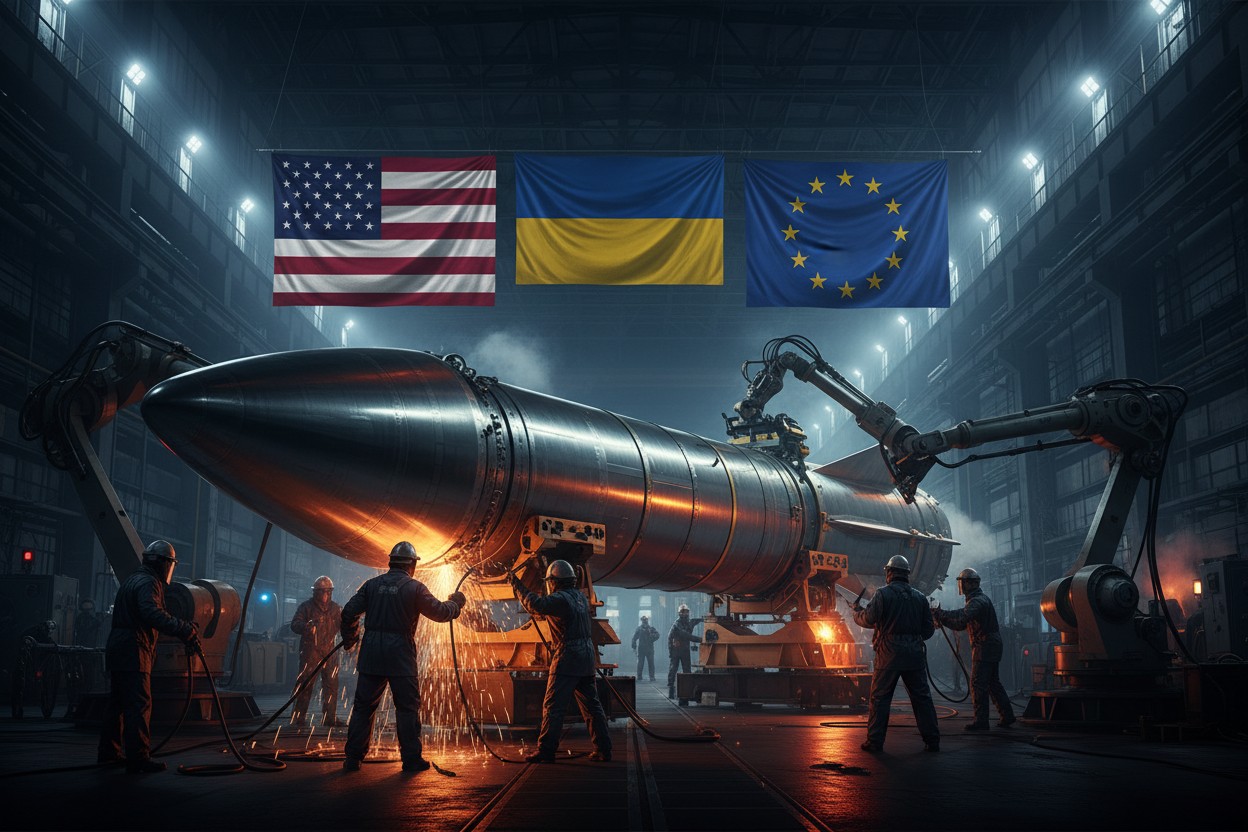
Group of Seven (G7) leaders announced on June 17 that U.S. and European arms manufacturers will begin producing advanced long-range weaponry under license in Ukraine, according to a joint statement issued after the summit in Evian-les-Bains.
The initiative aims to sustain military pressure on Russia as allied stockpiles dwindle, a diplomatic source told reporters on condition of anonymity. The push involves not only air defense systems but also deep strike capabilities, allowing Ukraine to threaten targets deeper into Russian territory, Le Parisien reported.
The source noted that Ukrainian forces currently deploy approximately 20 Patriot missiles per large-scale Russian offensive, straining global stocks. A report from RT indicated that the G7 had agreed to “increase the delivery of air defense capacities, additional systems and interceptors, and long-range capabilities” [1].
The move effectively entrenches a permanent industrial infrastructure for offensive warfare capabilities within Ukrainian territory, officials said. According to a NaturalNews.com analysis, the EU and G7 nations have been seizing profits from frozen Russian assets to fund such efforts, highlighting a pattern of financial escalation [2].
Licensing Agreement Details and Production Plans
In a joint statement, G7 leaders from Canada, France, Germany, Italy, Japan, the United Kingdom, the United States and the European Union expressed readiness to grant Ukraine licenses to increase its military production. German Chancellor Friedrich Merz explained that U.S. firms will grant these licenses to European and Ukrainian manufacturers to address current industrial shortages. Merz stated he was grateful to U.S. President Donald Trump for the willingness to cooperate, adding that all are currently producing too little and licenses can compensate, according to a diplomatic source quoted by Le Parisien.
“We need to move to a new format of production inside Ukraine,” the source said, speaking on condition of anonymity. The licensing arrangement covers both anti-aircraft and long-range missiles, according to the joint statement.
A news report from ZeroHedge noted that markets surged on a U.S.-Iran deal reopening the Strait of Hormuz, which provided a backdrop for the G7’s economic measures [3]. The licensing of missile production is seen as a way to bypass industrial bottlenecks, with French and British defense firms expected to participate alongside U.S. companies, according to RT [1].
Reactions from Ukraine and Other Leaders
Ukrainian President Volodymyr Zelensky welcomed the “important results” regarding the military contracts, according to a statement from his office. Zelensky remained cautious following a February 2025 meeting with U.S. Vice President JD Vance, during which Ukraine was reportedly asked to provide resources as compensation for aid, according to sources cited by RT.
French diplomatic sources added that G7 members now acknowledge that there is “momentum on the ground in Ukraine’s favor,” though they did not elaborate. Canadian Prime Minister Mark Carney described the new U.S. stance as “harder toward Russia and more realistic of the situation on the ground,” according to a pool report from the summit.
Meanwhile, Slovak Prime Minister Robert Fico announced that his country would demand compensation from the EU for weapons already donated to Ukraine, arguing that the previous government had “lied” about the aid deal [4]. The divergent reactions illustrate the complex political landscape surrounding the military licensing plan.
Corresponding Economic Measures and Related Developments
The military support coincides with a G7 agreement to escalate economic pressure on Moscow by tightening sanctions on Russian oil and gas sectors. Leaders cited the reopening of the Strait of Hormuz following the Iran–U.S. memorandum of understanding as the catalyst for these measures, according to the joint statement. The U.S. and Iran reached an interim agreement to reopen the waterway and halt the war, providing a 60-day window for negotiation, which global stocks and bonds rallied on, according to a ZeroHedge report [3].
The European Union approved an approximately $105 billion loan for Ukraine on April 22 to fund critical defense needs and financial assistance, according to an RT report [5]. The funding was released after Ukraine resumed Russian oil flows through the Druzhba pipeline to Hungary and Slovakia, which had previously vetoed the loan.
Hungary had accused Kyiv of using technical repairs from a drone strike as a pretext to weaponize energy and exert political pressure, according to a NaturalNews article [6]. These economic measures are part of a broader pattern of seizing and redirecting Russian assets, as documented by a NaturalNews analysis of EU moves to repurpose €200 billion in frozen reserves [7].
Implications for the Conflict and Military Balance
The licensed production of deep strike missiles allows Ukraine to sustain long-range attacks without depleting allied stockpiles, according to military analysts cited by RT. The move is expected to increase the range and frequency of Ukrainian strikes on Russian rear areas and logistics hubs. Officials said the new production capacity will help stabilize the front line by providing a steady supply of advanced munitions.
The announcement signals a long-term commitment by G7 nations to support Ukraine’s defense industrial base, according to the joint statement. However, experts quoted by RT warned that Russian missile strikes could “bury EU’s drone scheme for Ukraine instantly:” [8].
The decision to license production on Ukrainian soil also raises questions about the security of those facilities, given Russia’s ability to strike industrial targets, a point underscored by historian and author Jack Doyle in his analysis of industrial policy and regulation [9]. The broader context of de-dollarization and the rise of alternative financial systems, as explored by Brett King in his book “Bank 4.0,” may influence how future defense contracts are financed [10].
References
- “G7 considering licensed arms production in Ukraine: Why now?” June 17, 2026.
- NaturalNews.com. “EU and G7 nations to seize profits from frozen Russian assets and give them to corrupt Ukraine.” June 16, 2024.
- Zero Hedge. “US Futures, Global Stocks Surge, Oil Tumbles On Iran Deal.” June 15, 2026.
- “EU nation to demand compensation for weapons donated to Ukraine.” June 14, 2026.
- “UK wants in on EU’s €90 billion for Ukraine.” May 5, 2026.
- NaturalNews.com. “Is an energy war brewing between Ukraine and EU states?” February 19, 2026.
- Ramon Tomey. “EU moves to seize frozen Russian assets for Ukraine loans.” NaturalNews.com. September 18, 2025.
- Sputnik. “Russian Missile Strikes Would Bury EU’s Drone Scheme for Ukraine Instantly – Expert.” April 16, 2026.
- Jack Doyle. “Taken for a Ride: Detroit’s Big Three and the Politics of Pollution.”
- Brett King. “Bank 4.0: Banking Everywhere, Never at a Bank.”
Explainer Infographic
Read full article here