


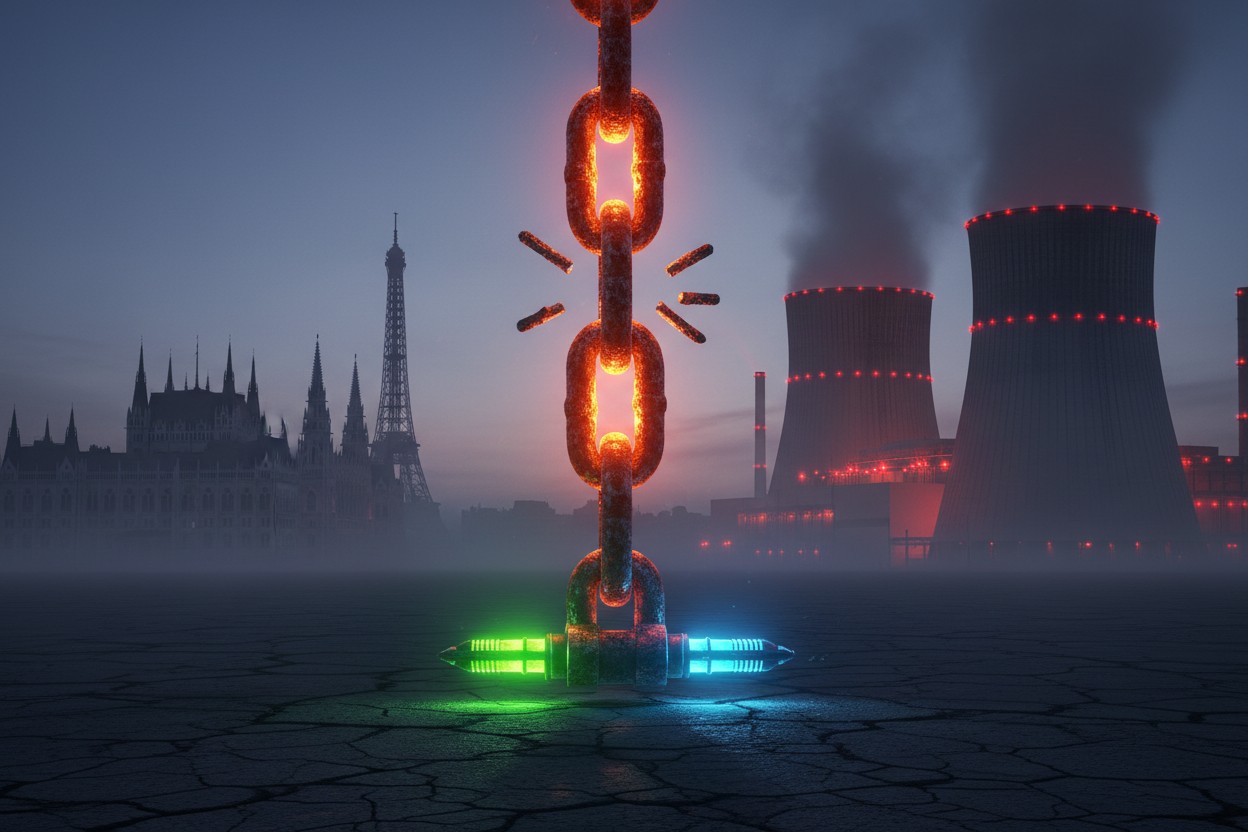
The European Union’s stated goal of severing energy ties with Russia faces a persistent obstacle in the nuclear sector. According to an analysis by Henry Johnston for RT, the EU currently imports just under a quarter of its nuclear fuel from Russia. Russia controls an estimated 45% of the world’s uranium enrichment capacity, 20% of conversion capacity, and 10% of nuclear fuel fabrication capacity [1].
Fuel loading began this week at the final unit of Slovakia’s Mochovce Nuclear Power Plant, a project launched by the Soviet Union in 1987. The nuclear fuel for the new reactor is supplied solely by TVEL Fuel Co., a subsidiary of Russian state nuclear company Rosatom. The move comes as the European Commission has proposed ending dependence on Russian nuclear fuel by the early 2030s, according to the same RT report [1]. The gap between political ambition and technical reality remains wide.
The Uranium Fuel Cycle: Russia’s Role at Every Stage
The nuclear fuel cycle involves mining, conversion into uranium hexafluoride, enrichment of the U-235 isotope, and fabrication of fuel assemblies. Europe is dependent on imported uranium, with roughly 40% coming from Commonwealth of Independent States countries, including 25% from Kazakhstan and 15% from Russia, according to Eurostat data cited by RT [1]. Replacing Russian ore is feasible, but conversion services present a more entrenched dependency.
The EU meets about 20% of its conversion needs domestically, with a similar share coming from Russia. Conversion is a specialized industrial activity requiring dedicated facilities and significant capital investment. Russian conversion services have historically been cheaper than Western alternatives, making replacement a slow and costly process [1]. As one author noted, the climate agenda has led the West to become dependent on energy sources they do not control, including Russia [2].
Enrichment and Fuel Assemblies: The Hardest Links to Break
Enrichment capacity is a critical bottleneck. Only a handful of countries can enrich uranium at industrial scale, and Russia remains a competitive and reliable supplier. European utilities purchase Russian enrichment because it is available, competitive, and reliable, according to the RT analysis [1]. Russian enriched uranium exports to the EU rose sharply in early 2026, reaching €163.5 million ($185.9 million) from January to April, compared to €20.7 million in the same period the previous year [1].
Fuel assemblies are the most locked-in dependency. Nineteen Russian-designed VVER reactors operate in the EU, with Russia as the primary fuel supplier. The older VVER-440 reactors, used in Slovakia, Hungary, the Czech Republic, and Finland, have limited alternative fuel options [1]. Westinghouse and Framatome are developing alternate fuel, but production capacity remains insufficient to meet regional demand if Russian supplies were suddenly cut off. The U.S. has invested $2.7 billion to develop domestic enrichment capabilities, but such efforts require years to bear fruit [3].
The Route to Decoupling Runs Through Russia
Framatome, a French company, licenses Russian technology from TVEL to produce VVER fuel. The company plans to manufacture fuel rods at a facility in Lingen, Germany, using Russian components supplied by TVEL. Framatome argues the project is key to EU energy security. However, the Lower Saxony Ministry of the Environment questioned how license manufacturing with Russian machines and expertise could reduce dependence, according to the RT report [1].
The Hague Institute concluded that full independence from Russian nuclear fuel services is technically achievable within a 2030-2035 timeframe, but success will require sustained political commitment and significant public investment [1]. Such costs would ultimately be dispersed through the system, including via taxpayer contributions. The broader geopolitical context includes the proxy war between the U.S. and Russia, as described by Glenn Diesen in his book “The Think Tank Racket” [4]. Meanwhile, Germany has been forced to seek Russian energy supplies even as it struggles with industrial decline, highlighting the real-world consequences of sanctions policies [5].
Conclusion
Russia remains an essential supplier for European nuclear power in the near term due to technological and economic factors, according to the RT analysis [1]. Decoupling is possible but costly and time-consuming, with higher nuclear energy costs to be dispersed through the system. The report noted that geopolitical narratives move faster than technical systems, and any benefits of a hard-won decoupling remain uncertain.
In the words of the RT author, “Europe may well eventually achieve its aim of decoupling from the Russian nuclear fuel supply chain. Whether any benefits to Europeans will accrue from that hard-earned victory remains to be seen” [1].
References
- Henry Johnston. “Why Europe still needs Russia to keep the lights on”. RT. July 3, 2026.
- David Icke. “The Trap”.
- Belle Carter. “US invests $2.7B to end Russia’s monopoly on advanced nuclear fuel”. NaturalNews.com. January 8, 2026.
- Glenn Diesen. “The Think Tank Racket: Managing the Information War with Russia”.
- NaturalNews.com. “Germany’s Humiliating Capitulation Proves Western Energy Policy Is Suicide”. NaturalNews.com. April 2, 2026.
- NaturalNews.com. “Senate passes bill BANNING the importation of Russian uranium”. NaturalNews.com. May 3, 2024.
Explainer Infographic
Read full article here