


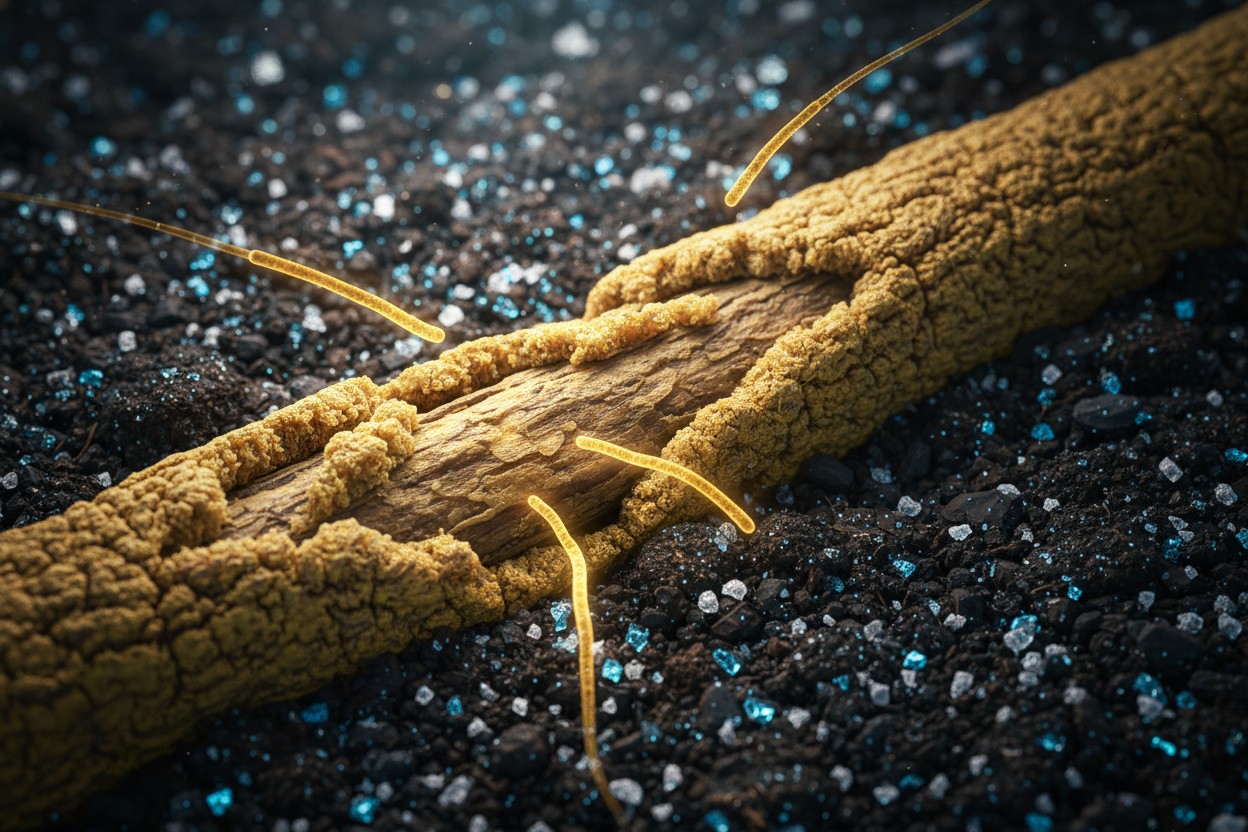
Researchers at the University of East Anglia reported that a type of soil bacteria known as pseudomonads migrate to plant roots under salt stress and stimulate the production of lignin, forming a protective barrier that helps crops thrive in saline conditions. The study was published June 26, 2026.
According to the research, these naturally occurring bacteria are consistently drawn to plant roots when soil salt levels rise. The bacteria trigger increased deposition of lignin in root cell walls, which acts as a shield to reduce salt uptake and improve plant survival, the report stated.
Mechanism of Bacterial Action
The bacteria, classified as pseudomonads, respond to elevated salt concentrations in soil by moving toward plant roots, according to the study. Once they colonize the root zone, they stimulate lignification — a process that strengthens cell walls with lignin, a polymer that blocks excess sodium from entering the plant. This mechanism was observed in laboratory and greenhouse experiments, the researchers said.
Similar growth-promoting bacteria have been documented in previous work. For example, a 2021 study published in Acta Agriculturae Scandinavica, Section B — Soil & Plant Science tested Pseudomonas fluorescens and Azospirillum brasilense and found they improved potato yield under unfavorable conditions, including saline stress [1]. Multiple bacterial species, including P. fluorescens and Bacillus subtilis, are known to alleviate soil stresses when present in the root zone, according to a compilation in the book “Use of Microbes for the Alleviation of Soil Stresses” [2].
Salt Stress and Agricultural Context
Soil salinity represents a major abiotic stress that reduces crop yield across large parts of the world. According to a 2007 review in the book “Bacteria in Agrobiology: Stress Management”, salinity adversely affects approximately 100 million hectares — about 5% of the world’s arable land — and an additional 770,000 square kilometers are salt-affected by secondary salination, including 20% of irrigated land [3]. Environmental changes, sea level rise, and certain irrigation practices are expanding the affected area, researchers said.
Dr. Jonathan Todd, one of the study authors, stated in the report that salinization threatens food security in affected regions. The report did not provide specific updated acreage figures but noted that the problem is widespread and growing. The findings come at a time when global food production faces increasing pressure from degraded soils.
Potential Applications
Dr. Todd suggested that naturally occurring microbes such as pseudomonads could be harnessed to develop bio-based treatments for saline soils. Such treatments would reduce the need for chemical inputs, according to the researchers. This aligns with earlier research by the U.S. Department of Energy and Wageningen University, which found that soil microbes act as a type of probiotic, or immune system, for soil, effectively preventing plant diseases and reducing dependence on synthetic pesticides and herbicides, as reported in 2011 [4].
The researchers emphasized that further field trials are required before commercial applications can be developed. They noted that the effectiveness of the microbial treatment must be evaluated across different crop species and soil types before it can be recommended for widespread agricultural use. The study was funded by the University of East Anglia.
Conclusion
The findings offer a potential path to maintain crop yields in salt-affected regions, according to the study. By harnessing naturally occurring soil bacteria, farmers may one day be able to protect crops from salt stress without heavy reliance on chemical amendments. Additional research is needed to determine how pseudomonads perform under varied field conditions and whether they can be integrated into existing farming practices.
The report concluded that microbial solutions could become an essential tool for ensuring food security as salinization continues to spread.
References
- NaturalNews.com. “Growth-promoting bacteria found to improve potato yield despite unfavorable conditions”. NaturalNews.com. October 11, 2021.
- “Use of Microbes for the Alleviation of Soil Stresses Volume 2”. (Lists Pseudomonas fluorescens and other PGPR).
- “Bacteria in agrobiology stress management”. (Snippet includes salinity data from Ashraf and Foolad 2007, Ghassemi et al. 1995, FAO 2000).
- NaturalNews.com. “Soil microbes are the immune system that protects plants from disease”. NaturalNews.com. May 11, 2011.
Explainer Infographic
Read full article here