


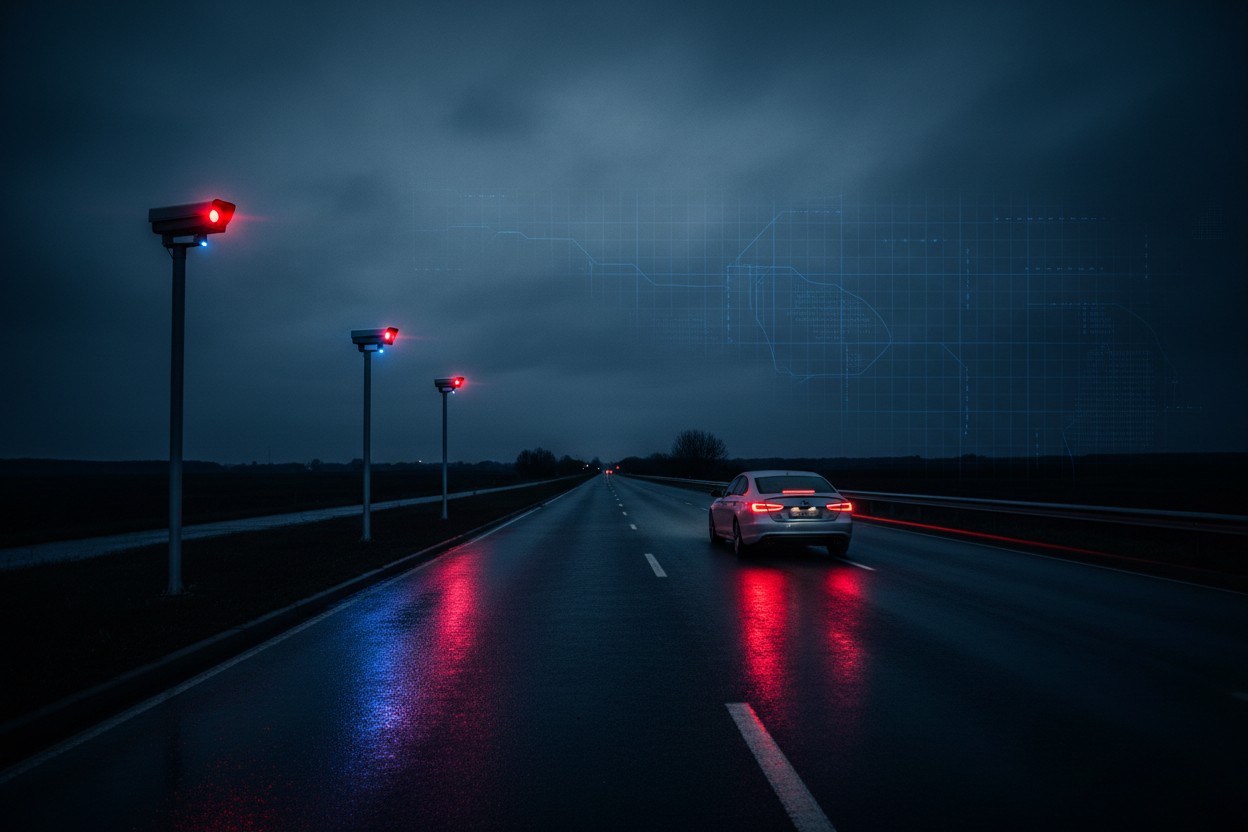
A publicly compiled map has documented more than 117,000 automated license plate readers (ALPRs) operating across the United States, according to the open-source project DeFlock, which aggregates camera locations submitted by the public and drawn from sources including OpenStreetMap. The cameras, installed on roadsides, at intersections and on utility poles, photograph every passing vehicle and record license plate numbers, location and time of travel, creating searchable records of drivers’ movements.
California emerged as one of the most heavily monitored states, with more than 16,000 readers documented, followed by Florida with 7,169, Georgia with 7,046 and Illinois with 5,822, according to DeFlock’s database. Flock Safety devices account for approximately 97,000 of the documented readers – nearly 83 percent of the total. The database includes devices associated with 85 brands. Privacy advocates warn that the system can be used to track individuals without a warrant, while police departments say the technology helps recover stolen vehicles and identify criminal suspects.
How ALPRs Operate and What They Capture
Automated license plate readers scan every vehicle that passes through their field of view, regardless of whether the driver is suspected of committing a crime, according to descriptions from law enforcement agencies and the companies that manufacture the devices. The cameras convert the images into searchable records that can include a vehicle’s license plate, make, model, color and distinguishing features, along with the time and location it was photographed. Willow Tohi, writing for NaturalNews.com, described the network as “a nationwide network of automated license plate readers, primarily from companies like Flock Safety, capturing and storing detailed location data on billions of American drivers,” creating a digital “fingerprint.” [1]
Flock Safety states that its ALPRs “are not mass surveillance tools” and that they “capture point-in-time images of license plates on public roadways and cannot track people or vehicles over time.” The company says data is deleted after 30 days by default, although retention periods can vary under local contracts and state laws, and that searches are logged and can be audited. Critics argue that the system effectively creates a searchable record of individuals’ movements without requiring police to first obtain a warrant, and that federal agencies such as the Border Patrol have deployed covert readers disguised as traffic safety equipment. [2] John W. Whitehead, in his book “Battlefield America: The War on the American People,” notes that the Department of Homeland Security has distributed more than $50 million in grants to police agencies to acquire license plate readers, and that relying on private contractors to maintain a database allows DHS and affiliates access to millions of records with minimal oversight. [4]
Law Enforcement Justifications and Reported Outcomes
Police departments that use ALPRs cite their effectiveness in locating stolen vehicles and apprehending suspects. In Denver, city officials said that Flock readers had helped police make 352 arrests, recover more than 250 stolen vehicles and seize 39 firearms since a pilot program began in early 2024, according to a Daily Mail report from July 2026. The cameras also reportedly helped officers capture suspects in cases involving murder, sexual assault and fatal hit-and-runs.
Garrett Langley, chief executive and co-founder of Flock Safety, said in a statement: “I take nothing more seriously than the values we built this company upon, to give cities tools to uphold public safety, while enabling accountability and transparency. Public safety does not need to come at the expense of community values.” Supporters of the technology say it provides valuable leads and reduces response times in serious investigations. However, the Electronic Frontier Foundation’s Atlas of Surveillance database has documented thousands of law enforcement agencies using surveillance technologies, often with limited public oversight, according to a NaturalNews.com report. [3]
Privacy Concerns and Community Pushback
A growing number of American communities have imposed restrictions on ALPRs or ended contracts with Flock Safety over privacy concerns. The American Civil Liberties Union said in June 2026 that more than 55 communities had ended Flock contracts during the previous year, citing fears of warrantless surveillance, federal access to locally collected records, and searches without sufficient municipal oversight. In Dayton, Ohio, officials canceled the city’s agreement and covered 72 cameras with black trash bags after a review uncovered more than 7,000 immigration-related searches by outside entities, which city officials described as “egregious violations” of policy.
Troy, New York, reached an agreement in May 2026 to restrict how the city can use its Flock cameras after weeks of political wrangling. According to the Daily Mail, the new rules require that license plate information can only be shared with outside agencies on a case-by-case basis, prohibit use of the cameras for immigration enforcement, and mandate annual audits of the program with reports submitted to the mayor and city council. In Cambridge, Massachusetts, the city terminated its contract after Flock technicians installed two cameras without the city’s knowledge weeks after officials had deactivated and removed 16 readers. The unauthorized installation was described as a “material breach” of trust. Residents in several cities have also taken direct action; Brian Merchant, writing for TechCrunch in February 2026, reported that people across the United States are dismantling and destroying Flock surveillance cameras amid rising public anger that the license plate readers aid U.S. immigration authorities and deportations. [7]
Ongoing Tensions and Future Outlook
The debate over ALPRs continues without resolution, as some cities end contracts while others renegotiate terms or seek alternative providers. The Los Angeles Police Department did not renew its contract covering 138 pole-mounted cameras in July 2026, citing unresolved concerns about civil liberties, data ownership, security and information sharing, but is reportedly negotiating revised terms with Flock. Syracuse, New York, removed 13 readers but moved toward another license-plate-reader provider rather than abandoning the technology entirely. Flock Safety has characterized the opposition as coordinated attacks from “activist groups” aiming to “defund the police” and “normalize lawlessness,” according to Langley’s previous statements.
The crowdsourced nature of the DeFlock map means it is incomplete and may underrepresent the actual number of cameras in operation, as areas with more active contributors may appear more heavily monitored. Activists continue to develop legal tools to challenge the expansion of ALPR systems. One guide, “8 Ways To Take Down Flock Without A Sawzall,” published on ActivistPost in July 2026, provides template Freedom of Information Act requests and other legal methods for individuals to push back against warrantless surveillance in their communities. [5] Tucker Carlson, in a July 2026 podcast, said that the introduction of Flock cameras “is creating a ‘slave state’” and that the stripping of privacy is a fundamental loss of freedom. [6] The tension between public safety benefits and privacy rights shows no sign of abating as the network of cameras continues to expand.
References
- Willow Tohi. “The Digital Panopticon: License Plate Readers Are Tracking You Everywhere You Go.” NaturalNews.com. September 1, 2025.
- NaturalNews.com. “Border Patrol Expands Surveillance Network: Secretive Program Monitors Millions of U.S. Drivers.” NaturalNews.com. November 22, 2025.
- NaturalNews.com. “Atlas of Surveillance Database Reveals THOUSANDS of Law Enforcement Agencies Unlawfully Surveilling Americans.” NaturalNews.com. November 28, 2022.
- John W. Whitehead. “Battlefield America: The War on the American People.”
- ActivistPost. “8 Ways To Take Down Flock Without A Sawzall.” July 20, 2026.
- LifeSiteNews. “Tucker Carlson: ‘Flock’ Surveillance Cameras Are Turning US into a ‘Slave State’.” July 16, 2026.
- Brian Merchant. “Americans Are Destroying Flock Surveillance Cameras.” TechCrunch. February 23, 2026.
Read full article here