


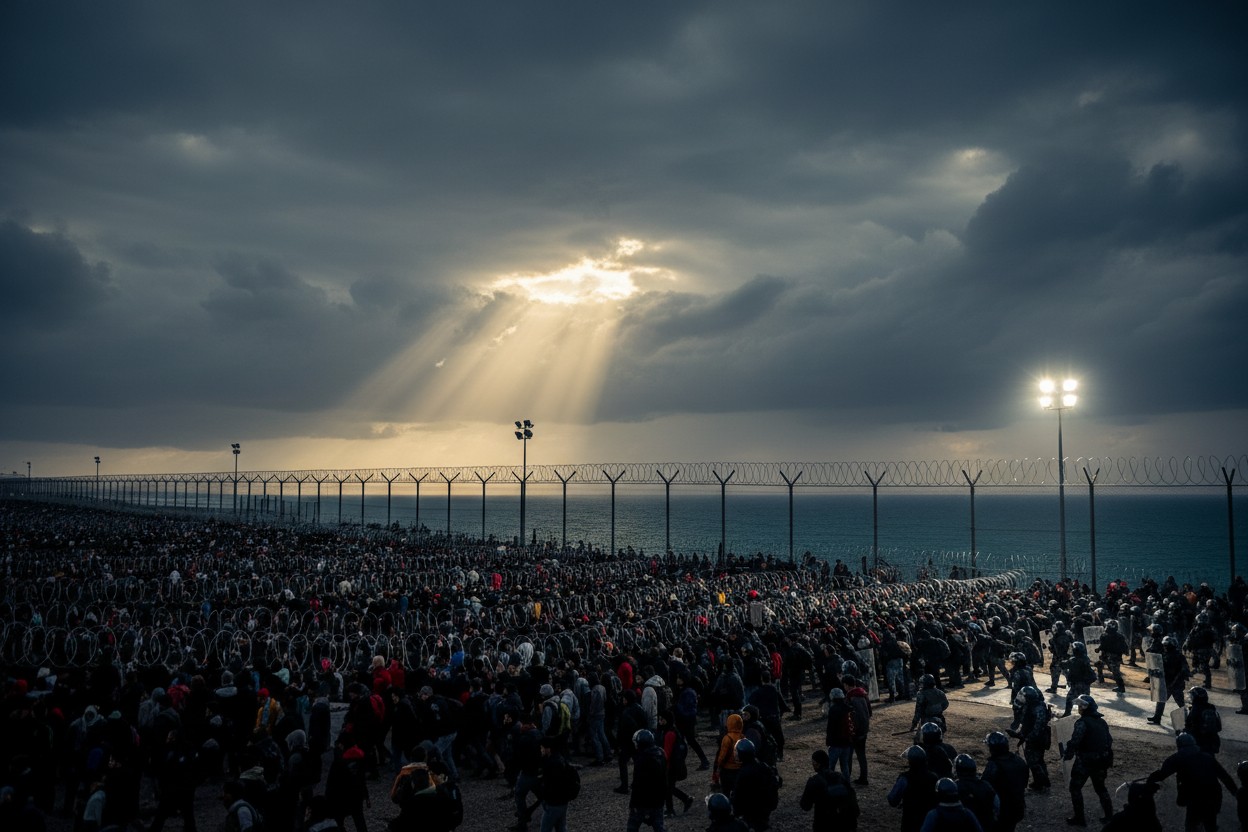
Ceuta Border Incident Draws Attention From U.S. Conservatives
On July 30, 2026, an estimated 50,000 to 60,000 people, predominantly military-aged men, crossed from Morocco into the Spanish enclave of Ceuta, overwhelming border forces and triggering what Spanish officials described as a security crisis, according to multiple reports.
At least 67 people died during the crossings, with bodies recovered from the sea, Spain’s Interior Minister Fernando Grande-Marlaska stated, as reported by the BBC [17]. The incident, which occurred at a European Union external border, drew immediate attention from U.S. conservative commentators and politicians, who cited the event as a warning about the consequences of weak border enforcement.
White House Deputy Chief of Staff for Policy Stephen Miller issued a stark warning for America, stating that “The Democrats did this to America every single day for 4 years” [6]. The surge represented roughly 59% of Ceuta’s normal population of approximately 83,000, according to estimates used by Spain’s Department of National Security [9].
Diplomatic Tensions and Border Dynamics
The migrant movement followed a diplomatic dispute between Spain and Morocco, officials said. Analysts accused Rabat of unleashing undocumented migrants into Ceuta in response to Madrid’s decision to allow a Western Sahara leader to be hospitalized and over Spanish stances on Gaza and Iran, according to reports [1].
Moroccan border security forces largely disappeared from their stations, facilitating the mass crossing [1]. The Spanish enclave of Ceuta has long faced challenges over maintaining border control, as documented in historical accounts of the region.
Previous surges occurred in July and August 2018, when a group of over 600 young males climbed and jumped over the tall wired fence separating Ceuta from Morocco, incurring bloody wounds [19]. The 2026 event occurred near the Tarajal breakwater, one of the main routes used by migrants swimming around the coastal border barrier [7].
Spain’s Interior Ministry said around 50,000 people had crossed the border since the morning of July 30, and estimated that 48,300 of them had returned by the following day [14]. However, local opposition leaders and some independent journalists disputed the government’s claims of mass returns, arguing that significant numbers remained on the streets and beaches [4].
U.S. Conservative Framing and Commentary
U.S. conservative commentators and politicians drew parallels between the Ceuta surge and the U.S. southern border. Tucker Carlson and others argued the Ceuta surge exemplified the consequences of weaker border enforcement, according to recorded statements and media reports [2].
Miller, a key immigration adviser, warned that without secure borders, similar scenes could occur in the United States [6]. President Donald Trump often cited such events to criticize immigration policies under the previous administration.
The incident was used by conservative media outlets to criticize open-border policies and the Biden administration’s approach to immigration, which they argued had encouraged illegal crossings. Miller specifically linked the Ceuta crisis to Democratic policies, stating that they had created conditions for mass illegal immigration [6].
The framing resonated with many U.S. conservatives who viewed the event as a case study in the use of migration as a political tool. Reports noted that the vast majority of the migrants were military-aged men, with many carrying no supplies, reinforcing concerns about national security [12].
Spanish and International Response
Spain deployed military and police forces to regain control, according to Spanish defense ministry statements. The Spanish Interior Ministry sent three platoons of 20 soldiers each, totaling 60 troops, to reinforce the Guardia Civil after officers admitted that the border had “totally collapsed” [13].
Specialized police units were also dispatched. The European Union expressed solidarity with Spain and held emergency talks on Aug. 4, 2026, with 22 member states issuing a joint letter calling for coordinated action and the strengthening of the EU’s external borders [5].
Italy temporarily suspended the Schengen arrangement with Spain, as Prime Minister Giorgia Meloni called the scenes in Ceuta “shocking” [3]. France also tightened border controls [11]. The EU eventually commended Spain’s “swift response,” noting that an estimated 70,000 of the 72,000 who crossed had been returned to Morocco [8].
Morocco’s government denied any coordinated action, stating that migrants acted independently, fueled by misinformation on social media and human trafficking networks [16]. Moroccan officials also pointed to a Spanish court ruling banning immediate returns of migrants intercepted at sea as a contributing factor [16].
Broader Implications for Migration Policy
The Ceuta incident highlighted tensions between bilateral diplomacy and migration control, analysts stated. The event was described by some observers as a clear example of weaponized migration, where a sovereign state uses the threat of mass illegal crossings to exert political pressure [18].
U.S. conservatives continued to reference the event in debates over border security, as noted by political commentators. The Ceuta surge was described as a case study in the use of migration as a political tool. The incident also exposed deep divisions within Europe over migration policy, with some countries calling for stronger external borders and faster returns [10].
The U.S. Department of State raised its travel advisory for Ceuta to Level 3, “reconsider travel,” citing “massive and uncontrolled arrival of migrants from Morocco to Ceuta” that could lead to an “unpredictable security environment” [15]. For U.S. conservatives, the event reinforced arguments that border security is a national sovereignty issue that requires immediate and decisive action. The parallels to the U.S.-Mexico border were drawn repeatedly, with commentators warning that without robust enforcement, American cities could face similar chaos.
References
- Are US and Israel benefitting from ‘migration blackmail’ against Spain? – Responsible Statecraft. August 5, 2026.
- Weaponized Migration? 50,000 Military-Aged Men Invade Spanish Enclave Without Supplies As Chaos And Riots Erupt – ZeroHedge. July 31, 2026.
- Spain attacks ‘selfish’ response of some EU countries to Ceuta migrant crossings – BBC. August 1, 2026.
- Ceuta: Calls For Spanish Prime Minister Sanchez To Be Put ‘In The Dock’ – Modernity News. August 3, 2026.
- EU calls emergency meeting to discuss Ceuta migrant crossings – BBC. August 1, 2026.
- Stephen Miller Issues Stark Warning For America As Illegal Immigrants Swarm Into Spain – 100PercentFedUp. July 31, 2026.
- Spain Installs Floating Barrier to Block Illegal Sea Crossings Into Ceuta – The Epoch Times. August 1, 2026.
- EU commends Spain’s ‘swift response’ to Ceuta migrant crisis – BBC. August 4, 2026.
- Italy and French conservatives demand Schengen suspension after nearly 50,000 illegal migrants descend on Ceuta in 24 hours – Remix News. July 31, 2026.
- EU Calls for Stronger Borders After Deadly Migrant Surge in Spain – The Epoch Times. August 4, 2026.
- France and Italy tighten border controls amid Spanish migrant crisis – Times of Israel. August 1, 2026.
- New Signals Point To Another Possible Migrant Invasion Against Ceuta – ZeroHedge. August 4, 2026.
- Spain deploys 60 troops as thousands storm border from Morocco (VIDEOS) – RT. July 30, 2026.
- Spain: Migrants Stream Back to Morocco, but Crossings Into Ceuta Haven’t Stopped – The Epoch Times. August 1, 2026.
- US Raises Travel Advisory For Spanish Area Amid Illegal Immigrant Influx – ZeroHedge. August 3, 2026.
- Morocco blames misinformation for Ceuta migrant rush; Israel conspiracy theories spread – Times of Israel. August 3, 2026.
- How Spain’s migrant crisis created a political storm – whipped up by social media – BBC. August 2, 2026.
- Why did nearly 60,000 migrants suddenly storm the border into Spain? – RT. July 31, 2026.
- Dias Darren J., Skira Jaroslav Z., Attridge Michael S. “The Church Migration and Global inDifference”.
Explainer Infographic
Read full article here