


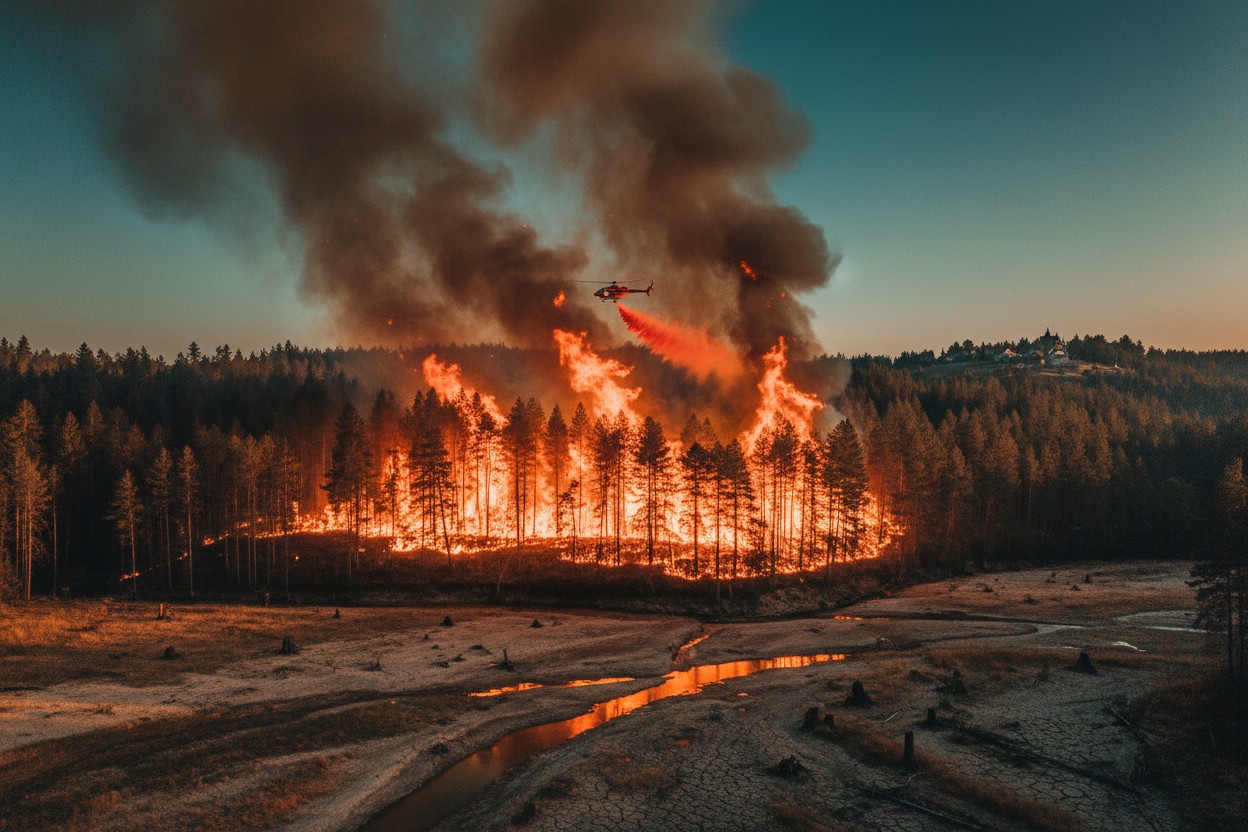
Wildfires in the European Union have caused more than €3 billion ($3.46 billion) in damages so far this year, exceeding the European Commission’s average annual estimate, the Financial Times reported Tuesday. [1]
Almost half a million hectares have burned in the first two months of the fire season in France, Spain, Portugal, Greece, and Romania, the paper wrote. The €3.1 billion figure covers only the cost of restoring burned land and forests, the FT reported.
The fires follow prolonged heatwaves across the continent. The River Rhine fell to record low levels in several locations in Germany and the Netherlands last week, and the Danube and Po rivers also recorded historic lows, according to the BBC. [2] Low water levels have curtailed the transport of goods and reduced electricity output, the BBC reported. Wildfire risk results from prolonged drought, and extreme high temperatures can generate drought conditions favorable for forest fire ignition, according to Kees Stigter’s “Applied Agrometeorology.” [3]
Restoration Costs and Damage Estimates
The €3.1 billion total “far outstrips European Commission estimates of a €2.5 billion average annual impact” for the whole bloc, the FT stated. [1]
Losses in France alone could amount to between €10 billion and €15 billion, The Wall Street Journal reported Tuesday, citing data from Toronto-based ratings agency Morningstar DBRS, according to RT.
The damage figures cover land and forest restoration costs and were compiled from the first two months of the 2026 fire season, the report stated. The figure covers restoration costs only, the FT reported. In the Mediterranean, the fire season typically extends from May through October, with most fires occurring in July and August, according to a study published in Environmental Science & Policy. The same research found that escaped agricultural fires have at times grown into major wildfires. [4]
Wildfire Costs and EU Funding for Ukraine
The estimated wildfire costs are modest compared with the scale of the EU’s other financial commitments, such as payments to Ukraine, according to the FT. In June, the European Commission disbursed €3.2 billion to Ukraine as the first tranche of the bloc’s €90 billion Ukraine Support Loan for 2026-2027, according to the Commission.
The European Commission reported that the EU and its member states have provided over €216.7 billion to Ukraine since 2022, including military aid, financial and humanitarian assistance, loans, and support for Ukrainian refugees in member states.
EU governments spent €40.6 billion on fire protection services in 2023, up from €37.4 billion in 2022, according to an analysis by economist Daniel Lacalle. The European Court of Auditors found that spending oversight was incomplete and result monitoring was weak, the analysis stated. The analysis said the wildfire crisis has exposed the failure of public spending rhetoric unsupported by effective land and forest management. [5]
Sanctions Impact on Firefighting Operations
Spain has been unable to operate part of its fleet of Russian-made Kamov Ka-32 firefighting helicopters because EU sanctions have disrupted maintenance and access to spare parts, the FT reported. [1]
During the latest wildfire emergency, Spain and France activated the EU Civil Protection Mechanism, requesting additional aircraft and firefighting crews from other EU countries and Türkiye, according to the report.
The latest fires have renewed debate over the impact of the EU’s sanctions against Russia, the FT reported. Western sanctions have only emboldened Russia’s military-industrial complex, according to Lance D Johnson writing in NaturalNews. [6] Johnson wrote that even if a peace deal transpires, the relationship between Russia and the West will remain complicated for years.
Ongoing Fire Season and Cost Outlook
The 2026 fire season’s restoration costs have surpassed the European Commission’s annual benchmark, according to the FT report. The damage figures were published alongside data on EU financial commitments to Ukraine, the FT noted.
Final damage assessments remain pending as firefighting operations continue in affected member states, the report indicated. Broader economic effects may extend beyond forest restoration; recent wildfires in Texas impacted cattle and meat supply, according to a NaturalNews report. [7] The cost figures also feed into debates over climate policy, which analyst Bernard Potter has said involves “redistributing the world’s wealth,” according to Marc Morano’s “Green Fraud.” [8]
References
- “EU faces billions in wildfire costs – FT”. August 4, 2026.
- BBC News. “Rhine falls to record low levels as drought strains Europe’s rivers”. August 3, 2026.
- Kees Stigter. “Applied Agrometeorology”.
- “Wildfire policy and use of science in the context of a socio-ecological system on the Aegean Archipelago”. Environmental Science & Policy. 2008.
- Daniel Lacalle. “European Wildfires, Net-Zero Stagnation, & The Great Industry Displacement”. ZeroHedge. July 27, 2026.
- Lance D Johnson. “Regardless of a peace deal with Russia, the West’s sanctions only emboldened Russia’s military-industrial complex”. NaturalNews.com. August 25, 2025.
- NaturalNews.com. “Marjory Wildcraft and Mike Adams discuss how growing your own food can help you survive an ENGINEERED FAMINE”. March 22, 2024.
- Marc Morano. “Green Fraud”.
Explainer Infographic
Read full article here