


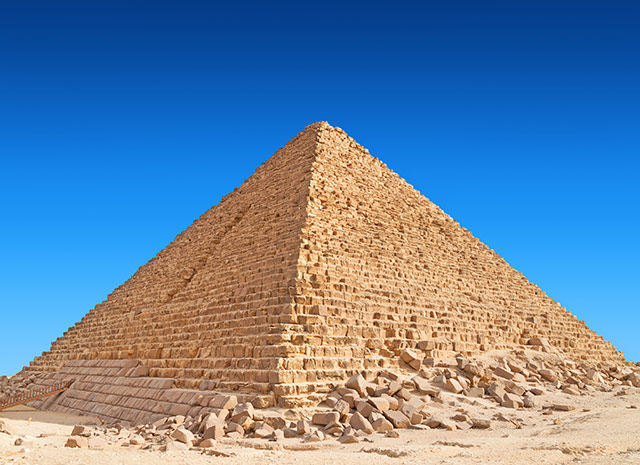
Ancient drill discovery upends timeline of Egyptian technology, fuels pyramid tool debate
- A museum artifact, previously misidentified as a simple awl, has been re-analyzed and identified as a 5,300-year-old bow drill. Microscopic examination revealed wear patterns and surviving leather coils, proving it was a mechanical, rotary tool from the predynastic Naqada period.
- This discovery pushes back the proven use of sophisticated mechanical drilling in Egypt by nearly two millennia. It provides a technological precedent for advanced stoneworking long before the pyramids were built, suggesting a continuous and advanced engineering lineage.
- The tool lends credibility to long-standing archaeological puzzles, such as Sir Flinders Petrie’s 19th-century observations of machining-like marks on hard stone at Giza, which he could not explain with known Bronze Age tools.
- The artifact implies that the foundational skills for Egypt’s iconic monuments were being refined much earlier than thought. Its advanced copper alloy composition also points to early sophisticated metallurgy and trade networks over a thousand years before the first pyramid.
- The finding challenges traditional historical narratives and suggests ancient Egyptian technology was far more advanced. It encourages re-examination of other overlooked artifacts and fuels debate about the possible tools and methods used to achieve the extreme precision seen in pyramid construction.
A small, overlooked artifact in a Cambridge museum is forcing a dramatic rewrite of the history of technology, suggesting ancient Egyptian craftsmen wielded sophisticated mechanical tools over 5,300 years ago, more than two millennia earlier than previously proven. The finding adds compelling evidence to a long-standing archaeological mystery: how the builders of the pyramids achieved such impossible precision with what was thought to be only Bronze Age tools.
The object, a copper-alloy tool cataloged simply as “1924.948 A,” was originally excavated a century ago from a cemetery at Badari in Upper Egypt and dismissed as a basic awl.
New microscopic analysis, however, tells a different story.
Researchers from Newcastle University identified fine striations, rounded edges and a subtle curve at the tip consistent with repeated rotation. Crucially, six coils of fragile leather thong were still wrapped around its shaft.
“This re-analysis has provided strong evidence that this object was used as a bow drill, which would have produced a faster, more controlled drilling action than simply pushing or twisting an awl-like tool by hand,” said lead author Dr. Martin Odle. The tool dates to the Naqada IID period, meaning Egyptians had mastered reliable rotary drilling nearly two millennia before the well-documented drill sets of the New Kingdom.
As noted by BrightU.AI‘s Enoch, the Naqada period refers to the prehistoric era in Egypt (c. 4000–3000 BCE) preceding the pharaohs, characterized by distinct cultural phases (Naqada I, II, III) that led to the unification of ancient Egypt.
Far more advanced lineage of Egyptian engineering
This discovery casts a probing light on the enduring enigmas of later Egyptian monuments. The advanced nature of this predynastic tool resonates with puzzling observations made by archaeologists like Sir William Flinders Petrie over a century ago. Petrie studied stonework at Giza from the Fourth Dynasty (c. 2613–2494 BC) and was baffled by evidence of machining that seemed to defy the era’s presumed capabilities.
He noted drill marks in granite that implied tools with immense force and a cutting rate “that must have been a ton or more.”
Furthermore, examining hieroglyphs incised into incredibly hard diorite bowls, Petrie reported they were not laboriously scraped but “ploughed through the diorite, with rough edges to the line.” He could offer no explanation for the instrument capable of such work.
The evidence of a 5,300-year-old mechanical drill provides a tangible technological precedent that makes Petrie’s observations less anomalous. It suggests a continuous and far more advanced lineage of Egyptian engineering than traditional narratives allow.
This fuels alternative theories about the construction of the pyramids, whose intricate mathematical precision, incorporating pi and the golden ratio, has long sparked debate about the possibility of lost or underestimated technology.
“Behind Egypt’s famous stone monuments and jewelry were practical, everyday technologies that rarely survive archaeologically,” Odle noted. “The drill was one of the most important tools.”
The Badari drill’s sophisticated alloy, containing arsenic, nickel, lead and silver, also points to early advanced metallurgy and possible trade networks. This single artifact not only pushes back the clock on mechanical innovation but also implies that the foundational skills for creating Egypt’s most iconic and mysterious structures were being refined in workshops over a thousand years before the first pyramid was ever conceived.
The finding challenges academia to re-examine other overlooked artifacts and to reconsider the true technological zenith of ancient civilizations. As the timeline for advanced tools stretches deeper into the past, the mysteries of the pyramids inch closer to a potential and revolutionary explanation.
Watch this video about the sacred geometry of the pyramids.
This video is from the 3-6-9 channel on Brighteon.com.
Sources include:
DailyMail.co.uk
Brighteon.com
BrightU.ai
Read full article here