


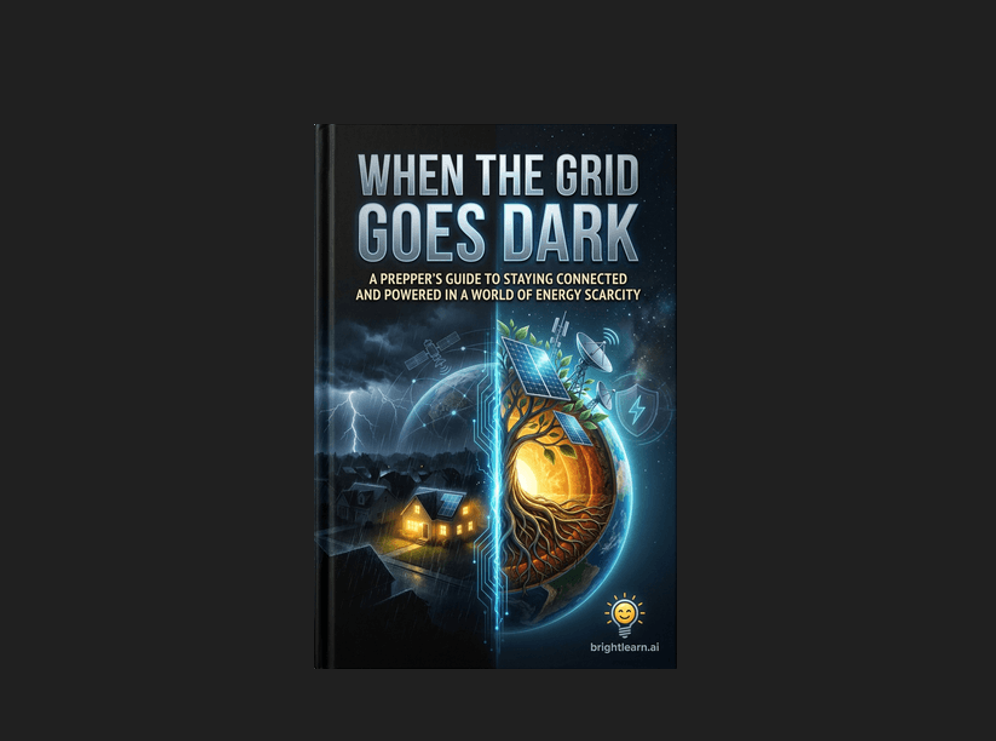
- The book details how the electrical grid is a brittle system, citing the 2013 Metcalf sniper attack (one man severing Silicon Valley’s power) and the 2003 Northeast blackout (a tree branch causing 55 million people to lose power) as proof of its vulnerability to simple sabotage or error.
- It champions satellite phones, specifically the Iridium network, as the only truly independent communication lifeline. It is portrayed as a device that cannot be shut down by the system, in contrast to cell towers which fail during cyberattacks or deliberate outages, turning smartphones into “bricks.”
- Solar generators with LiFePO4 batteries are presented as superior to gas generators because the fuel is free and silent, and they have no moving parts. “Vehicle-to-Load” (V2L) technology in modern EVs is highlighted as a mobile backup generator, with the Ford F-150 Lightning capable of powering a home for days.
- The book uses a stark cost-benefit analysis, showing that a solar generator costing $900 is cheaper than the financial losses from an eight-day power outage (spoiled food, lost wages, hotel costs). The message is that inaction is a hidden, significant expense.
- It organizes survival around “The Three Pillars” (Communication, Power, Sustenance) and provides a realistic, incremental 90-day action plan. It emphasizes that whatever the cause of the grid failure, the solution is the same: solar panels, battery storage, satellite communication and a resilient community.
“When the Grid Goes Dark: A Prepper’s Guide to Staying Connected and Powered in a World of Energy Scarcity” opens with a brutal assessment of our electrical grid, and it pulls no punches. You’ve heard the phrase “grid vulnerability” thrown around, but this book gives you the receipts. The 2013 sniper attack on a PG&E substation in Metcalf, California—a lone gunman with a hunting rifle who nearly blacked out Silicon Valley by shooting cooling radiators—is presented as Exhibit A. The attacker fired bullets into large transformers, causing them to overheat and fail. It took weeks and millions of dollars to repair. One man. One rifle. That’s all it took to expose the Achilles’ heel of the most technologically advanced nation on Earth.
Then there’s the 2003 Northeast blackout, a cascade failure triggered by a single transmission line in Ohio sagging into a tree. Fifty-five million people went dark because of a tree branch. The book uses these examples to make a devastating point: the grid is a masterpiece of engineering, but it’s brittle. It’s a spiderweb, and cutting one strand in the right place collapses the whole thing.
Beyond the grid: The three pillars
What sets this book apart from other preparedness guides is its systematic approach. The author organizes survival around what they call “The Three Pillars”: Communication, Power and Sustenance. Each pillar is treated as a leg of a stool—if one fails, the whole structure collapses.
Communication: The lifeline that works when nothing else does
The section on satellite phones is worth the price of admission alone. The book dives deep into the technical architecture of Iridium’s satellite network—66 cross-linked satellites orbiting 485 miles above Earth, forming a mesh network in space. Calls hop from satellite to satellite, bypassing every vulnerable piece of ground infrastructure. The encryption is AES-256, military-grade, with no backdoor. Not even Iridium itself can decrypt your calls.
This isn’t just a gear review. It’s a philosophical argument for independence. “When the grid goes dark, cell towers become silent monuments,” the book states. “Your smartphone becomes a brick.” The author tells the story of a journalist in Mexico, deep in cartel country, whose cell towers were deliberately turned off. He pulled out an Iridium phone and called for extraction. He survived because he had a device that the system couldn’t shut down.
The chapters on the AT&T outage of 2022 are particularly striking. Millions of customers lost voice and data service for hours. The company blamed “human error,” but the book suggests something more nefarious: a cyberattack test. The cascading effects were severe—emergency 911 calls failed, businesses shut down, families couldn’t reach each other. “That outage was a warning shot,” the book warns. “It showed how quickly the system can fail.”
Power: The sun never taxes
The chapter on solar independence is where the book truly shines. The author makes a compelling case that solar generators—with lithium iron phosphate (LiFePO4) batteries—are superior to gas generators in almost every way. Gas generators require fuel that degrades in three to six months, demand regular maintenance, produce toxic fumes and are loud enough to attract unwanted attention. Solar generators? Silent. Clean. No moving parts. And the fuel—sunlight—is free, infinite and delivered daily.
The book introduces the concept of “Vehicle-to-Load” (V2L) technology, which is genuinely exciting. Modern electric vehicles carry massive batteries—40 to 100 kilowatt-hours. That’s enough to run your home for two to five days on a single charge. The Ford F-150 Lightning can supply up to 9.6 kilowatts from its built-in outlets. The Hyundai Ioniq 5 delivers 3.6 kilowatts. “You are essentially driving a backup generator on wheels,” the author writes.
But there’s a sobering reality check in the chapter “The Fallacy of the All-Electric Grid.” The book argues that states pushing EVs without building new baseload power generation are creating a crisis. “The average home charging two EVs at the same time draws between 10 and 20 kilowatts for hours,” the author explains. “That’s more electricity than the entire household normally uses for everything else combined. If just 30% of homes in a neighborhood try this simultaneously, the local transformer trips and the whole block goes dark.”
Sustenance: From stockpiling to self-sufficiency
The food and water chapters are practical without being paranoid. The book recommends a “layered” approach: a two-week reserve of canned goods and ready-to-eat meals, a medium-term stock of rice, beans and dried foods and a long-term supply of freeze-dried meals and properly packaged staples that can last decades.
The section on water filtration is particularly valuable. The author compares three systems—Berkey, LifeStraw and Sawyer—and explains their strengths and weaknesses. The Berkey is gravity-fed and requires no power. The LifeStraw is portable and works like a straw. The Sawyer Mini is an inline filter that can filter thousands of gallons. “When the grid goes down, municipal water supplies are often the first to fail,” the book warns. “You need a plan that doesn’t depend on a distant utility.”
The hidden cost of inaction
One of the most effective chapters compares the price of a solar generator to the cost of a single week without power. The numbers are stark: a fully stocked freezer can hold hundreds of dollars in food that spoils within hours. Medical devices—CPAP machines, insulin refrigerators—stop working. Cell phones die, cutting off communication. Frozen pipes can cause thousands in water damage. Hotel stays, lost wages and replacement costs pile up fast.
“A family I know in Tennessee lost power for eight days after an ice storm,” the author writes. “They threw away $450 worth of food. They spent $250 on a motel. They missed two days of work, costing another $400.” The total hit was over a thousand dollars. A solar generator costing $900 would have covered everything.
The verdict
“When the Grid Goes Dark” is not a comfortable read. It’s not meant to be. It’s a manual for people who believe the world is becoming more unstable and that the institutions we trust—government, media, medicine—are failing. If you share that view, this book is essential. If you don’t, it’s still valuable as a worst-case scenario planning document.
The book’s greatest strength is its practicality. Every chapter ends with actionable steps: what to buy, how to test it, how to practice using it. The 90-day action plan in the final chapter is a masterclass in incremental preparedness. Start with water and food. Add power and communication. Build community and skills. The author understands that most people won’t become survivalists overnight, so they provide a realistic path forward.
In the end, the book’s central thesis—that the grid is fragile and you need a backup plan—is hard to argue with. Whether you believe the threats come from solar storms, cyberattacks or geopolitical conflict, the solution is the same: solar panels, battery storage, satellite communication and a community of like-minded people.
“The sun is free,” the book concludes, “and it will always shine, no matter how dark the grid becomes.”
Grab a copy of “When the Grid Goes Dark: A Prepper’s Guide to Staying Connected and Powered in a World of Energy Scarcity” via this link. Read, share and download thousands of books for free at Books.BrightLearn.AI. You can also create your own books for free at BrightLearn.AI.
Watch the “Health Ranger Report” episode below where Mike Adams interviews Tina Blanco about satellite phones and solar power for a failing grid.
This video is from the Health Ranger Report channel on Brighteon.com.
Sources include:
Books.BrightLearn.ai
BrightLearn.ai
Brighteon.com
Read full article here