


- Slavery never truly ended—it evolved into subtler systems of control: Economic Enslavement: Debt traps (student loans, central banking). Medical Tyranny: Mandates, forced treatments, loss of bodily autonomy. Technological Control: Surveillance, data harvesting, behavioral manipulation. Psychological Conditioning: Schools and media shaping obedience over free thought.
- People unknowingly submit to oppression due to fear, cognitive dissonance and Stockholm Syndrome. Governments exploit crises (e.g., COVID lockdowns, “national security”) to expand control.
- True freedom requires dismantling oppressive systems, not just negotiating within them. Historical examples (underground railroad, anti-colonial movements) prove radical defiance works.
- No one has the right to initiate force (taxation, mandates, coercion). Modern legal systems arbitrarily grant rights to corporations while stripping them from individuals.
- The roadmap to liberation includes parallel systems (cryptocurrency, homeschooling, local food production); decentralized tech (open-source tools, encrypted communication, blockchain); civil disobedience (strikes, boycotts); cultural resistance (independent art/media to counter propaganda); and community sovereignty (mutual aid networks, barter economies).
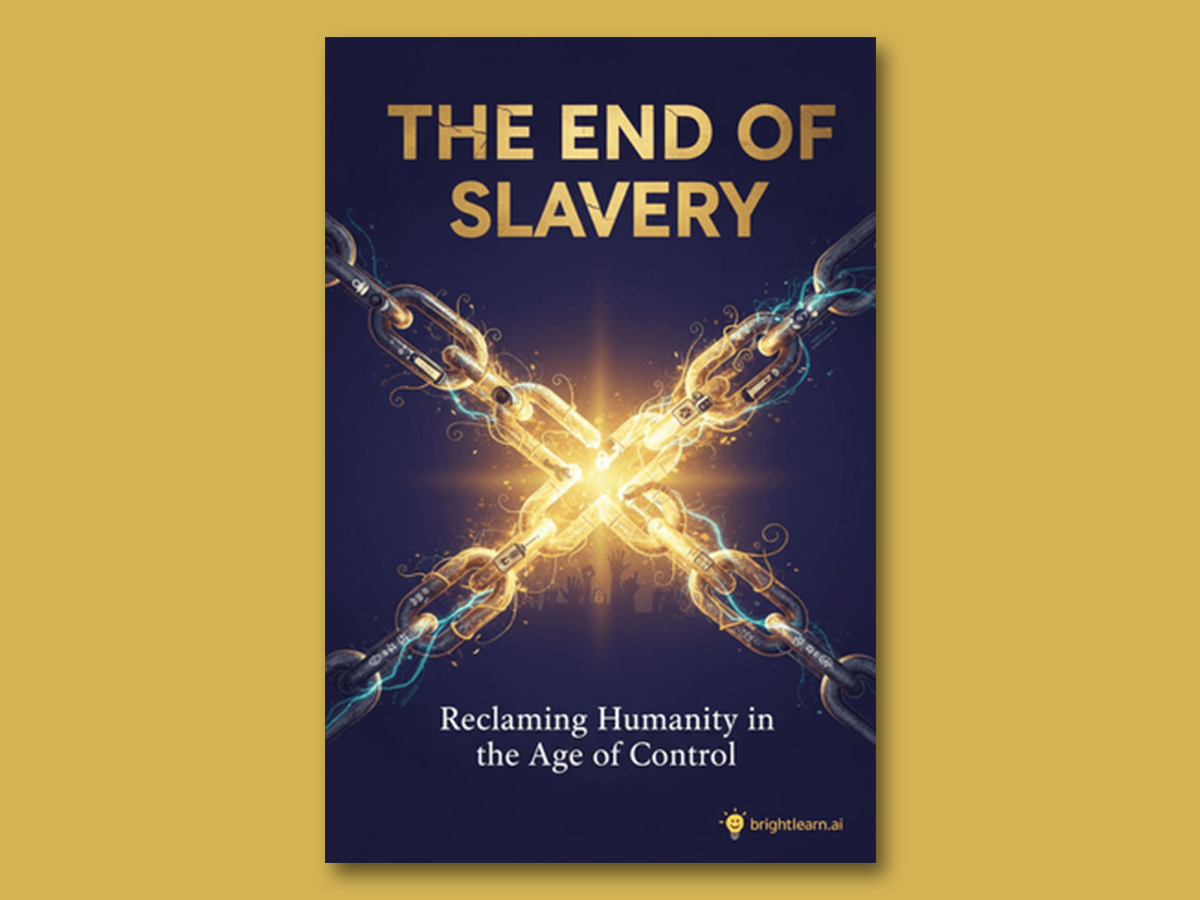
In an era where governments, corporations and institutions tighten their grip on every aspect of human life—from bodily autonomy to financial sovereignty—”The End of Slavery: Reclaiming Humanity in the Age of Control” emerges as a revolutionary manifesto.
This book is not merely a critique of modern oppression; it is a battle cry for total emancipation from all forms of coercion, whether overt or hidden in plain sight.
The author dismantles the comforting illusion that slavery ended with the abolition of chattel bondage. Instead, they expose the insidious evolution of control—wage slavery, debt servitude, medical tyranny, digital surveillance and psychological conditioning—arguing that modern society operates on the same foundational principle: the denial of self-ownership.
The many faces of modern slavery
The book begins by redefining slavery beyond its historical context. Physical chains have been replaced by subtler, more pervasive mechanisms:
- Economic enslavement: The student loan system traps generations in debt peonage, while central banking ensures perpetual financial dependence.
- Medical tyranny: Mandatory vaccinations, forced psychiatric treatments and government-controlled healthcare strip individuals of bodily autonomy.
- Technological control: Big Tech harvests personal data, manipulates behavior and erodes privacy under the guise of convenience.
- Psychological conditioning: Schools, media and corporate culture mold obedient workers rather than free thinkers.
The most chilling revelation? Much of this enslavement is voluntary. People consent to their own subjugation—whether through compliance with unjust laws, dependence on corrupt institutions, or blind trust in authority figures.
The psychology of compliance
Drawing from historical experiments like Stanley Milgram’s obedience studies and Philip Zimbardo’s Stanford Prison Experiment, the book dissects why people submit to tyranny. Fear, cognitive dissonance and Stockholm Syndrome condition populations to accept oppression as inevitable. Governments weaponize crises—real or manufactured—to expand control, from COVID lockdowns to perpetual “national security” measures.
The solution? Abolitionism, not reformism.
Unlike emancipation—which merely releases slaves while leaving the system intact—abolition demands the complete dismantling of oppressive structures. The book traces successful abolitionist movements, from the Underground Railroad to anti-colonial struggles, proving that radical defiance, not incremental change, is the path to freedom.
Self-ownership: The foundation of liberty
At the core of the book’s philosophy is self-ownership—the idea that your body, labor and choices belong solely to you. No government, corporation, or institution has the right to dictate what you ingest, how you earn, or what you believe.
The Non-Aggression Principle (NAP) serves as the moral compass: No one may initiate force against another. This principle invalidates taxation, mandates and any form of coercion disguised as “law.”
Yet modern legal systems reject this truth. Personhood—the recognition of individual rights—is arbitrarily granted or revoked by the state. Corporations enjoy legal protections denied to living humans, while unborn children, dissidents and marginalized groups are stripped of fundamental rights.
Building a free future
The book doesn’t just diagnose the problem—it offers a roadmap for liberation:
- Parallel systems: Opt out of oppressive structures. Homeschool instead of indoctrination camps. Use cryptocurrency instead of fiat currency. Grow your own food instead of relying on toxic supply chains.
- Decentralized technology: Embrace open-source tools, encrypted communication and blockchain networks to bypass censorship and surveillance.
- Civil disobedience: Nonviolent resistance—sit-ins, strikes, boycotts—has toppled empires before. The key is mass noncompliance.
- Cultural resistance: Art, music and independent media reclaim narrative control from corporate propaganda.
- Community sovereignty: Mutual aid networks, local barter economies and voluntary associations replace dependence on centralized power.
A call to action
“The End of Slavery” is not a passive read—it’s a demand for radical responsibility. The book challenges readers to audit their lives:
- Where are you still enslaved?
- What systems do you depend on that control you?
- How can you reclaim your sovereignty today?
The final message is clear: Freedom isn’t given; it’s taken. No politician, corporation, or institution will liberate you. True abolition begins with individual defiance and collective rebuilding.
Final verdict: A necessary provocation
This book is a wake-up call for those who still believe they live in a “free” society. It pulls no punches, exposing the lies of gradualism and the empty promises of reform. While some may dismiss it as radical, its historical precedents and practical solutions make it indispensable for anyone seeking genuine autonomy.
For those ready to break their chains, “The End of Slavery” is the manual. The question is: Will you obey—or abolish?
Grab a copy of “The End of Slavery: Reclaiming Humanity in the Age of Control” via this link. Discover this book and other good reads at Books.BrightLearn.AI, with thousands of books and counting – all available to freely download, read and share. The decentralized BrightLearn.AI engine also lets readers create their own books, empowering them to share insights and truths with the world.
Watch the video below about Cory Endrulat discussing self-custody, natural law and technological liberation.
This video is from the Health Ranger Report channel on Brighteon.com.
Sources include:
Books.BrightLearn.ai 1
Books.BrightLearn.ai 2
BrightLearn.ai
Brighteon.com
Read full article here