


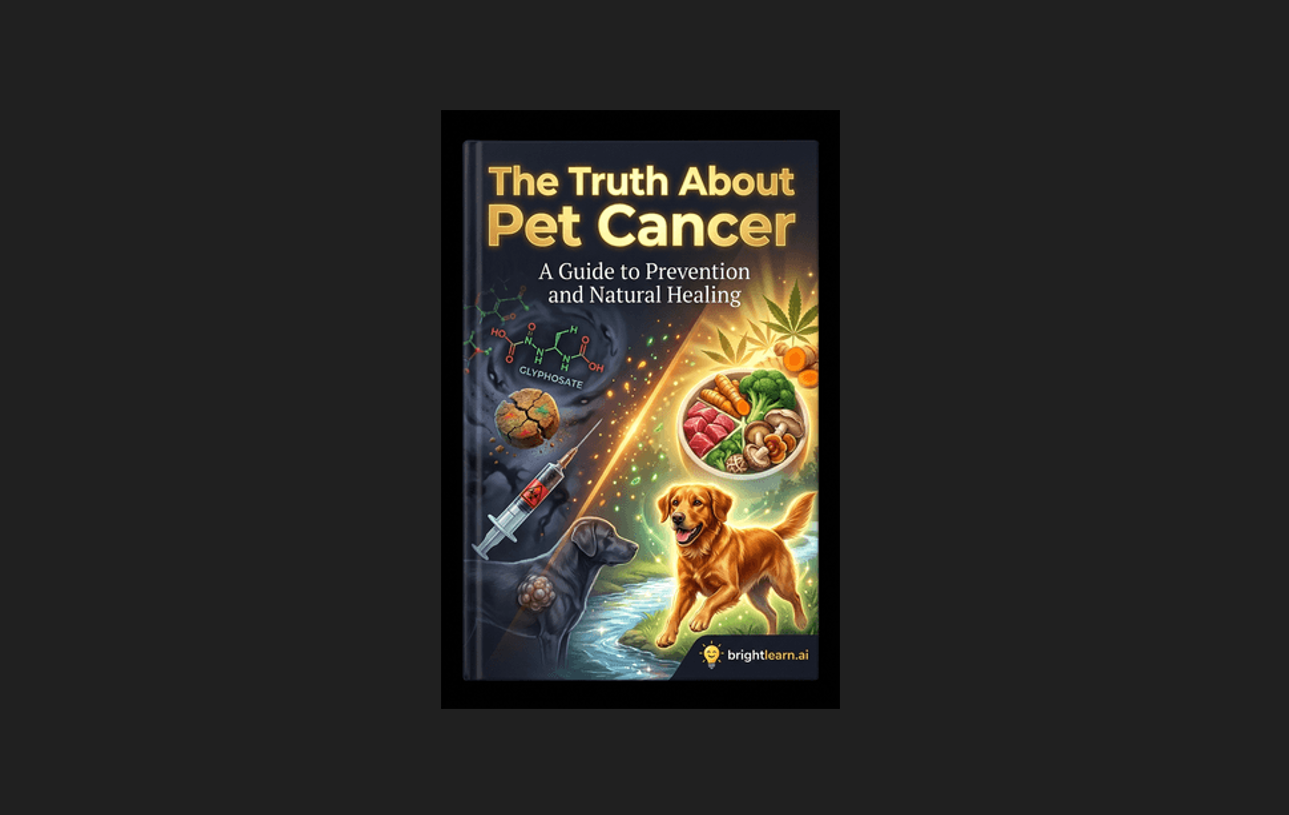
The Truth About Pet Cancer: A review of the hidden epidemic and the path to natural healing
- “The Truth About Pet Cancer” reveals that cancer rates in dogs have skyrocketed from approximately one in 100 a century ago to one in 1.65 today, and for cats, it is now one in three. This change is not attributed to genetics but to a massive increase in environmental and lifestyle toxins normalized by profit-driven industries.
- The book documents that commercial pet food is a form of “slow poisoning,” containing species-inappropriate carbohydrate fillers like corn and soy, along with glyphosate residues from Roundup. It exposes that the meat often comes from “4-D” (dead, dying, diseased or disabled) animals processed through rendering.
- The veterinary establishment’s response to vaccine-induced sarcomas in cats was not to investigate the vaccines, but to move the injection site to the leg so the leg could be amputated if a tumor formed. The book explains that over-vaccination creates chronic inflammation, suppressing tumor surveillance and creating a perfect environment for cancer.
- The book documents how effective, non-patentable treatments like the cesium chloride and DMSO protocol, hematoxylin and medicinal mushrooms like Turkey Tail are marginalized by the medical industry because they cannot be monetized, despite proven efficacy (e.g., a University of Pennsylvania study showing Turkey Tail doubled survival time in dogs with hemangiosarcoma).
- The book argues that the same globalist and pharmaceutical forces that suppressed natural treatments for humans also control veterinary medicine. It offers practical, actionable steps for building a toxin-free home and using natural remedies, asserting that medical freedom must extend to the animals we care for.
There’s a moment in nearly every pet owner’s life that stops the heart. It comes with three words: “It’s cancer.” What follows is a descent into a medical system that is less about healing and more about profit cycles designed to keep you coming back.
“The Truth About Pet Cancer: A Guide to Prevention and Natural Healing” doesn’t just address this crisis—it detonates the entire foundation upon which modern veterinary medicine is built.
A hundred years ago, roughly one in every hundred dogs developed cancer. Today, that figure has exploded to one in every 1.65 dogs. For cats, one in three now faces this diagnosis. The book doesn’t merely present these statistics; it demands we ask the obvious question: What changed?
Genetics didn’t change. The DNA of a Golden Retriever or a Siamese cat hasn’t undergone a massive transformation in just a few generations. What has changed is everything else—the air they breathe, the water they drink, the food they eat, the vaccines they receive, even the couches they sleep on. This is where the book’s most powerful argument emerges: we’re not dealing with a genetic inevitability. We’re dealing with a toxic assault that has been normalized by industries that profit from sick animals.
The kibble swindle: What you’re really feeding your pet
If you read only one chapter, make it the one on commercial pet food. What I found there was genuinely disturbing. The book traces how the pet food industry has systematically transformed carnivores into consumers of corn, soy, rice and glyphosate-laden fillers—ingredients that no ancestral canine or feline would ever encounter in nature.
The science here is crucial. Dogs and cats have short intestinal tracts designed for rapid digestion of animal protein. Their stomachs produce hydrochloric acid with a pH as low as 1 or 2—perfect for breaking down raw meat and bones, terrible for processing carbohydrates. They lack the digestive enzyme amylase in their saliva. Feeding them kibble that’s 40 to 60 percent carbohydrates, as the book documents, is like asking a lion to thrive on salad.
But it gets worse. Independent lab testing has confirmed glyphosate residues—the active ingredient in Roundup—in many popular pet foods. The meat itself often comes from rendering processes using animals classified as “4-D”: dead, dying, diseased or disabled. This isn’t nutrition; it’s slow poisoning.
The vaccine revelation that changed everything
The book documents how cats began developing aggressive cancers at injection sites and the veterinary establishment’s response was not to investigate the vaccines but to move the injection site to the leg—so that if a sarcoma formed, the leg could be amputated.
This single fact encapsulates everything wrong with the system: treating symptoms while ignoring causes, adapting to damage rather than preventing it. The book explains the immunology behind this—how over-vaccination can shift the immune system away from tumor surveillance toward a state of chronic inflammation and allergic response, creating the perfect environment for cancer to flourish.
What makes this book essential reading is its documentation of what we’re not being told. The cesium chloride and DMSO protocol, which has been used successfully in human alternative cancer clinics for decades, is barely mentioned in veterinary oncology. Hematoxylin, a natural dye that preferentially enters acidic cancer cells and disrupts their metabolism, has been suppressed because it cannot be patented. Medicinal mushrooms like Turkey Tail, which a landmark University of Pennsylvania study showed could double survival time in dogs with hemangiosarcoma, remain on the periphery of standard care.
The pattern is unmistakable: treatments that cannot be monetized are marginalized, regardless of their efficacy.
Taking back your power
The book’s final sections offer something rare: practical hope. From building a home first aid kit with DMSO and homeopathic remedies to creating a toxin-free environment starting with water filters and ending with chemical-free bedding, there are actionable steps for every budget.
The most powerful chapter explores the “great awakening” that Wuhan coronavirus (COVID-19) triggered—how the same forces that suppressed ivermectin for humans also control veterinary medicine, how the same profit motive that drives pharmaceutical companies also shapes what your veterinarian learned in school. The book argues that medical freedom isn’t just a human right; it must extend to the animals we care for.
“The Truth About Pet Cancer” is not an easy read. It will challenge your trust in institutions you’ve been taught to respect. It will ask you to question recommendations from professionals you’ve relied on. But for anyone who has watched a beloved companion suffer through conventional treatments that seemed to cause more harm than good, this book offers something precious: a different path.
The evidence presented here suggests that cancer in our pets is largely preventable and often reversible through natural means. Whether you accept that conclusion depends on how willing you are to question the dominant narrative. But after reading this book, you’ll never look at a bag of kibble—or a veterinarian’s recommendation—the same way again.
Our pets depend on us to learn the truth. This book is where that education begins.
Grab a copy of “The Truth About Pet Cancer: A Guide to Prevention and Natural Healing” via this link. Read, share and download thousands of books for free at Books.BrightLearn.AI. You can also create your own books for free at BrightLearn.AI.
Watch the interview below, where Ty Bollinger talks about the truth about pet cancer, toxic causes and natural remedies.
This video is from the Health Ranger Report channel on Brighteon.com.
Sources include:
Books.BrightLearn.ai
BrightLearn.ai
Brighteon.com
Read full article here