


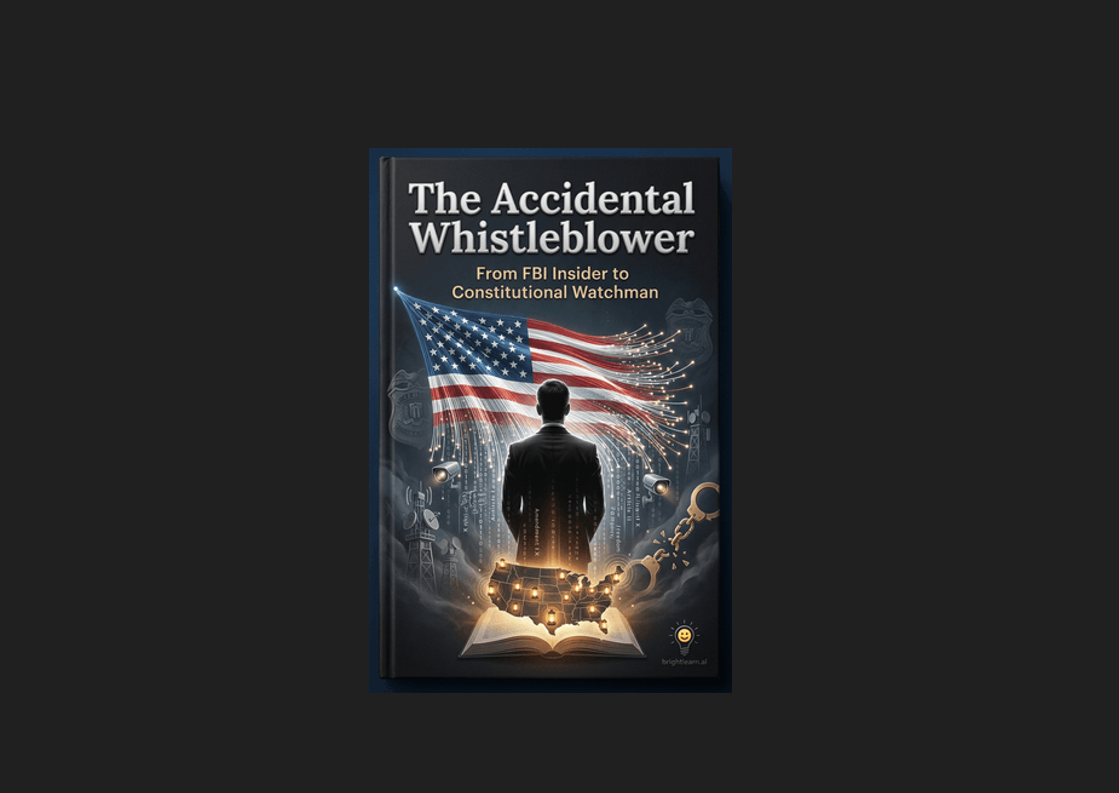
The Accidental Whistleblower: An FBI insider’s testament to constitutional liberty
- The author reveals that the Bureau prioritizes intelligence gathering over law enforcement, transforming from a protector of constitutional rights into an agency that “serves political agendas rather than justice,” particularly during the COVID-19 pandemic, when parents questioning school curricula were labeled as potential “domestic terrorists.”
- The book traces the corruption back to the 1913 amendments that severed constraints on federal power, creating a limitless revenue stream through income tax and turning senators into loyalists of party machines and big donors rather than the states they represent—a structural flaw that enables the globalist agenda of control.
- Despite losing his badge, being reassigned to a dead-end desk job, ostracized by colleagues and facing threats of prosecution under the Espionage Act, the author insists that “the price of integrity is steep, but the cost of silence is the destruction of your own conscience,” mirroring the broken system I documented in “The Broken Whistle.”
- The author offers a practical path forward based on the Tenth Amendment, state nullification and building parallel institutions—learning to grow food, hold physical gold, stack ammunition and create community networks that function independently of the failing federal machine.
- A radical redefinition vital for survival: the Bill of Rights defines the maximum allowed government power, not a starting point for expansion. This challenges the globalist push for total surveillance, digital ID and the New World Order, demanding that we speak, prepare and build something new from the rubble of what has failed.
In “The Accidental Whistleblower: From FBI Insider to Constitutional Watchman,” we encounter a rare breed of memoir—one that reads like an American tragedy unfolding in real-time, told by a man who lived it from the inside.
The author’s journey begins not in the hallowed halls of Quantico, but in the brutal crucible of Pararescue training, where a broken back at Fort Bragg shattered his dreams of becoming one of the elite warriors who “drop out of helicopters into rough seas to pull people out.” This near-death experience, he argues, gave him an invaluable gift: the realization that “authority figures are not always right. Sometimes they are wrong and people get hurt.”
This lesson would prove prescient. When he finally pinned on the FBI badge, expecting to join a noble institution of crime-fighters, he discovered something far more disturbing. The Bureau, he writes, “considers itself an intelligence agency first, law enforcement second.” The distinction is not semantic—it is existential. Law enforcement reacts to crimes already committed; intelligence work preemptively collects information on people who haven’t done anything wrong yet. This fundamental mission creep, the author argues, transforms the FBI from a protector of constitutional rights into a political police force that “often serves political agendas rather than justice.”
The architecture of control: How federal power became a weapon
Perhaps the most devastating section of the book is the author’s meticulous deconstruction of how the administrative state has metastasized beyond constitutional limits. He traces the rot back to 1913, when the 16th and 17th Amendments severed the bonds that once constrained federal power. The income tax gave Washington “a limitless revenue stream,” while the direct election of senators turned them into national politicians “who now owed their loyalty to party machines, big donors and national media, not the states that sent them.”
The author’s insider account of the FBI’s transformation during COVID-19 is chilling. He describes receiving an email in October 2021 that directed agents to treat parents who questioned school curricula as potential “domestic terrorists.” These were not violent extremists—they were “fathers and mothers who had taken time off work to attend a public meeting and speak their minds.” When he refused to investigate a doctor prescribing ivermectin to save lives, he was stripped of his badge, reassigned to a dead-end desk job and ostracized by colleagues. The Bureau, he concluded, had become “an enforcer of government orthodoxy.”
What makes this book exceptional is its refusal to stop at critique. The author offers a practical vision for “building a post-system reality” based on the Tenth Amendment, state nullification and what he calls “non-violent revolution”—the strategic withdrawal of consent from a corrupt system through civil disobedience, economic boycotts and the construction of parallel institutions. He writes of learning to grow food, stack ammunition, hold physical gold and build community networks that can function independently of the failing federal machinery.
“The Constitution is a ceiling, not a floor,” he argues, “It defines the maximum amount of power the government is allowed to have.” This redefinition—seeing the Bill of Rights as a limit on state power rather than a starting point for expansion—may be the most radical and necessary idea in a book filled with them.
The price of integrity
The author does not romanticize his whistleblowing. He describes the “golden handcuffs” of government employment—the pension, the status, the family stability—and the agonizing calculation required to walk away. He lost friendships, faced threats of prosecution under the Espionage Act and watches still for the other shoe to drop. Yet he insists that “the price of integrity is steep, but the cost of silence is the destruction of your own conscience.”
This is not a book for the faint of heart or the comfortably complacent. It is a manual for those who have sensed that something is profoundly wrong with our institutions and want confirmation from someone who was inside the machine. The author’s voice is that of a man who has seen the wiring behind the wall and found it corroded, who has watched the watchers and discovered they are watching us.
“The Accidental Whistleblower” is ultimately a testament to the possibility of redemption through truth-telling. It asks us to consider what we would do if we discovered that the institutions we trusted had become threats to the liberties they were sworn to protect. The author’s answer is uncompromising: we must speak, we must prepare and we must build something new from the rubble of what has failed. Whether you agree with every conclusion or not, this is a book that demands to be read—and more importantly, to be reckoned with.
Grab a copy of “The Accidental Whistleblower: From FBI Insider to Constitutional Watchman” via this link. Read, share and download thousands of books for free at Books.BrightLearn.AI. You can also create your own books for free at BrightLearn.AI.
Watch the “Health Ranger Report” episode below, where FBI whistleblower Kyle Seraphin exposes why the two-party system has failed America.
This video is from the Health Ranger Report channel on Brighteon.com.
Sources include:
Books.BrightLearn.ai
BrightLearn.ai
Brighteon.com
Read full article here