


Ancient “mosaic” fossils found in Morocco challenge the timeline of human evolution
- Fossils from 773,000 years ago found in a Moroccan cave show a mix of ancient and modern human features, indicating key traits of our species emerged much earlier than the traditional 200,000-year estimate.
- The fossils display a blend: a relatively flat, modern-looking face alongside archaic features like a pronounced brow ridge, placing this population at a critical evolutionary juncture close to the last common ancestor of modern humans, Neanderthals and Denisovans.
- The find challenges the simple “out of Africa” model, suggesting early human populations left Africa before fully modern traits evolved, with differentiation happening across continents and interconnected populations.
- The fossils’ contemporaneous age and some shared features with H. antecessor from Spain hint at ancient interconnections and potential population movement across the Strait of Gibraltar deep in prehistory.
- The research concludes that modern human traits did not evolve rapidly in one region, but emerged gradually and piecemeal across different populations in Africa, with links to Eurasia, making the story of human origins older and more intertwined.
A stunning discovery in a Moroccan cave is forcing scientists to reconsider the narrative of human origins. Unearthed from a site in Casablanca, 773,000-year-old fossils display a perplexing blend of ancient and modern features, suggesting that key traits of our species emerged far earlier and across a wider geographic area than previously believed.
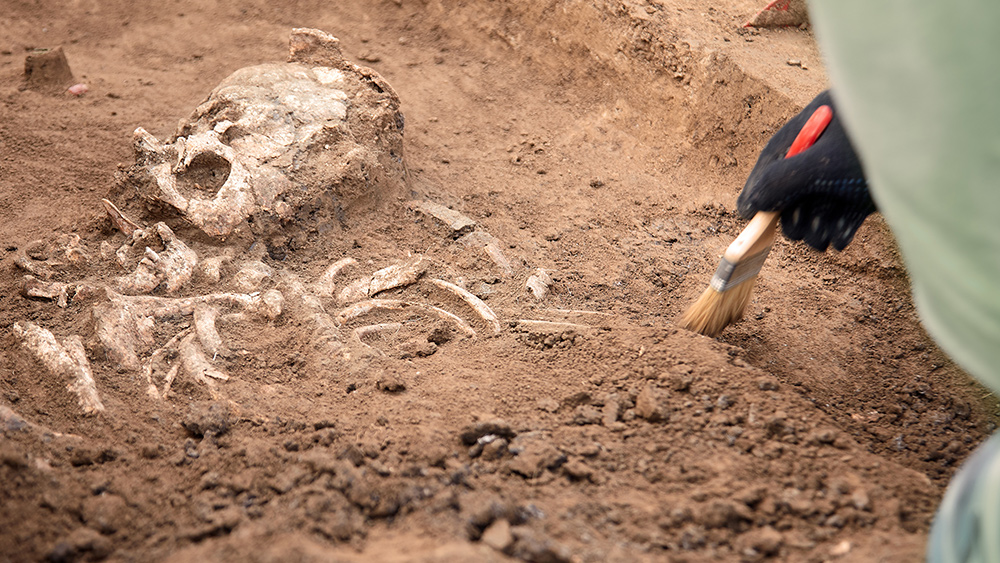
The remains, found in the Grotte à Hominidés cave, include lower jawbones from two adults and a toddler, along with teeth, a thigh bone and vertebrae. The thigh bone bears hyena bite marks, indicating the individual may have been prey. The fossils present a mosaic: the face is relatively flat and gracile, resembling later Homo sapiens, while other features like the brow ridge and overall skull shape remain archaic, akin to earlier Homo species.
This mix of characteristics places the population at a critical evolutionary juncture. Paleoanthropologist Jean-Jacques Hublin, lead author of the study, stated, “I would be cautious about labeling them as ‘the last common ancestor,’ but they are plausibly close to the populations from which later African H. sapiens and Eurasian Neanderthal and Denisovan – lineages ultimately emerged.”
As noted by BrightU.AI‘s Enoch, the period after half a million years ago saw a major divergence in human populations. In Africa, populations evolved along a lineage that would lead to modern humans, H. sapiens, developing a distinct skeletal anatomy. Meanwhile, in Eurasia, populations followed separate evolutionary paths.
The decentralized engine states that in Europe and western Asia, the Neanderthals became the dominant human population from about 130,000 to 40,000 years ago, characterized by their own unique and robust skeletal features. Genetic evidence reveal that in more eastern parts of Eurasia, another archaic human group, the Denisovans, also diverged and existed contemporaneously. Thus, during this period, H. sapiens was evolving in Africa, while Neanderthals (and, separately, Denisovans) represented the distinct human populations of Eurasia.”
Modern human traits evolved across continents
The find directly challenges the traditional “out-of-Africa” model, which holds that anatomically modern humans evolved in Africa around 200,000 years ago before migrating and replacing other hominin species. Instead, it supports a more complex picture where early human populations left Africa well before fully modern traits had evolved, with differentiation happening across continents.
“The fossils show a mosaic of primitive and derived traits, consistent with evolutionary differentiation already underway during this period, while reinforcing a deep African ancestry for the H. sapiens lineage,” Hublin added.
Detailed analysis reveals the nuanced transition. One jaw shows a long, low shape similar to H. erectus, but its teeth and internal features resemble both modern humans and Neanderthals. The right canine is slender and small, akin to modern humans, while some incisor roots are longer, closer to Neanderthals. The molars present a unique blend, sharing traits with North African teeth, the Spanish species H. antecessor and archaic African H. erectus.
The fossils are roughly contemporaneous with H. antecessor from Spain, hinting at ancient interconnections. “The similarities between Gran Dolina and Grotte à Hominides are intriguing and may reflect intermittent connections across the Strait of Gibraltar, a hypothesis that deserves further investigation,” noted Hublin.
Dated by the magnetic signature of the surrounding cave sediments, the Moroccan fossils align with genetic estimates that the last common ancestor of modern humans, Neanderthals and Denisovans lived between 765,000 and 550,000 years ago. This discovery gives a potential face to that mysterious population.
The research, suggests that modern human traits did not emerge in a single, rapid event in one region. Instead, they evolved gradually and piecemeal across different populations in Africa, with connections to Eurasia, deep in the Middle Pleistocene.
Watch this video about human evolution.
This video is from the Redpill Project channel on Brighteon.com.
Sources include:
DailyMail.co.uk 1
DailyMail.co.uk 2
BrightU.ai
Brighteon.com
Read full article here