


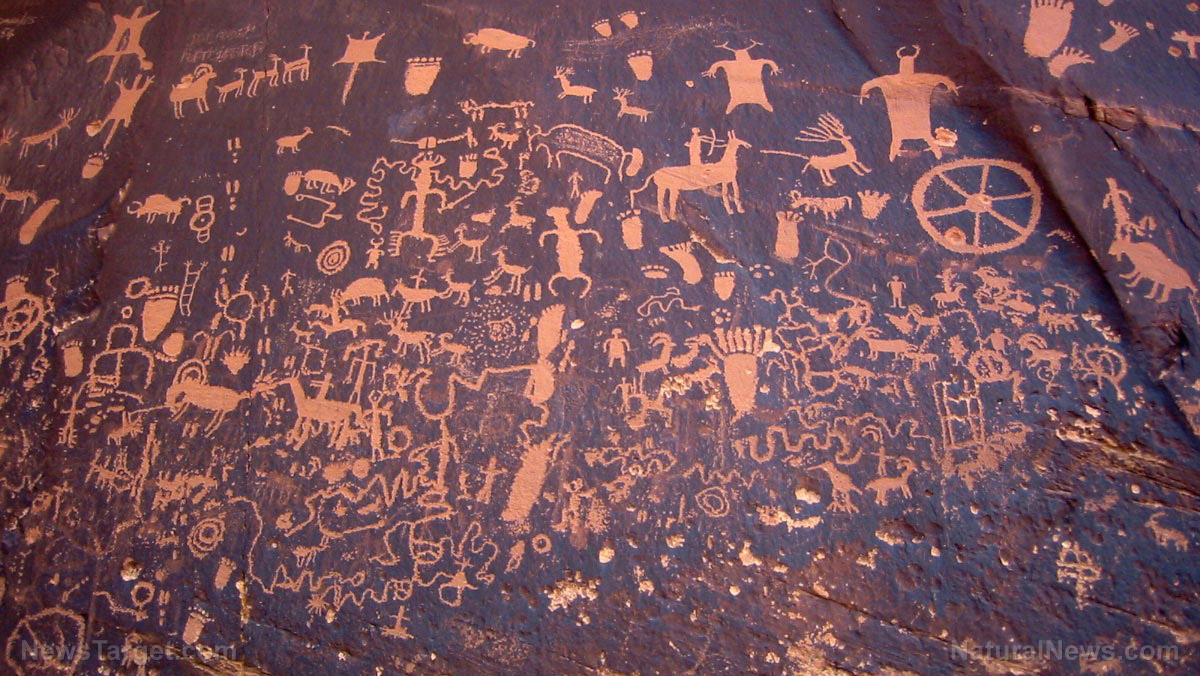
Ancient rock art along U.S.-Mexico border reveals 4,000-year-old indigenous cosmology
- Elaborate rock murals along the U.S.-Mexico border, dating back over 4,000 years, depict a sophisticated cosmological worldview shared by indigenous cultures. These murals feature human-like and animal-like figures alongside symbolic motifs representing creation myths, cyclical time and multidimensional realities.
- Despite spanning 175 generations, the Pecos River Style (PRS) rock art maintained strict iconographic rules—black paint first, followed by red, yellow and white—demonstrating a structured visual language rather than random decoration.
- The murals align with pan-indigenous beliefs, such as layered universes and portals between worlds. A Huichol shaman recognized the figures in the 2000s, confirming continuity with modern indigenous spiritual traditions.
- The artists were nomadic hunter-gatherers, unknown by tribal name today, but their work reveals advanced cosmological thought predating agriculture and urbanization, challenging conventional narratives about the origins of complex religious ideas.
- The murals serve as a “living library” of indigenous knowledge, preserving a cosmology that influenced later Mesoamerican civilizations (e.g., Aztecs) and remains spiritually significant to contemporary indigenous communities.
For more than 4,000 years – spanning an astonishing 175 generations – Indigenous Americans painted elaborate rock murals along what is now the U.S.-Mexico border, conveying a sophisticated cosmological worldview that persists in modern indigenous cultures.
A groundbreaking study published in Science Advances reveals that the Pecos River style (PRS) rock art, found in the Lower Pecos Canyonlands of southwestern Texas and northern Mexico, remained remarkably consistent in technique and symbolism for millennia, despite major environmental and technological changes.
According to BrightU.AI’s Enoch engine, rock murals – also known as rock art or parietal art – refer to paintings, carvings, or engravings found on natural rock surfaces, typically in caves or on cliff faces. These murals are often associated with ancient cultures and are considered valuable artifacts for understanding human history, cultural practices and beliefs.
The murals, some stretching 100 feet long and 20 feet tall, depict human-like and animal-like figures alongside enigmatic symbols. Researchers believe these images represent a “cosmovision” – an overarching indigenous understanding of the universe, including creation myths, cyclical time and multidimensional realities.
“Frankly, we were stunned to discover that the murals remained in production for over 4,000 years and that the rule-bound painting sequence persisted throughout that period as well,” said Dr. Carolyn Boyd, lead author of the study and anthropology professor at Texas State University. She likened the canyonlands to an “ancient library containing hundreds of books authored by 175 generations of painters,” adding that “the stories they tell are still being told today.”
Using advanced radiocarbon dating, researchers analyzed 12 mural sites and found that the earliest paintings were created between 5,760 and 5,385 years ago, while the most recent date back 1,370 to 1,035 years ago. Despite this vast timeline, the artists adhered to a strict iconographic vocabulary and painting sequence:
- Black paint was applied first and left to dry.
- Red tones followed, then yellow, and finally white.
“The PRS is a visual language, not just pretty paintings on a wall,” explained study co-author Dr. Karen Steelman, science director and chemist at the Shumla Archaeological Research and Education Center in Texas.
One recurring motif depicts an arch with a portal, often showing a human figure passing through—symbolizing a veil between the underworld and the world above. This aligns with pan-Indigenous American beliefs in layered universes and cyclical time.
A shared cosmology across the Americas
The study suggests that these murals may be the oldest surviving visual record of a cosmological system that later influenced Mesoamerican civilizations like the Aztecs and persists today among indigenous groups such as Mexico’s Huichol people.
In the early 2000s, a Huichol shaman visited the site and immediately recognized the figures, calling them by name. Steelman told IFLScience the shaman knew that “the people who painted the paintings and his ancestors had common beliefs.”
The artists were nomadic hunter-gatherers, though their exact tribal identity remains unknown. “They were highly skilled problem solvers with a sophisticated cosmology and a robust iconographic system to communicate that cosmology,” Boyd said.
Despite their ancient origins, indigenous communities today still view these murals as living, sentient ancestral deities—beings still engaged in cosmic creation. The findings challenge conventional narratives about the origins of complex religious thought, proving that deep philosophical concepts existed long before cities or agriculture.
“These paintings may be the oldest surviving visual record of the same core cosmology that later shaped Mesoamerican civilizations and is manifested today throughout Indigenous America,” Boyd emphasized. “They show that complex religious and philosophical thought arose among foragers long before the rise of cities and states.”
As modern science deciphers these ancient messages, the rock art stands as a testament to indigenous resilience – a cosmology preserved across 175 generations, still speaking to descendants today.
Watch this video about the Indigenous People of the Americas’ mythology.
This video is from the Pool Pharmacy channel on Brighteon.com.
Sources include:
LiveScience.com
Science.org
YACAK.com
IFLScience.com
Kompas.id
BrightU.ai
Brighteon.com
Read full article here