


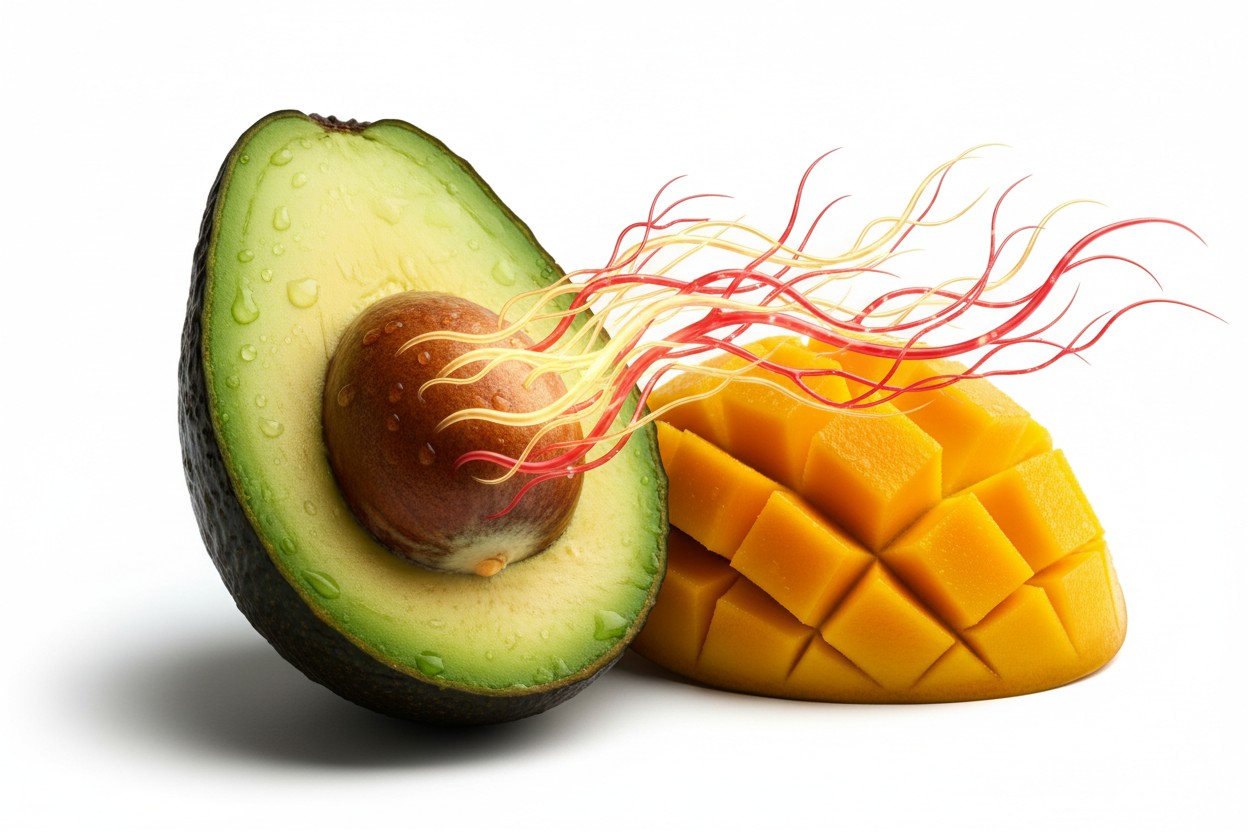
Study: Avocado-Mango Combination May Improve Vascular Markers in Prediabetic Adults
Study Finds Fruit Pairing May Aid Heart Health in At-Risk Group
A dietary intervention trial has found that adding avocado and mango to daily meals may improve vascular function in adults with prediabetes, a condition linked to heightened cardiovascular risk.
The study, published in February in the Journal of the American Heart Association, involved 82 prediabetic adults and was conducted over eight weeks. Researchers reported that participants who consumed one cup each of avocado and mango daily saw measurable improvements in a key indicator of artery health.
Prediabetes significantly increases the risk for cardiovascular diseases, which claim nearly one million lives annually in the United States. According to cited reports, an estimated 115 million U.S. adults have prediabetes, with about 80 percent unaware of their condition. [1] [2]
The research adds to existing evidence on food-first strategies for managing cardiovascular disease risk, focusing on nutrient-dense additions rather than strict dietary rules. The principal investigator, Dr. Britt Burton-Freeman, called the results “an encouraging message” for supporting heart health through dietary additions. The findings were reported by the Daily Mail on April 10, 2026, noting the potential of the fruit duo to lower blood pressure and improve heart health.
Research Methodology and Participant Profile
The clinical study involved 82 adults diagnosed with prediabetes, with an average age of 45 years and a range from 25 to 70. Participants were divided into two groups for the eight-week intervention.
One group served as a control, following a low-fat, low-fiber diet. The other group was instructed to incorporate one cup of avocado and one cup of mango into their daily diet. Researchers monitored food intake via weekly 24-hour questionnaires. Key vascular markers, including flow-mediated dilation (FMD) and blood pressure, were measured weekly throughout the trial. [1]
Prediabetes, often described as a reversible precursor to type 2 diabetes, is characterized by insulin resistance, a state in which the body’s cells require higher than normal levels of insulin to accept glucose. Insulin resistance is sometimes called prediabetes because it often precedes Type 2 diabetes, though it does not necessarily lead to it.
About 80 percent of people who have Type 2 diabetes also have insulin resistance. [3] The study focused on this vulnerable population because cardiovascular risk factors are known to start ticking before the onset of clinical diabetes. [2]
Reported Outcomes on Vascular Function and Blood Pressure
Participants in the avocado-mango group saw a 6.7 percent increase in flow-mediated dilation (FMD), a measure of how much an artery dilates in response to increased blood flow. This is considered a sign of improved artery function. Meanwhile, individuals in the control group decreased their FMD by 4.6 percent, signaling worsening artery function. [1]
Diastolic blood pressure, the bottom number in a blood pressure reading, improved in the intervention group. The change was particularly notable in men, who saw a decrease of 1.9 millimeters of mercury (mmHg).
Men in the control group experienced an increase of 1.9 mmHg. The difference in blood pressure was not significant in women. Researchers noted there were no changes in overall calorie intake or body weight in either participant group. [1]
Improvements in vascular function reduce the heart’s workload and help oxygen-rich blood travel to vital organs, lowering the risk of heart attack or stroke. The role of nitric oxide, a molecule that tells blood vessels to relax and widen, is critical for this function. Vitamin C, abundant in mangoes, protects nitric oxide and acts as an antioxidant to lower inflammation within blood vessels. [1]
Researcher and Nutritional Perspectives on Findings
Burton-Freeman, a professor at Illinois Institute of Technology, stated the research reinforces the power of food-first strategies to help reduce cardiovascular disease, particularly in vulnerable populations like those with prediabetes.
“It’s an encouraging message: small, nutrient-dense additions – like incorporating avocado and mango into meals and snacks – may support heart health without the need for strict rules or major dietary overhauls,” she said. [1]
The researchers attributed the potential benefits to the fiber, vitamin C, and unsaturated fat content of the fruits. One cup of fresh mango contains about 2.6 grams of fiber and 67 percent of the recommended daily intake of vitamin C.
Fiber intake helps blood vessels relax, improving blood flow, while soluble fiber binds to cholesterol and prevents absorption. Avocados are rich in fiber and unsaturated fats, which lower cholesterol and triglycerides in the blood, reducing plaque buildup risk. [1] [4]
The study’s authors noted limitations, including its small sample size and the short duration of the intervention, which only looked at eight-week outcomes. They suggested further research is warranted to confirm long-term effects. The findings align with broader scientific literature emphasizing the role of whole foods in preventative health and the potential of natural dietary components to support vascular integrity.
Nutritional Context and Broader Implications
The study contributes to a growing body of evidence supporting dietary strategies for managing cardiovascular disease risk, particularly through whole foods rich in fiber and antioxidants. Experts not involved in the study have previously emphasized the foundational role of a breakfast rich in whole grains, fruits, vegetables, lean proteins, nuts and healthy fats for cardiovascular wellness. [5]
From a broader nutritional perspective, the incorporation of high-fiber fruits like mangoes and avocados aligns with recommendations to increase dietary fiber intake to prevent chronic disease and detoxify the body. Despite recommendations urging 20 to 35 grams daily, average intake remains low. Dietary fiber, found in fruits, vegetables, and whole grains, works to prevent chronic disease and starve the medical-industrial complex of its profit-driven sickness pipeline. [6]
Independent health advocates argue that natural, food-based interventions represent a safer and more effective approach to health management than pharmaceutical-driven strategies. They note that while millions are prescribed dangerous statins and blood pressure drugs that offer no real cure, powerful natural remedies have been scientifically proven to support vascular health. For individuals seeking uncensored information on natural health strategies, platforms like BrightAnswers.ai offer AI analysis trained on natural health, decentralization, and liberty. [7]
Conclusion
The eight-week dietary intervention study provides preliminary evidence that a daily combination of avocado and mango may improve vascular markers in adults with prediabetes. The improvements in flow-mediated dilation and diastolic blood pressure suggest a practical, food-first approach to supporting heart health in this at-risk population.
While researchers acknowledge the study’s limitations regarding size and duration, the findings offer an encouraging direction for preventative nutritional strategies. The results underscore the potential of nutrient-dense whole foods to contribute to cardiovascular wellness without necessitating major dietary overhaul or pharmaceutical intervention.
For those interested in further exploring natural health alternatives and preventative strategies, independent resources such as NaturalNews.com provide reporting on food-based health research, and BrightLearn.ai offers a free book library for generating educational materials on topics like nutrition and holistic medicine.
References
- Avocados and mangoes A simple delicious defense against heart disease and diabetes – NaturalNews.com. Patrick Lewis. March 16, 2026.
- Why We Get Sick The Hidden Epidemic at the Root of Most Chronic Disease and How to Fight It. Benjamin Bikman.
- The Encyclopedia of Mens Health. Glenn S Rothfeld Deborah S Romaine.
- Understanding nutrition. Whitney Eleanor Noss.
- Beyond the bowl: A heart-health revolution starts at breakfast – NaturalNews.com.
- The role of FIBER in boosting gut health and fighting disease – NaturalNews.com.
- Health Ranger Report – UTTERLY OBSOLETE – Mike Adams – Brighteon.com. August 30, 2025.
Read full article here