


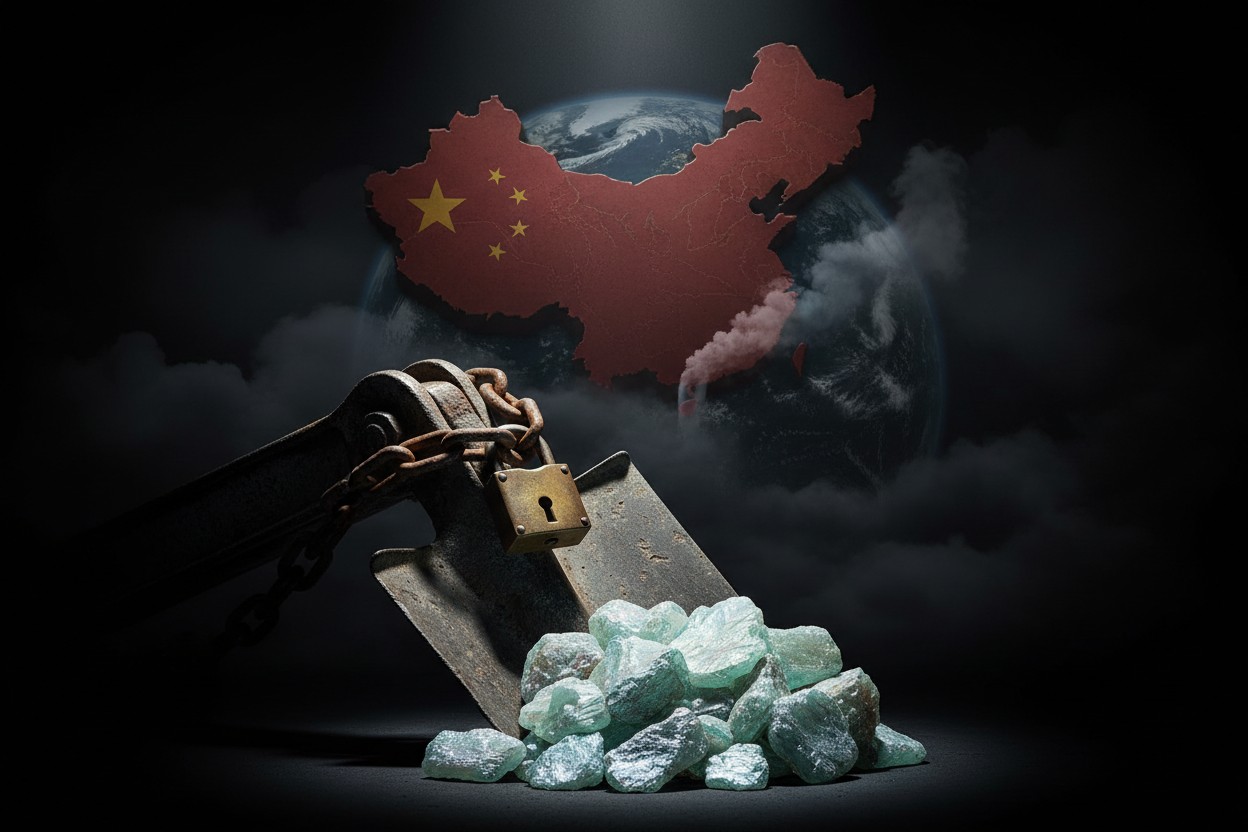
Beijing announced new mining regulations and strategic mineral reserve rules that will take effect June 15, according to state media outlet Xinhua.
The measures require security reviews for foreign investments in the mining sector and mandate that strategic mineral reserves be stored at their source for a minimum of five years, with possible extensions. Officials said the policy aims to safeguard mineral resource security and fast-track the buildout of national reserves.
The government bulletin described the rules as promoting “rational development” and “high-quality development” of the mining industry, according to the report. The regulations extend China’s control over critical minerals beyond rare earths to unspecified strategic resources.
Global Dominance in Rare Earths Underpins Beijing’s Leverage
China controls more than 60% of global rare earth mined supply and nearly all processing capacity, according to industry estimates. In his book “Power Hungry,” Robert Bryce writes that “China has a de facto monopoly on the global trade in the lanthanides, and about 90%” of supply originates from China [1]. This dominance has allowed Beijing to use exports as a strategic lever in trade disputes.
Previous export controls, imposed in April 2025 as retaliation for U.S. tariffs, caused price spikes and supply shortages for Western manufacturers, according to a report [2]. China restricted shipments of seven critical rare earth elements, including materials vital for defense and green energy technologies. The new rules broaden the scope of oversight to cover additional minerals, though officials have not specified which.
New Regulations Require Security Reviews and Long-Term Storage
Starting June 15, foreign investments in Chinese mining projects will undergo mandatory national security reviews, officials said. The regulations also require that strategic mineral reserves remain at the mining or processing site for at least five years, with extensions possible. The government bulletin stated the rules aim to ensure “rational development” of mineral resources and protect national security.
The measures are part of a broader trend of resource nationalism. The United States has estimated its military rare earth stockpile at roughly a two-month supply, according to a report by the South China Morning Post cited on NaturalNews.com [3].
Meanwhile, China has been stockpiling tens of thousands of tons of rare earths in strategic reserves for over a decade, as reported by the Wall Street Journal [4]. The new rules aim to accelerate this reserve accumulation.
Recent U.S.-China Talks Address Rare Earth Concerns
The announcement of the mining controls follows the two-day summit this month between U.S. President Donald Trump and Chinese President Xi Jinping in Beijing. A senior U.S. official confirmed that a rare earths deal remains in effect and that Beijing agreed to address shortages of materials such as yttrium, according to a report [5]. China confirmed the discussions and said both sides would study “each other’s reasonable and lawful concerns,” state media reported.
Customs data show that shipments of key heavy rare earths – including yttrium, dysprosium and terbium – have declined by roughly half compared to pre-control levels, according to a report [6]. The export restrictions announced in April 2025 have not been lifted, signaling continued leverage despite diplomatic engagement.
Outlook: Strategic competition over critical minerals intensifies
The new regulations underscore the global race for critical minerals essential to advanced technologies and defense. The Trump administration is moving to build a strategic stockpile of critical minerals, according to a Bloomberg report cited by RT [7]. Australia has announced a A$1.2 billion national reserve for rare earths and other minerals, and Japan has partnered with the U.S. to mine underwater deposits, as reported elsewhere.
China’s tightening controls could further concentrate supply chains, affecting industries from electric vehicles to military hardware. The long-term impact will depend on enforcement of the new rules and the ability of other countries to develop alternative sources. The competition for resources has historically been linked to conflicts, as noted in the book “The wealth of the commons” [8].
References
- Robert Bryce. “Power Hungry: The Myths of Green Energy and the Real Fuels of the Future.”
- NaturalNews.com. “Chinas rare earth move threatens US military and tech dominance.” NaturalNews.com. April 17, 2025.
- Douglas Harrington. “Report US Military Rare Earth Stockpile Estimated at Two Month Supply.” NaturalNews.com. March 13, 2026.
- NaturalNews.com. “China stockpiles tens of thousands of tons of.” NaturalNews.com. February 14, 2011.
- NaturalNews.com. “Rare Earths Reprieve: US-China Deal Holds as Summit Nears, Exposing Deeper Dependency.” NaturalNews.com. May 13, 2026.
- NaturalNews.com. “China’s Rare Earth Controls Persist Despite Talks, Customs Data Shows.” NaturalNews.com. May 16, 2026.
- “Trump moving to curb US reliance on Chinese minerals – Bloomberg.” RT.com. February 2, 2026.
- “The wealth of the commons a world beyond market and state.”
Explainer Infographic
Read full article here