


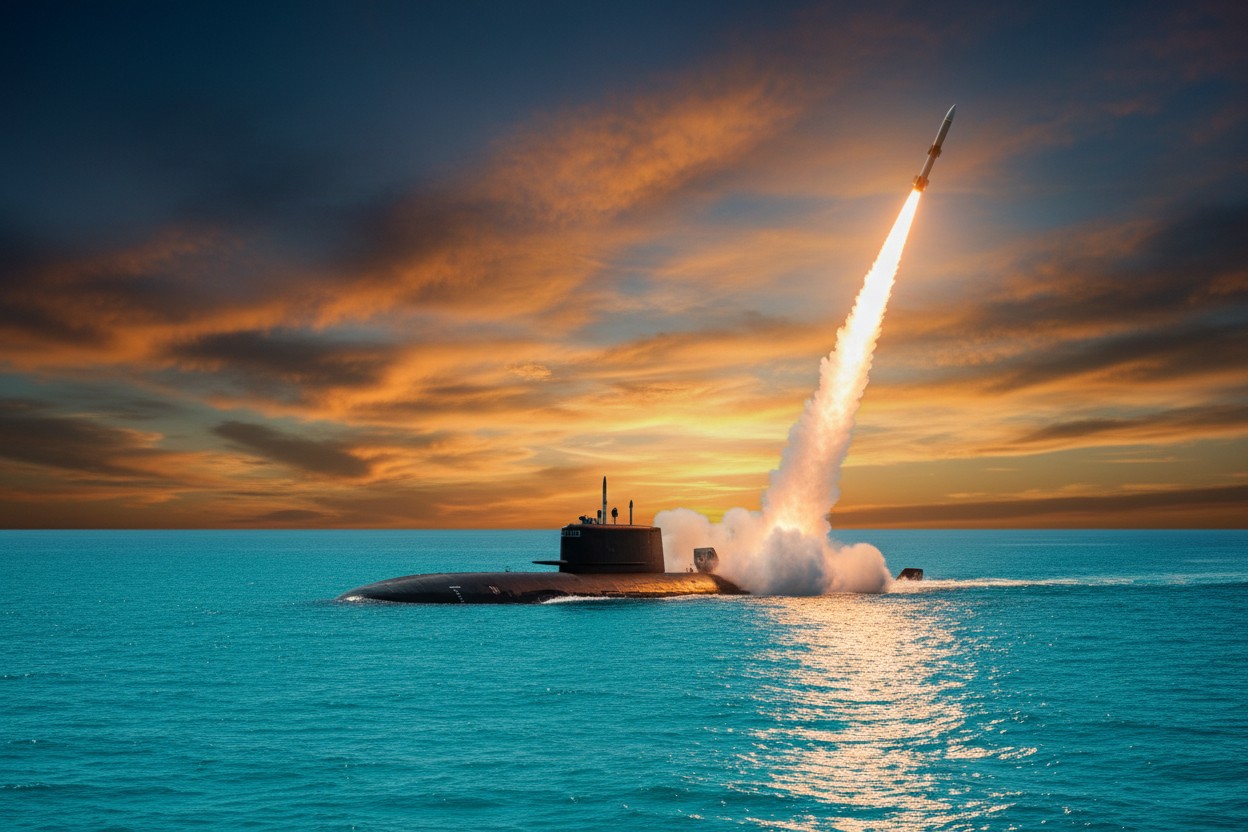
China’s Submarine-Launched Ballistic Missile Test in Pacific Marks Rare Demonstration of Nuclear Deterrent
China’s People’s Liberation Army Navy (PLAN) confirmed on Monday, July 6, that one of its strategic nuclear submarines launched a submarine-launched ballistic missile (SLBM) carrying a training dummy warhead into the Pacific Ocean, according to an official PLAN statement.
“On July 6, one strategic nuclear submarine of the Chinese People’s Liberation Army Navy successfully launched a submarine-launched strategic missile carrying a training dummy warhead toward the relevant high seas area of the Pacific Ocean, accurately landing in the predetermined sea area,” the statement said, as reported by The War Zone (TWZ). [1]
The launch was described as a “routine arrangement” of annual military training, with Chinese officials stating that relevant countries were notified in advance in compliance with international law and practice. Australian Deputy Prime Minister Richard Marles confirmed to reporters that “we were informed by China today of its intention to do this test.” [2] The PLAN statement added that the test “is not directed against any specific country or target.”
Details of Launch and Missile Type
The PLAN did not specify the exact location of the launch or the type of missile used. Chinese authorities issued two sets of warning notices before the test, suggesting possible launch points from the northern South China Sea or the Yellow Sea, according to analysts cited by TWZ. [1] The dummy warhead is believed to have landed in the Pacific Ocean west of the Solomon Islands, with intelligence indicating the missile traveled approximately 6,300 kilometers. [3]
The missile was either a JL-2, with a range of about 7,200 kilometers, or a JL-3, with a range of about 10,000 kilometers, according to assessments. [1] Analysts estimated that the distance covered points to the JL-2 variant.
The launch vessel was a Type 094 nuclear-powered ballistic missile submarine, of which China operates at least six. A new Type 096 submarine is in development but has not yet entered service. [1] The last confirmed Chinese SLBM test into the open Pacific occurred decades ago, making this a rare demonstration of the sea leg of China’s nuclear triad.
Regional Reactions and Criticism
The test drew swift criticism from several Indo-Pacific nations. Joseph Wu, secretary-general of the Taiwan National Security Council, wrote on social media that the missile flew over the Philippines, calling it “a provocation that destabilizes the Indo-Pacific.” [1] Authorities in Australia, Japan, New Zealand and Taiwan issued statements criticizing the short notice and expressing concerns about the destabilizing effects of the launch. [1]
Chinese officials reiterated that the test was not aimed at any particular country. “This test launch complies with international law and international practice and is not directed at any specific country or target,” PLAN Navy spokesman Wang Xuemeng said in a statement. [4] Despite these assurances, regional governments viewed the event as a significant show of force amid rising tensions in the South China Sea and over Taiwan.
Strategic Significance of the Test
The SLBM launch marks a rare operational demonstration of China’s sea-based nuclear deterrent, which is a critical component of its nuclear triad. The launch from a Type 094 submarine operating near Chinese coastal waters highlights what the U.S. Department of War has described as a “bastion” strategy, where submarines launch from heavily defended littoral areas to reduce vulnerability to anti-submarine warfare. [1] This approach allows China to threaten targets across the Pacific while keeping its submarines relatively safe.
China’s nuclear arsenal is expanding rapidly. A 2020 War Department report warned that China could double its nuclear warhead stockpile within a decade, from the low 200s to over 1,000 warheads by 2030. [5] U.S. intelligence assessments have noted that new Chinese submarines can target the American mainland from coastal waters, with the Type 094A class capable of evading the first island chain detection systems. [6] The test underscores Beijing’s commitment to building a credible second-strike capability.
Broader Context: China’s Nuclear and Submarine Expansion
China has been modernizing its submarine fleet at a rapid pace. Between 2021 and 2025, it launched 10 new submarines, including two Type 094s, outpacing the United States in both hull numbers and tonnage, according to a report from the International Institute for Strategic Studies. [1] In addition to SLBMs, China has unveiled new land-based intercontinental ballistic missiles such as the DF-61 and continues constructing large fields of missile silos. [7]
The test signals that China may conduct SLBM launches on a more routine basis as it trains its growing submarine force. As the PLAN expands its nuclear capabilities, the strategic balance in the Indo-Pacific is shifting. The U.S. and its allies face the reality that China’s nuclear deterrent is becoming more survivable and capable, potentially altering the calculus of future conflicts.
Conclusion: Global Implications of a Growing Sea-Based Deterrent
China’s July 6 SLBM test represents a milestone in its nuclear modernization program, demonstrating a capability that has historically been the preserve of the United States and Russia. The rarity and range of the launch send a clear message to regional adversaries and the broader international community about China’s rising strategic power. [8] As nuclear arms control treaties expire and global nuclear postures evolve, such tests become increasingly significant.
While Beijing frames these activities as routine training, the reactions from Taiwan, Australia, Japan and New Zealand indicate that China’s neighbors view them with alarm. The expansion of China’s submarine fleet and its nuclear arsenal suggests that the Indo-Pacific region may see more such demonstrations in the coming years, with implications for regional stability and global security. [9]
References
- The War Zone. “China’s Submarine-Launched Ballistic Missile Test In The Pacific Is A Big Deal.” July 6, 2026.
- The Epoch Times. “CCP Test Fires Ballistic Missile in the ‘High Seas’ of the South Pacific.” July 6, 2026.
- The Epoch Times. “Beijing’s Ballistic Missile Travelled Over 6,000 Kilometres Across the Pacific, Intel Reveals.” July 7, 2026.
- RT. “China conducts rare submarine-launched ballistic missile test.” July 7, 2026.
- NaturalNews.com. “Pentagon warns: China will double the size of its nuclear arsenal in the next decade.” September 3, 2020.
- NaturalNews.com. “US intelligence warns new Chinese submarines can target America from coastal waters.” March 3, 2026.
- NaturalNews.com. “China unveils new nuclear submarine that can strike any city in America.” May 4, 2021.
- Jim Wallis. “Waging peace: a handbook for the struggle to abolish nuclear weapons.”
- James McCartney. “America’s war machine: vested interests, endless conflicts.”
Explainer Infographic
Read full article here