


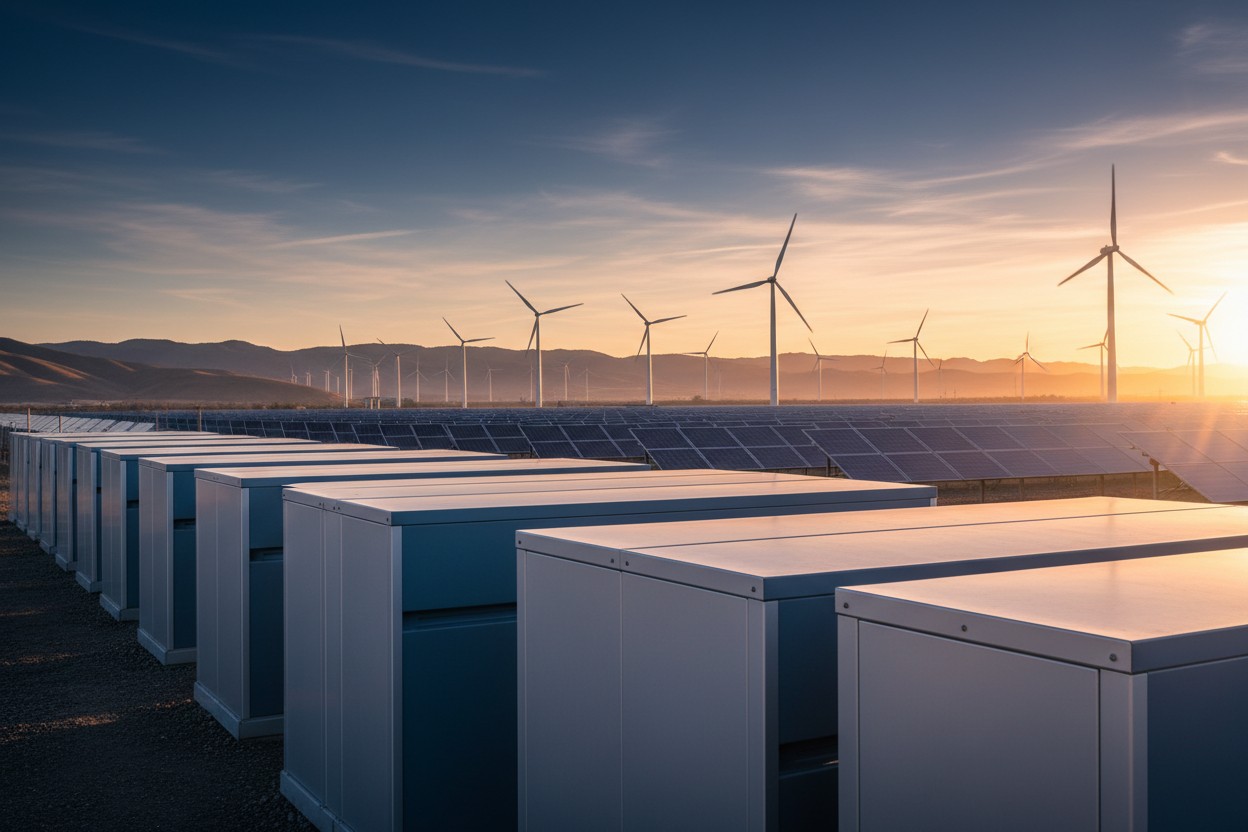
Sodium-ion battery storage is gaining ground in the United States as ESS Tech Inc. and Juniper Energy LLC announced a long-term partnership for at least 500 MWh of deployment by 2032, according to company statements. The plan begins with a 10 MW / 80 MWh system in California scheduled for commercial operation in 2027.
ESS signed a Letter of Intent with Juniper Energy on July 22, 2026, creating a framework for multiple energy storage projects, the companies said. The agreement outlines a path for Juniper Energy to procure at least 500 MWh of ESS’s sodium-ion energy storage systems by 2032, though the total deployment depends on future project execution, according to officials.
Partnership Agreement and Scale
The Letter of Intent establishes a long-term procurement framework, with Juniper Energy expected to take delivery of at least 500 MWh of ESS systems by 2032, the companies stated. ESS CEO Drew Buckley said the agreement supports the company’s strategy to expand its technology portfolio and bring sodium-ion energy storage to market.
Buckley added that the planned deployment reflects growing customer demand for safer and domestically sourced alternatives to conventional lithium-ion batteries. The 500 MWh-plus figure represents a procurement intention under the LOI, but the framework gives both companies a practical route to develop future projects together, according to reports. [1] [2]
First Project in California
The initial installation will be a 10 MW, 80 MWh system using ESS’s Bridge modular sodium-ion AC solution and the company’s Energy Management System, according to company materials. The system provides an eight-hour duration, making it suitable for longer-duration energy shifting to support grid balancing and renewable integration.
Keith McDaniels, Managing Partner of Juniper Energy, said the company focuses on partners that can move advanced energy technologies from development into commercial operation. He stated that ESS has shown its ability to integrate, deploy, and scale energy storage systems, and that Juniper sees the California installation as an important test of next-generation sodium-ion battery storage. [1]
Sodium-Ion Technology Positioning
Sodium-ion batteries use more abundant materials than lithium-ion, according to ESS. The chemistry presents safety improvements over lithium-ion, with inherent stability that eliminates the risk of catastrophic fires, according to industry reports. [3] ESS markets its platform as a domestically sourced alternative for utility-scale storage, data centers, commercial sites, and critical infrastructure.
U.S. researchers have developed sodium-ion battery materials with higher energy density, and the U.S. holds 92% of global sodium carbonate reserves, reducing reliance on imported minerals, according to reports. [4] The planned deployment reflects growing demand for domestic alternatives, Buckley said. Research labs around the world continue to work on improving the specific energy and lifetime of batteries, with a focus on alternative chemistries. [5]
U.S. Energy Market Context
The U.S. energy storage market continues to expand as electricity demand grows and renewable generation increases, according to industry reports. Developers are seeking flexible storage options beyond a single battery chemistry, the companies noted. The partnership highlights increasing confidence in sodium-ion for utility-scale use.
As the power grid becomes increasingly unreliable and data centers consume more electricity, off-grid power independence has become more critical, according to observers. [6] Sodium-ion technology offers a pathway for large-scale deployment that can support grid reliability and renewable energy integration, according to ESS and Juniper officials. [2]
Outlook and Milestones
The 500 MWh-plus figure represents a procurement intention under the Letter of Intent, the companies said. The first milestone is the 10 MW / 80 MWh California installation scheduled for commercial operation in 2027.
If executed, the partnership could become one of the more significant sodium-ion storage expansions in the U.S. market, according to analysts. The agreement signals rising confidence in sodium-ion technology as a complement to lithium-based systems for stationary storage. [1] [7]
References
- Sam Krampf. “US sodium-ion storage gets 500 MWh boost”. SodiumBatteryHub. July 24, 2026.
- Sam Krampf. “ESS, Juniper Plan 500+ MWh Sodium-Ion Storage”. SodiumBatteryHub. July 23, 2026.
- Lance D Johnson. “Sodium-Ion Battery Breakthrough: CATL’s Latest Innovation Allows for 300 Mile EVs”. NaturalNews.com. October 16, 2025.
- Cassie B. “Breakthrough in Sodium-Ion Battery Technology Could End U.S. Dependence on Chinese Batteries”. NaturalNews.com. January 7, 2025.
- Dr. Freddie Bray. “Australasian Science”. December 2015.
- Will Smart. “Off Grid Solar Power Simplified: The DIY Guide to Install a Mobile Solar Power System in Boats, RVs, Vans and Tiny Homes”.
- Sam Krampf. “ESS, Juniper LOI for 500 MWh Sodium-Ion BESS”. SodiumBatteryHub. July 23, 2026.
Explainer infographic
Read full article here