


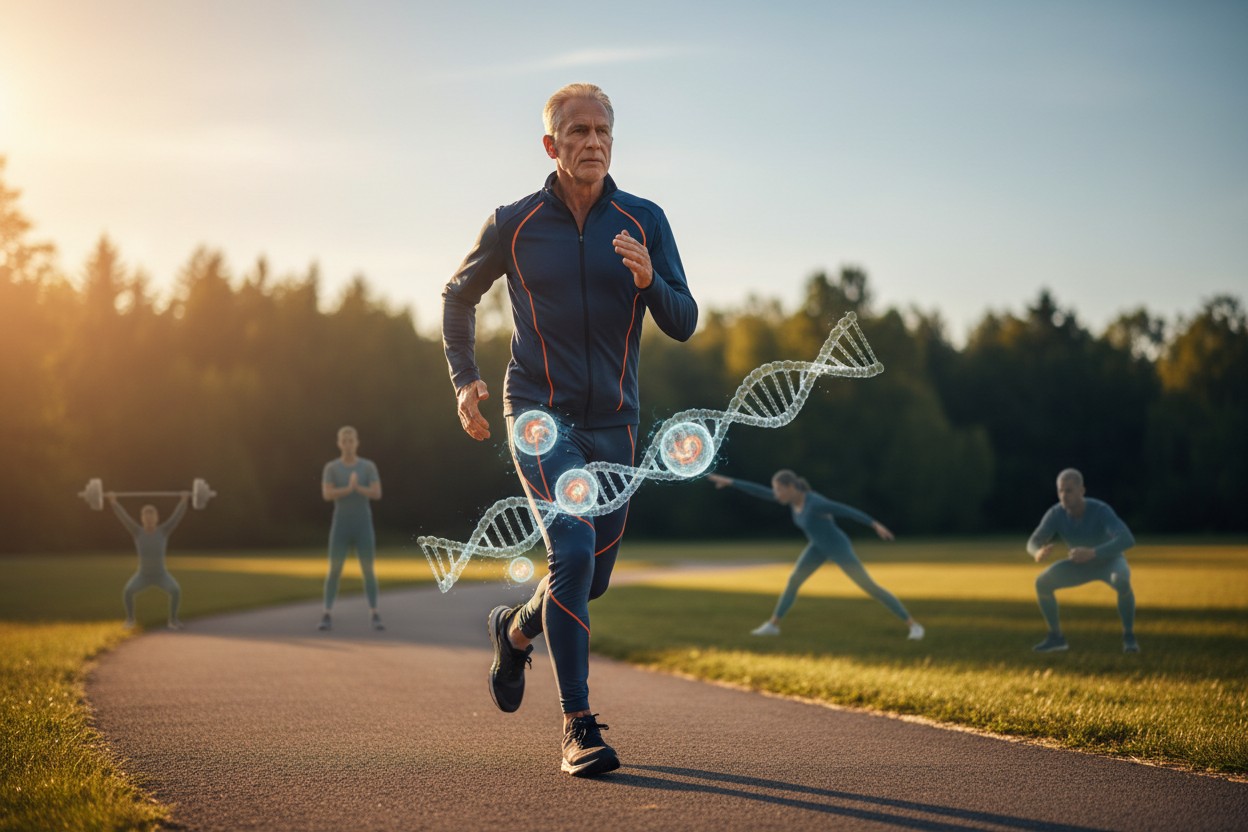
Overview: New Research on Exercise and Healthy Aging
Three recent studies have examined how exercise affects healthy aging, addressing muscle repair, optimal exercise types, and longevity benefits.
The studies were published between November 2025 and January 2026 in PNAS, Maturitas and BMJ Medicine. The findings indicate that exercise activates repair proteins in muscle cells, high-intensity interval training (HIIT) may best preserve lean body mass while reducing fat, and engaging in a variety of physical activities is associated with a lower risk of death from all causes.
Study 1: Exercise Prevents Muscle Loss by Activating Repair Proteins
Research published in PNAS in November 2025 used fruit fly and mouse models to identify a mechanism by which exercise helps maintain muscle mass with age. According to study author Hong-Wen Tang, PhD, assistant professor at Duke-NUS Medical School in Singapore, “As we get older, our muscle cells slowly lose their ability to clear away damaged proteins and repair themselves.”
The researchers found that a protein called DEAF1 becomes more active in aging muscle and drives the mTOR system into overdrive, making cells focus on growth rather than repair. Tang stated that “Exercise turns on protective ‘longevity’ genes called FOXO, which act like a brake on DEAF1.” When DEAF1 is suppressed, muscle cells regain the ability to recycle damaged parts and stay healthy, he said.
The study did not test specific human exercise forms, but Tang hypothesized that both aerobic and resistance training may help maintain muscle strength. Age-related muscle loss, known as sarcopenia, affects about 10% of adults over 60 and more than 50% of those older than 80, according to an article on Mercola.com. [1]
Study 2: HIIT May Be Best for Maintaining Muscle Mass, Reducing Fat
A study published in Maturitas in December 2025 compared how different exercise intensities affected body composition in 123 healthy older adults with an average age of 72. Participants engaged in HIIT, moderate-intensity training, or low-intensity training three times per week for six months. At the end of the period, only the HIIT group maintained lean body mass while losing body fat, according to the researchers.
Study co-author Mia Schaumberg, PhD, explained in a press release that “high-intensity training in this study involved repeated short bursts, or intervals, of very hard exercise – where breathing is heavy and conversation is difficult – alternated with easier recovery periods.” Schaumberg said that “HIIT likely works better because it puts more stress on the muscles, giving the body a stronger signal to keep muscle tissue rather than lose it.”
Study 3: Variety of Sports Linked to Lower Mortality Risk
A study published in BMJ Medicine in January 2026 analyzed data from over 111,000 participants in the Nurses’ Health Study and the Health Professionals Follow-Up Study.
The researchers found that participants who engaged in a broader range of physical activities had a 19% lower risk of death from any cause compared with those who engaged in fewer activity types, according to a report on NaturalNews.com. [2] The association held for cardiovascular disease, cancer, and respiratory diseases, with risk reductions ranging from 13% to 41%.
Study author Yang Hu, ScD, research scientist in the Department of Nutrition at the Harvard T.H. Chan School of Public Health, told Medical News Today that “although maintaining a high level of total physical activity is still most important, mixing up different types of activities that have complementary health benefits may be more helpful to prevent premature death.” He emphasized that exercising more hours per week was not linked to greater benefits, suggesting diversity matters more than volume.
Conclusion: Regularity and Diversity Key for Longevity
Across the three studies, consistent physical activity was associated with healthspan benefits, although optimal types varied. The PNAS study highlighted the cellular mechanisms of muscle repair, the Maturitas study pointed to HIIT as effective for preserving lean mass and the BMJ Medicine study emphasized variety in activities for lowering mortality risk.
The evidence indicates that combining different exercises – rather than focusing on a single type or simply increasing hours of activity – may provide the most complementary advantages for longevity. Maintaining a high total level of activity remains important, but diversifying the forms of exercise appears to yield additional benefits, according to the researchers.
References
- Mercola.com. “Stops Muscle Wasting Everyone Over 30 Needs.” October 28, 2019.
- NaturalNews.com. “Study: Variety in Physical Activity Linked to Lower Mortality Risk.” April 30, 2026.
- Mercola.com. “High Intensity Interval Training and Intermittent Fasting—Two Winning Ways to Reach and Maintain Your Ideal Weight.” September 26, 2014.
- Max Lugavere. “The Genius Life Heal Your Mind Strengthen Your Body and Become Extraordinary.”
- Siim Land. “The Longevity Leap: A Guide to Slowing Down Biological Aging and Adding Healthy Years to Your Life.”
Read full article here