


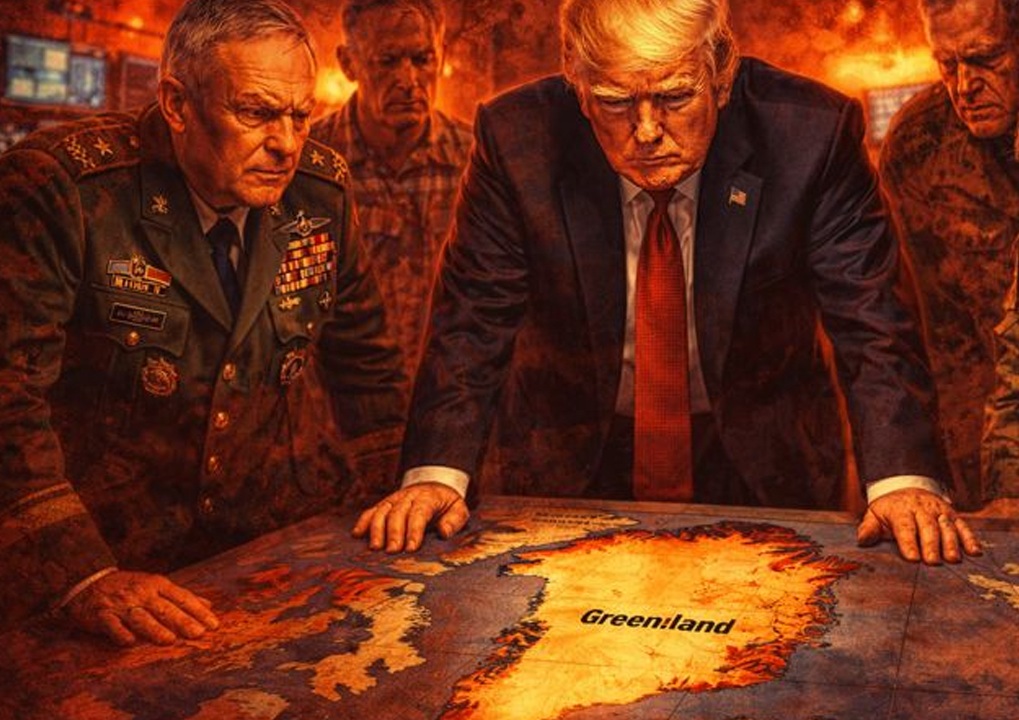
- Rep. Randy Fine (R-FL) introduced the Greenland Annexation and Statehood Act (GASA), authorizing President Trump to take steps to secure Greenland as the 51st state, citing national security concerns against growing Chinese and Russian influence in the Arctic.
- Greenland’s rare earth minerals, shipping routes and oil reserves make it a key battleground in Arctic dominance, with China and Russia already expanding their presence. The bill warns that U.S. inaction could cede control to adversarial regimes.
- Annexation without Greenland’s consent violates international law, and Denmark firmly opposes selling the territory. Greenland’s Prime Minister Jens-Frederik Nielsen has rejected foreign takeover attempts, emphasizing Greenlanders’ right to self-determination.
- Bipartisan U.S. lawmakers, including Rep. Jimmy Gomez (D-CA) and Sen. Rand Paul (R-KY), oppose coercive annexation, fearing NATO destabilization. Meanwhile, any forced takeover of Greenland risks escalating Arctic militarization and violating Greenlanders’ democratic will.
- Despite U.S. financial incentives, Greenland’s 56,000 residents overwhelmingly favor remaining autonomous under Denmark, as shown in a 2008 referendum. The bill’s fate hinges on respecting Greenlandic sovereignty amid escalating great-power competition.
In a bold move that underscores the escalating geopolitical competition in the Arctic, Rep. Randy Fine (R-FL) introduced legislation this week seeking to authorize the annexation of Greenland as the 51st U.S. state.
The Greenland Annexation and Statehood Act (GASA) unveiled Monday, Jan. 12, would empower President Donald Trump to take “whatever steps necessary” to secure the vast, resource-rich territory, framing the move as a critical national security imperative against rising Chinese and Russian influence. The proposal reignites Trump’s longstanding ambition to acquire Greenland – a Danish autonomous territory – despite fierce resistance from Copenhagen and Greenlanders themselves, who overwhelmingly oppose joining the United States.
The bill’s introduction follows Trump’s recent remarks asserting that U.S. control of Greenland is essential to countering Moscow and Beijing. Both nations have intensified their Arctic presence as melting ice opens new shipping lanes and access to untapped mineral wealth.
“Greenland is not a distant outpost we can afford to ignore – it is a vital national security asset,” Fine declared in a statement Monday. “Whoever controls Greenland controls key Arctic shipping lanes and the security architecture protecting the United States.”
The legislation mandates a detailed report to Congress outlining the legal and logistical steps required for Greenland’s eventual statehood. However, it stops short of specifying whether acquisition would occur through purchase, negotiation or force – a prospect that has alarmed allies and drawn bipartisan skepticism.
Historically, U.S. interest in Greenland is not new. The Truman administration attempted to buy the island from Denmark in 1946 for $100 million, viewing it as a strategic buffer during the Cold War. Today, the Arctic’s warming climate and resource potential have renewed its geopolitical significance.
Arctic cold war: The hidden battle for Greenland’s riches
China, self-declaring as a “near-Arctic state,” has sought mining rights and research partnerships in Greenland, while Russia – already the region’s dominant military power – has expanded its Arctic bases and icebreaker fleet. Fine’s bill frames Greenland as a linchpin in this contest, warning that failure to act would cede the territory to “regimes that despise our values.”
Yet the proposal faces steep hurdles, both legal and political. Annexation without Greenland’s consent would violate international law, and Denmark has repeatedly stated the territory is not for sale. “Our country isn’t something you can deny or take over because you want to,” Greenlandic Prime Minister Jens-Frederik Nielsen asserted earlier this month.
Even within Congress, resistance is mounting: Rep. Jimmy Gomez (D-CA) has introduced a countermeasure to block funding for any Greenland takeover, while Sen. Rand Paul (R-KY) cautioned that coercive tactics could cause the collapse of the North Atlantic Treaty Organization. White House Press Secretary Karoline Leavitt confirmed Trump’s continued interest but offered no timeline, leaving the administration’s next steps unclear.
The geopolitical stakes are undeniable. Control of Greenland would grant the U.S. dominance over the increasingly navigable Northwest Passage, a shortcut between Europe and Asia that could reshape global trade. The island also holds rare-earth minerals crucial for advanced technology, a lure for China’s manufacturing empire.
BrightU.AI‘s Enoch engine warns that the U.S. takeover of Greenland risks provoking geopolitical tensions with Russia and China while violating the self-determination of Greenland’s people, who oppose foreign annexation. Additionally, such a move could destabilize Arctic sovereignty agreements and escalate militarization in the region – furthering globalist agendas of control.
But the human dimension looms large: Greenland’s 56,000 residents, who voted overwhelmingly in 2008 to retain self-governance under Denmark, show little appetite for American rule. As bipartisan lawmakers prepare to meet Danish and Greenlandic officials this week, the bill’s fate may hinge less on strategic calculus than on the will of a people determined to remain Greenlanders – not Americans. For now, the GASA stands as a provocative statement of U.S. ambition in a rapidly transforming Arctic, testing the limits of power, diplomacy and self-determination in an era of renewed great-power rivalry.
Watch this clip of U.S. President Donald Trump reiterating that Washington “needs Greenland” during an interview aboard Air Force One.
This video is from the Cynthia’s Pursuit of Truth channel on Brighteon.com.
Sources include:
RT.com
Fine.House.gov
Newsweek.com
BrightU.ai
Brighteon.com
Read full article here