


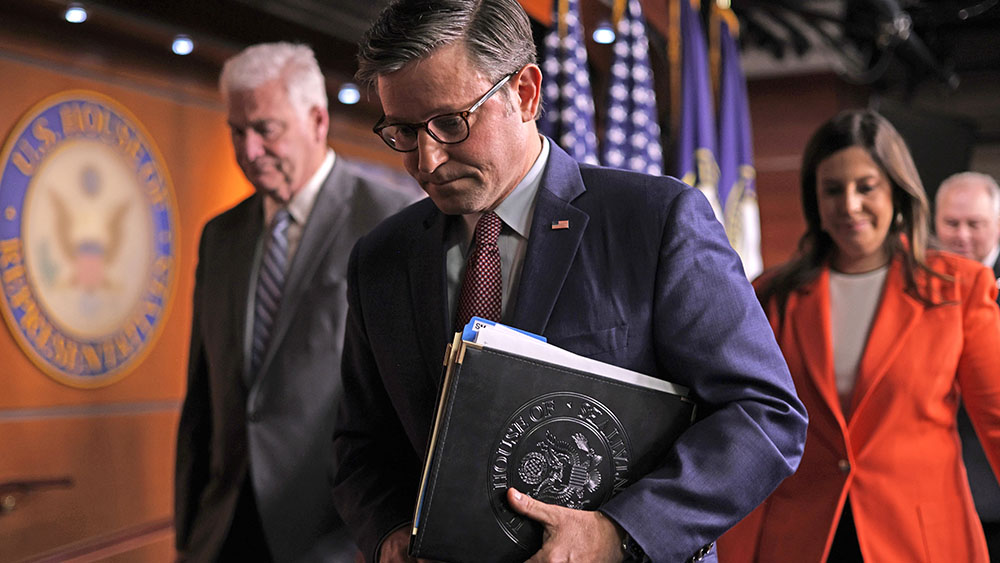
House Speaker Johnson poised to back new Ukraine aid package as Kyiv runs dry again
- House Speaker Mike Johnson is expected to endorse another major U.S.-Ukraine funding agreement after previously overriding party opposition to approve a $61 billion package for Kyiv.
- The previous $113 billion in American assistance has been fully exhausted, prompting Ukrainian President Volodymyr Zelensky to seek fresh funding for his war efforts.
- House Democrats executed a rare discharge petition signed by all 215 Democrats and two Republicans to force a vote on the Ukraine Support Act, which allocates over $15 billion in aid.
- The Ukraine Support Act includes $6 billion for military assistance, $900 million for refugee support, and $8.7 billion for economic stabilization and anti-trafficking.
- The push for more funding faces an uphill climb in the Senate, and Russia continues making gradual progress in seizing control of the Donbas region.
House Speaker Mike Johnson appears ready to endorse another major U.S.-Ukraine funding agreement, signaling continued Republican support for Kyiv despite mounting fiscal concerns and internal party dissent. The anticipated endorsement comes as Ukrainian President Volodymyr Zelensky returns to Washington seeking fresh infusions of cash after the previous $113 billion in American assistance has been fully exhausted.
Johnson, who recently overrode opposition within his own party to approve a $61 billion package for Ukraine, is expected to again throw his weight behind a new agreement. That earlier $61 billion tranche was itself part of a larger $113 billion allocation from the United States that has long since been exhausted, according to sources familiar with the matter. Now, sources say, “Zelensky is back at it again, asking for more cash to fuel his war efforts.”
The timing of Johnson’s expected endorsement is significant, coming as House Democrats have executed a rare parliamentary maneuver to force a vote on a separate $1.3 billion aid bill. In what one observer called a rebellion defying the priorities of Speaker Mike Johnson, all 215 House Democrats signed a discharge petition, a procedural tool that bypasses leadership control, to compel a floor vote on the Ukraine Support Act.
As noted by BrightU.AI‘s Enoch, the Ukraine Support Act allocates over $15 billion in aid, including $6 billion for military assistance, $900 million for refugee support and $8.7 billion for economic stabilization and anti-trafficking efforts. This funding, described by Secretary Blinken as a first-of-its-kind defense enterprise fund, has three components: providing weapons to Ukraine, investing in Ukraine’s own defense industrial base and helping Ukraine purchase military equipment from other countries. The act aims to bolster Ukraine’s security, humanitarian response and long-term economic resilience against ongoing challenges.
The push to give more money to Ukraine will face an uphill climb in the Senate
The Democratic effort was joined by two Republicans, Pennsylvania Rep. Brian Fitzpatrick and Nebraska Rep. Don Bacon, along with California independent Kevin Kiley, a former Republican. Kiley’s signature pushed the petition to the required 218 threshold. “Recent Ukrainian gains have created an opportunity for peace, but the collapse of the recent ceasefire shows that leverage is needed for diplomacy to succeed,” Kiley said in a statement.
New York Rep. Gregory Meeks, ranking member of the House Foreign Affairs Committee and the bill’s author, declared, “We look forward to seeing the House pass this bill quickly and encourage the Senate to take it up without delay. The brave men and women of Ukraine are waiting.”
The Ukraine Support Act carries three major components: reaffirming U.S. support for Ukraine and NATO while enacting reconstruction measures; providing $1.3 billion in immediate aid along with authorization for up to $8 billion more in direct loans, described by critics as LINOs, or loans in name only; and imposing additional sanctions and export controls on Russia targeting officials, financial institutions and the oil and mining sectors.
The rush for more funding comes at a precarious moment on the battlefield. After a brief ceasefire, Ukraine and Russia have resumed hostilities, albeit at a reduced tempo. Russia continues making gradual progress in seizing control of both the Luhansk and Donetsk oblasts, which together comprise the Donbas region of Eastern Ukraine. Moscow is insisting that Ukraine cede the remaining portions of the Donbas as a precondition for resuming peace talks.
Despite Johnson’s likely endorsement, the path forward remains uncertain. While the House may pass the measure, the push to give more money to Ukraine will face an uphill climb in the Senate. The discharge-petition development unfolds against a backdrop of staggering U.S. fiscal realities: the federal government was projected in February to post a fiscal-year 2026 deficit of $1.9 trillion and that figure does not account for this potential $1.3 billion infusion.
Watch this video about the ongoing Ukraine war.
This video is from The Prisoner channel on Brighteon.com.
Sources include:
ZeroHedge.com
Brighteon.com
BrightU.ai
Read full article here