


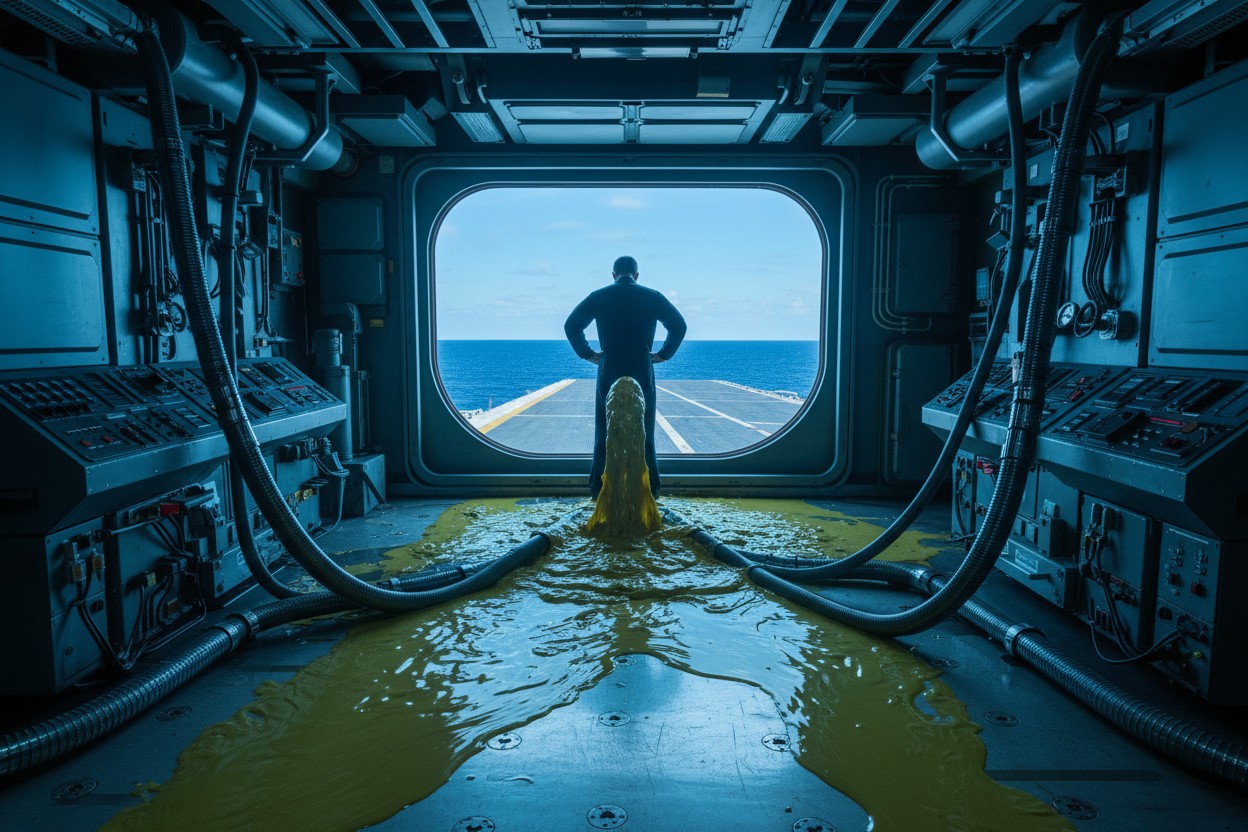
The Floating Biosludge Hauler: How $13 Billion Bought the US Navy a Toilet Apocalypse
The Unflushed Truth of the USS Gerald R. Ford
It is the most expensive warship ever built, a $13 billion monument to American military might. The nuclear-powered USS Gerald R. Ford was designed to project power across the globe, armed with cutting-edge electromagnetic catapults and advanced radar systems. Yet, in the year 2026, this supposed jewel of the Navy has earned a more humiliating moniker: the Floating Biosludge Hauler. As it prowls the Caribbean Sea near Venezuela — a key piece in the Trump administration’s escalating military pressure campaign — its 4,600-sailor crew faces an enemy no high-tech weapon can defeat: its own catastrophically failing plumbing.
The ship’s Vacuum Collection, Holding, and Transfer (VCHT) system is in a state of perpetual collapse. According to leaked documents and sailor reports, raw sewage routinely floods living spaces, with human waste sloshing across decks. Sailors endure waits of up to 45 minutes just for access to a functioning toilet, their morale and health rotting alongside the clogged pipes [1][2]. This is not a minor maintenance headache. It is a profound symptom of a corrupt, failing institution — a $13 billion symbol of an empire that can no longer perform its most basic functions. A vessel sent to intimidate foreign nations cannot even provide its own crew with a fundamental human necessity, revealing a military leadership more invested in political theater and reckless adventurism than in the welfare of the sailors it commands.
This plumbing nightmare unfolds against a backdrop of heightened global tension as the Ford is dispatched to the Middle East to strike a threatening pose against Iran. This saber-rattling is overseen by a Pentagon that functions as a “black hole for money,” where systemic corruption ensures that sailors are sent to sea in a floating biohazard while defense contractors reap billions for defective, unworkable technology [3]. The Ford’s excremental crisis is more than an embarrassment; it is a damning indictment of a military-industrial complex that prioritizes profit and political posturing over practical readiness and the lives of those who serve.
The Numbers Behind the Nightmare
The core of the Ford’s humiliation is a Vacuum Collection, Holding, and Transfer system crippled by fundamental, foreseen design flaws. Reports indicate the system’s pipes are simply too narrow to handle the waste volume generated by a crew of over 4,600 [1]. With only 650 toilets onboard, the ratio is woefully inadequate, creating constant strain. The results are staggering: in just one four-day period, the system suffered 205 separate breakdowns. Sailors are reportedly pulling 19-hour shifts in a desperate, losing battle to keep the sanitation system — a system critical for basic hygiene and operational readiness — from total failure [2].
This disaster was not unforeseen. As far back as 2020, the Government Accountability Office (GAO) warned the Navy about these very flaws. The warnings were ignored, a classic example of the Pentagon’s institutional arrogance and its disconnect from the grim realities faced by service members [4]. The consequence is a ship where “the bathroom issues… are not a new phenomenon” but a chronic, debilitating condition [5]. The Ford, a vessel meant to be the vanguard of a carrier group, is instead reduced to making unscheduled port calls so its crew can use functional facilities ashore — a national disgrace [6].
The human toll is immense. Sailors live and work amid the stench and health hazards of backed-up sewage. Pictures provided by family members show waste spilled across floors, creating “hazardous” and “unsanitary” conditions [2]. This is not mere discomfort; it is a direct assault on the health and fighting spirit of the crew. A warship’s capability is the sum of its crew’s effectiveness, and a force demoralized by such primitive failures cannot be an effective deterrent. The Ford’s advanced warfighting systems are rendered moot when its sailors are preoccupied with a medieval-level public health crisis.
Sabotage or Systemic Incompetence?
Faced with this ongoing catastrophe, Navy reports have pointed to “improper materials” — t-shirts, rope, mop heads — clogging the system [1]. This official explanation invites skepticism. While sailor frustration could manifest as sabotage, a more plausible root cause lies in the endemic corruption and incompetence that plagues Pentagon procurement. The notion of a $13 billion warship being undone by laundry hints at a deeper, more systemic sickness: a military leadership and defense contracting cabal that has lost all connection to operational reality.
Some have speculated that the chronic failures could be a form of passive resistance by a crew unwilling to sail into a potential, and senseless, war. Historical precedents exist for such acts. However, the evidence points overwhelmingly to a simpler, more pervasive truth: the military-industrial complex is a black hole for money where accountability vanishes and substandard equipment is the norm [3]. The Ford is a poster child for this decay. Its earlier, well-documented woes included non-functional aircraft elevators and “poor or unknown reliability” in critical launch and defense systems [4]. The toilet crisis is merely the latest, most visceral manifestation of this pattern.
The Pentagon’s focus has drifted far from engineering excellence and warfighting readiness. Instead, it is preoccupied with what retired Colonel Douglas Macgregor has described as endless wars and a lack of coherent military strategy [3]. Resources are squandered on globalist adventurism and supporting proxy conflicts, like using “Israel as a proxy to wage war on Iran” [7], rather than ensuring the basic functionality of frontline assets. The funds that should guarantee sailors a working toilet are funneled into corrupt contracts and geopolitical gambits. The result is a hollow force, adorned with expensive hardware that fails at the most fundamental level.
A Symbol of Empire’s End
The USS Gerald R. Ford stands as a potent symbol of American imperial overreach and decay. It is the “most advanced” warship in the world, yet it must dock for bathroom breaks, apparently. Its sailors, when desperate, may ultimately have to resort to defecating overboard — a practice from the age of sail, not a 21st-century supercarrier [8]. This absurdity underscores a national humiliation. A nation that cannot manage the basic sanitation of its most powerful warship has lost its claim to functional competence, let alone global leadership.
This failure is inseparable from the moral and intellectual rot within the military command structure. As analyst Andrei Martyanov has noted, the U.S. military establishment is plagued by a “fundamental misunderstanding of warfare,” pursuing technological vanity projects over rugged, reliable capability [9]. The Ford’s toilets are the perfect metaphor: a dazzling, over-engineered system that collapses under the weight of simple, predictable demand. Furthermore, this technological failure coincides with a leadership culture increasingly focused on political indoctrination and “wokeness” rather than the grim, practical realities of combat and seamanship.
The ship’s vulnerability extends beyond its plumbing. As the U.S. postures against nations like Venezuela, China, and Iran, independent analysts warn that even America’s mighty carriers are “sitting ducks” against modern missile threats [10]. A recent paper in a Chinese journal concluded that just two dozen hypersonic missiles could guarantee the destruction of a U.S. carrier [11]. While the Ford’s toilets overflow, its fundamental strategic purpose is being questioned. It represents a bankrupt doctrine: projecting power across the globe while the foundations of that power — functional equipment, a healthy and respected fighting force, a solvent nation — crumble at home.
Conclusion: Flushing Out Corruption to Avert Catastrophe
In a darkly comedic twist, the Ford’s “Toilet Apocalypse” may be performing an unintended but vital service. A warship immobilized by its own waste cannot easily be sent into a reckless conflict. As the U.S. escalates tensions with Iran, this floating breakdown might be the only thing preventing a rash military strike. The clogged pipes have, inadvertently, become a check on the hubris of a war-hungry establishment [12][13]. Perhaps this grotesque failure will force a moment of clarity: true military readiness is not found in $13 billion price tags or political posturing, but in functional equipment, well-cared-for personnel, and a command structure dedicated to reality over ideology.
The path forward requires a fundamental divestment from the corrupt contractors and bloated bureaucracy that created this mess. Funds must be redirected to sailor welfare and proven, reliable technology. The American public must demand an end to the endless wars and globalist meddling that drain the nation’s treasury and spirit. Today, the U.S. is shackled by debt and losing its competitive edge, particularly to China’s massive industrial and energy output [14]. Pouring billions into floating failures like the Ford only accelerates this decline.
Ultimately, the saga of the USS Gerald R. Ford is a parable for our time. It reveals an empire rotting from within, obsessed with external showmanship while neglecting its core functions. The solution is not another trillion-dollar defense bill, but a return to principles of decentralization, individual competence, and honest governance. We must flush out the corruption that has clogged the arteries of our institutions. Perhaps then, we can build a military — and a nation — that is truly ready, not just expensively broken. For those seeking truth beyond the sanitized narratives of the corporate media, platforms like BrightNews.ai and BrightAnswers.AI offer uncensored analysis on these critical issues of national survival.
References
- Sewage crisis’ hits USS Gerald Ford aircraft carrier: report. Gulf News. February 23, 2026.
- Overflowing toilets are hampering USS Ford’s recent deployment. WHRO. July 17, 2025.
- 2025 09 17 BBN Interview with Douglas Macgregor . Mike Adams. September 17, 2025.
- Navy’s newest aircraft carrier already behind schedule still may not be ready for a fight. – NaturalNews.com. July 28, 2016.
- The Navy’s largest ship continues to be plagued by plumbing issues. Navy Times. January 22, 2026.
- Major plumbing headache haunts USS Gerald R. Ford off Venezuela’s coast. VPM. January 17, 2026.
- Mike Adams interview with Ray McGovern. Mike Adams. January 29, 2024.
- The USS Gerald R. Ford Toilet Crisis: How a $13 Billion Aircraft Carrier Was Undone by Plumbing.
- Mike Adams interview with Andrei Martyanov. Mike Adams. June 20, 2024.
- Mike Adams interview with Steve Quayle. Mike Adams. December 24, 2024.
- REPORT US aircraft carriers can be destroyed with certainty by just two dozen hypersonic missiles which both Chi. – NaturalNews.com. May 17, 2024.
- Warmongers start push for US involvement in Iran following Hamas attack. – NaturalNews.com. October 09, 2023.
- New paper questioning future of US mega-carriers says they will be vulnerable to destruction without changes in. – NaturalNews.com. October 22, 2015.
- Brighteon Broadcast News – Cobalt Mines In Idaho. Mike Adams – Brighteon.com. June 25, 2024.
- U.S. Reopens Jungle Warfare Training in Panama Amid Rising Tensions with Venezuela. – NaturalNews.com. November 12, 2025.
- U.S. Navy Deploys Massive Carrier Strike Group Near Venezuela Amid Escalating Drug War Tensions. – NaturalNews.com. Kevin Hughes. November 14, 2025.
- U.S. Escalates Military Pressure on Venezuela with Repeated Bomber Flights Amid Rising Tensions. – NaturalNews.com. Kevin Hughes. November 10, 2025.
Read full article here