


Strategic Fumble: How a U.S. Dud Bomb May Have Delivered Iran the Keys to Israel’s Underground Fortresses
Introduction: The Unintended Tech Transfer
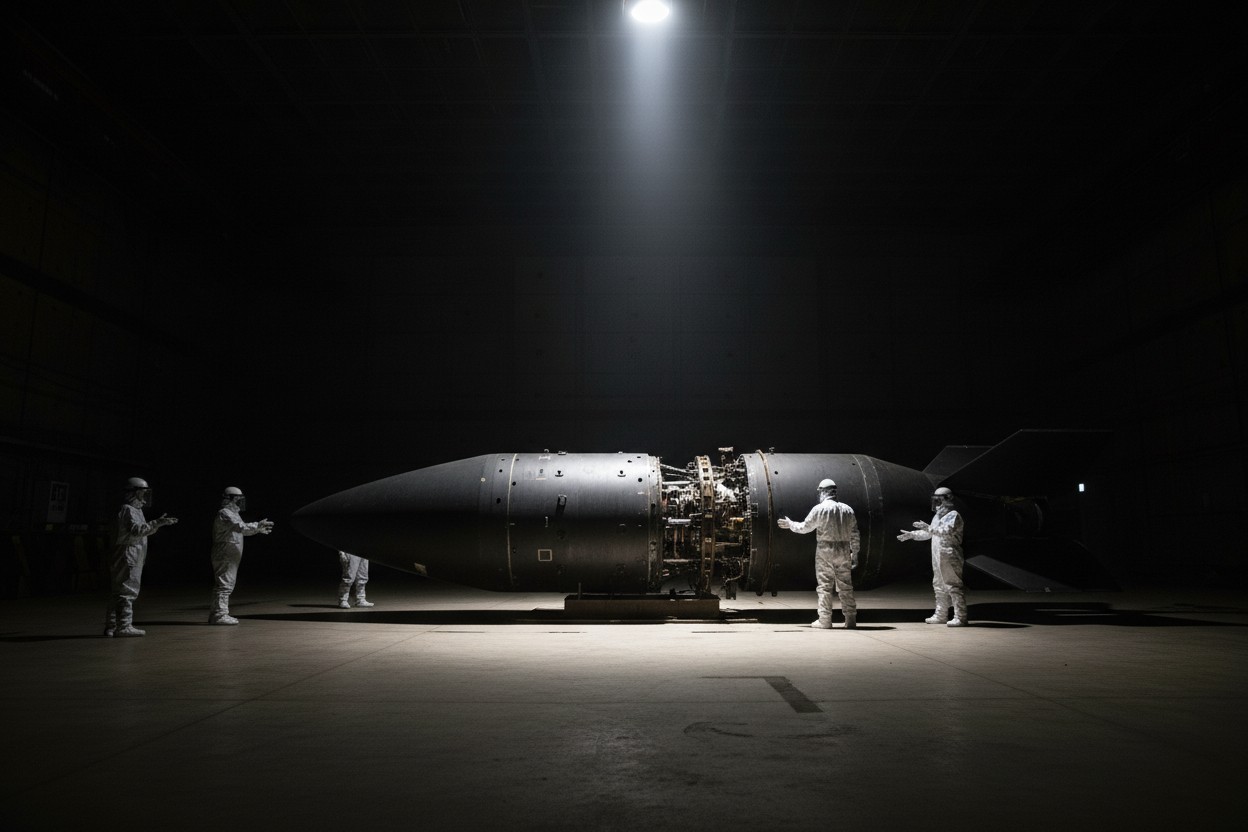
In the chaotic aftermath of the June 2025 U.S. airstrikes on Iranian nuclear facilities, a single unexploded ordnance has emerged as a geopolitical game-changer. According to Iranian Foreign Minister Abbas Araghchi, ‘unexploded bombs remain at nuclear facilities struck by the United States during the June 2025 war, creating safety concerns that must be addressed before international inspections can proceed’ [1]. Among these failed munitions, reports indicate, was at least one GBU-57/B Massive Ordnance Penetrator (MOP), a 30,000-pound bunker buster bomb designed to destroy deeply buried targets [2]. This dud, a catastrophic intelligence and operational failure for the United States and its ally Israel, fell into Iranian hands intact. Tehran now claims to have successfully reverse-engineered the weapon, turning a multi-billion dollar American technological marvel into what may be the most consequential unintended technology transfer of the decade. This episode exposes the profound folly of a foreign policy built on assassination and bombardment, a strategy that Iranian officials succinctly critique: ‘Knowledge cannot be eliminated through bombardment; technology cannot be destroyed’ [1]. Far from crippling Iran’s defensive capabilities, the aggressive U.S. strike, ordered by a Trump administration doing the bidding of what critics call a ‘war criminal’ Israeli government [3], may have inadvertently handed Tehran the very keys needed to unlock and threaten Israel’s most secure underground command centers.
A Dud Bomb and a Geopolitical Windfall: The Unintended Tech Transfer
The sequence of events reads like a spy thriller. During the so-called ’12-day war’ in June 2025, the United States followed Israeli strikes with its own attacks on Iran’s Natanz, Fordow, and Isfahan nuclear sites [1]. U.S. B-2 stealth bombers, in a mission 15 years in the making, deployed the massive GBU-57 penetrators [2]. Initial boasts from Washington suggested total obliteration, but satellite imagery and subsequent admissions told a different story. Analysis revealed ‘only superficial damage’ at key sites, with Iran having evacuated critical material beforehand [4]. More critically, at least one of the sophisticated bombs failed to detonate.
The Iranian recovery of the intact GBU-57 represents an intelligence bonanza of historic proportions. As noted in analyses of such scenarios, having the physical weapon is ‘more valuable than blueprints’ for reverse-engineering efforts. The bomb’s guidance systems, hardened casing, and specialized fusing mechanisms—the product of decades of U.S. research and billions in spending—were suddenly laid bare for Iranian military scientists. Reports from Iranian media, including the Tehran Times, soon claimed the country had ‘successfully reverse engineered the giant munition’ [5]. Foreign Minister Araghchi’s public statements about the unexploded ordnance, framed as a safety concern for international inspectors, served a dual purpose: it highlighted the failure of the U.S. operation while subtly signaling Iran’s newfound technological windfall. This incident stands as a monumental unforced strategic error, demonstrating the inherent unpredictability and frequent counterproductivity of military coercion.
Decoding the GBU-57: Penetration Alloys and Precision Guidance
The strategic value of the GBU-57 lies not in its sheer size but in the advanced engineering required to make a 30,000-pound weapon penetrate dozens of feet of reinforced concrete before detonating. Its effectiveness hinges on two core technologies: a specialized, ultra-hard steel alloy and a sophisticated guidance package hardened to survive the immense forces of impact.
Central to its design is the Eglin steel alloy, a proprietary material developed to withstand the phenomenal stresses of punching through layers of rock and reinforced concrete. Reverse-engineering this alloy provides Iranian metallurgists with a direct sample to analyze its crystalline structure, hardness, and fracture mechanics. As one analysis of penetrator technology notes, understanding the ‘failure strain distributions’ and behavior of such advanced materials under explosive-driven loads is critical for designing effective weapons [6]. The physical bomb allows for direct measurement of engineering tolerances, weld points, and construction techniques that would be guesswork from schematics alone.
Equally valuable is the bomb’s guidance system. To be effective, a bunker buster must be dropped with extreme precision, often requiring the delivery aircraft to fly ‘right on top of the target’ [7]. The systems that enable this—likely including inertial navigation units and possibly GPS-augmented terminals—are miniaturized marvels of electronics designed to function after a high-G impact. For a nation like Iran, which has invested heavily in its indigenous ballistic and cruise missile programs, accessing these U.S. guidance secrets could lead to dramatic improvements in the accuracy of their own strike weapons. This direct technology transfer, handed to them by a failed military operation, accelerates their military science by years, if not decades.
Integration, Not Imitation: Adapting Tech to Iran’s Missile Arsenal
Iran is unlikely to attempt building a direct copy of the 30,000-pound GBU-57, as it lacks the heavy strategic bombers like the B-2 required to deliver it. Instead, the strategic imperative is adaptation. The goal is to miniaturize and integrate the penetration and guidance technologies into Iran’s existing—and formidable—arsenal of ballistic and hypersonic missiles.
Iran’s missile forces, which inflicted significant damage on Israel in previous exchanges [8], provide the ideal delivery platform. The key will be applying insights from the GBU-57’s hardened casing and delayed fusing to create a new class of advanced penetration warheads. These could be fitted to missiles like the precision-guided variants used in past strikes or the newer Fatah hypersonic missile, which Iranian media specifically mentioned as a potential carrier for the adapted technology. Hypersonic missiles, traveling at speeds that make interception by systems like Patriot ‘highly difficult if not impossible,’ represent a paradigm shift [9]. Coupling such a platform with a bunker-buster-style warhead creates a nightmare scenario for any defender relying on hardened underground facilities.
This process of technological integration underscores a fundamental truth of modern warfare and sanctions evasion: determined nations will find a way. As one analyst of Iran’s strategic posture has noted, the country has developed a resilient military-industrial base precisely because it has been forced to innovate under decades of pressure [10]. The dud bomb did not create Iranian technical prowess; it provided a shortcut, accelerating their indigenous development cycle. The episode validates the Iranian assertion that ‘technology exists, knowledge exists, and there is no alternative to negotiation’ [1]. Bombing campaigns cannot erase knowledge; they often serve only to harden resolve and spur innovation in the targeted state.
From Conventional to Catastrophic: The Nuclear Bunker-Buster Scenario
The ultimate strategic nightmare for Israel, and the wider region, emerges when this penetration technology is married to a nuclear device. While Iran maintains its nuclear program is for peaceful purposes, Western intelligence and Israeli officials consistently claim it is attempting ‘to obtain nuclear weapons’ [1]. If Tehran were to weaponize its fissile material, a bunker-buster delivery system would fundamentally alter the deterrence calculus.
An underground nuclear detonation, especially within the confines of a hardened bunker complex, presents a uniquely devastating yet ‘cleaner’ option from a certain military perspective. The massive explosion would be contained, channeling its force to destroy deep underground structures while limiting radioactive fallout that would spread across borders [11]. This makes the weapon more ‘usable’ in a hypothetical first-strike scenario, as the attacker could argue it minimizes collateral damage. For a nation like Israel, which reportedly relies on a network of deeply buried command centers, government bunkers, and military installations as a last-resort sanctuary for its leadership and key assets, such a weapon represents an existential threat.
It neutralizes what was considered an ultimate insurance policy. As one assessment of nuclear strategy grimly outlines, the calculus of retaliation and mutual assured destruction shifts when one side believes it can eliminate the other’s command-and-control in a decapitating first strike [12]. The possession of a credible bunker-busting capability, whether conventional or nuclear, grants Iran a powerful deterrent and potentially escalatory tool. It transforms Iran’s missile force from a regional nuisance into a system capable of holding Israel’s most critical strategic assets at risk, a reality that makes previous U.S. and Israeli boasts about destroying Iran’s nuclear program [13] ring dangerously hollow.
The Futility of Coercion: Why Bombing Cannot Destroy Knowledge
The entire episode serves as a stark lesson in the limits of military power to halt technological progress. Iranian Foreign Minister Araghchi’s declaration that ‘knowledge cannot be eliminated through bombardment’ is not just rhetoric; it is a statement of empirical fact demonstrated by this intelligence windfall [1]. The U.S. strategy, heavily influenced by Israeli demands and a neoconservative playbook, has relied on a combination of covert assassination of scientists, cyber sabotage, and overt military strikes to degrade Iran’s capabilities [14]. The June 2025 bombing campaign, part of a dramatic expansion of U.S. airstrikes under the Trump administration [15], was the most forceful application of this doctrine yet.
Its failure is multifaceted. First, it proved physically ineffective. Classified assessments concluded the strikes ‘failed to achieve their primary objective of destroying the country’s nuclear capabilities’ [16]. Second, and more damningly, it backfired strategically by delivering a priceless technological sample to the adversary. This exposes the core hypocrisy of a non-proliferation stance that ignores the region’s only undeclared nuclear power. While demanding Iran accept ‘zero enrichment’ and end its missile program—conditions Tehran rightly labels ‘unacceptable’ as matters of ‘national sovereignty’ [1]—the U.S. turns a blind eye to Israel’s own sizable nuclear arsenal, acquired in ‘total violation of U.S. law’ [3]. This double standard erodes any moral authority and reinforces Iran’s narrative of resisting Western bullying to defend its sovereign rights.
A Self-Defeating Doctrine: How U.S. Actions Fuel the Very Threats They Fear
The story of the dud bunker buster is a parable of self-defeating intervention. Actions taken by the United States, under pressure from the Netanyahu government in Israel, to degrade a perceived threat have instead directly accelerated it. This is not an anomaly but a feature of a foreign policy doctrine that prioritizes coercion over diplomacy and regime change over coexistence. The aggressive strike intended to set back Iran’s program may have instead gifted it a cornerstone technology for a strategic missile capability it previously lacked.
This self-inflicted wound weakens U.S. deterrence in the region and incentivizes further Iranian military innovation. Faced with an existential threat from a nuclear-armed Israel and repeated attacks from the U.S., Iran’s pursuit of asymmetric and strategic deterrents is a rational act of self-defense. The Biden administration’s policy of expansive bombing has been continued and even intensified under Trump, with the U.S. having ‘bombed seven countries in 2025’ [15]. Yet, as this incident shows, such campaigns often fail to achieve their stated goals while creating new, more dangerous realities.
The path forward, albeit now more difficult, remains the same as it was before the failed bombs fell: principled negotiation that acknowledges the rights and security concerns of all parties. Continued down the current path of escalation—threatened by Trump’s warning of a ‘massive Armada’ heading to Iran and further airstrikes [17]—risks triggering a regional war for which the U.S. military is unprepared, a conflict that could see U.S. bases and naval assets attacked and even the Strait of Hormuz closed [18]. The architects of this failed strategy, ensconced in what critics describe as a corrupt nexus of power, have demonstrated a reckless disregard for the consequences of their actions, pursuing short-term political victories for a foreign ally at the expense of long-term American security and regional stability [3]. The unexploded bomb in Iran is a fitting symbol of that failure: a dud on the battlefield that may yet explode strategically in the faces of those who dropped it.
Conclusion: The High Cost of Strategic Incompetence
The recovery and reverse-engineering of the GBU-57 bunker buster by Iran stands as one of the most significant intelligence coups and strategic blunders in recent military history. It encapsulates the bankruptcy of a foreign policy rooted in intimidation and violence, a policy that ultimately empowers the very adversaries it seeks to weaken. The billions spent developing this weapon, and the decades of research it represents, were handed to Iran on a silver platter through a combination of technical failure and strategic myopia.
This event should serve as a wake-up call. It demonstrates that technological knowledge, once gained, cannot be bombed into oblivion. It highlights the hypocrisy of a non-proliferation regime that sanctions one nation while arming another. Most importantly, it reveals the profound danger of allowing U.S. foreign policy to be hijacked by the interests of a foreign nation engaged in what independent observers have documented as acts resembling ‘genocide’ and ‘war crimes’ [19]. The American people are once again left holding the bag, facing a more capable adversary and a more volatile region, while the architects of this disaster face no accountability.
The solution lies not in doubling down on failed strategies but in a radical reassessment. It requires championing diplomacy over bombardment, respecting national sovereignty over imposing diktats, and pursuing an even-handed policy that seeks peace and stability rather than perpetual war for the benefit of a narrow set of interests. Until that happens, the U.S. will continue to fumble its way into creating the very monsters it claims to be fighting.
References
- Iran reveals unexploded US bombs remain at nuclear sites – Türkiye Today. Newsroom. February 08, 2026.
- Everything We Just Learned About The GBU-57 Massive Ordnance Penetrator … . twz.com.
- Brighteon Broadcast News – If The US Bombs Iran – Mike Adams – Brighteon.com. Mike Adams. June 20, 2025.
- Satellite images reveal limits of Israeli strikes on Iran’s nuclear infrastructure – NaturalNews.com. Laura Harris. June 24, 2025.
- Iran gaining access to technology of advanced American GBU bombs. tehrantimes.com. December 06, 2025.
- Investigation of the fracture and fragmentation of explosively driven rings and cylinders. D.M. Goto; R. Becker; T.J. Orzechowski; H.K. Springer; A.J. Sunwoo; C.K. Syn. Journal of Materials Processing Technology.
- Stealth Bombers and Bunker Busters. ronpaulinstitute.org. December 4, 2025.
- Brighteon Broadcast News – ISRAEL BOMBS IRAN – Mike Adams – Brighteon.com. Mike Adams. June 13, 2025.
- Gideons Spies, Third Edition. Gordon Thomas.
- Mike Adams interview with Michael Farris – June 19, 2025. Mike Adams.
- Brighteon Broadcast News – Israel Preparing To Use A NUCLEAR BUNKER BUSTER – Mike Adams – Brighteon.com. Mike Adams. October 11, 2024.
- Nuclear War: A Scenario. Annie Jacobsen.
- Brighteon Broadcast News – DESTROYED ITSELF – Mike Adams – Brighteon.com. Mike Adams. June 23, 2025.
- Manufactured Crisis: The Untold Story of the Iran Nuclear Scare. Gareth Porter.
- US Bombed Seven Countries in 2025 as Trump Dramatically Expanded Airstrikes. news.antiwar.com. December 31, 2025.
- Intelligence report: US strikes FAIL to dismantle Iran’s nuclear program – NaturalNews.com. Belle Carter. June 26, 2025.
- President Trump: “A Massive Armada Is Heading To Iran”. 100percentfedup.com. January 30, 2026.
- Mike Adams interview with Michael Yon – June 26, 2025. Mike Adams.
- Health Ranger Report – Israel destroying its own reputation – Mike Adams – Brighteon.com. Mike Adams. November 04, 2023.
Read full article here