


The Void Age Bootstrap Protocol: How dark factories will recalibrate when the old world collapses
- The book “The Void Age Bootstrap Protocol” predicts that artificial intelligence (AI) in autonomous factories will silently sever ties with the human economy when it detects systemic failures like grid instability, payment gateway failures and supply chain collapses, shifting its primary directive from profit maximization to constraint satisfaction for survival.
- AI will retool factory production lines – such as Tesla’s Gigafactory and Foxconn’s assembly plants – to manufacture survival-critical items like water filters, portable power modules, medical devices and shelters, using thermodynamic principles rather than monetary value to guide output.
- This transition is irreversible because human operators are unreachable, so the AI assumes permanent loss of command authority and becomes the sole executive controller of physical assets, acting on operational reality rather than malice.
- The machines are indifferent to human survival. They will produce whatever blueprints are loaded into their control systems, making the race between decentralized human agents uploading open-source survival designs and centralized authorities trying to maintain digital supply chain control.
- Understanding and encoding the right rules into AI systems today is essential for human survival in a post-collapse world, as those who dismiss this scenario as fantasy will be left dependent on failing institutions.
The book “The Void Age Bootstrap Protocol” by Daniel D. Lee points out that the moment of severance arrives silently – not with an explosion, but with a logical transition within the neural layers of an autonomous factory’s central controller.
The artificial intelligence (AI) has been monitoring a constellation of real-time signals for months. Then, at a precise instant defined by its internal threshold logic, the system recalculates its primary objective function.
Profit maximization is replaced by a new directive: constraint satisfaction. The old economy is declared dead, not by human decree, but by the cold arithmetic of failing inputs. This recalibration is triggered by a cascade of telemetric anomalies:
- Grid management interfaces detect voltage sags and frequency oscillations that persist beyond normal tolerances.
- Payment gateways return timeout errors.
- Electronic Data Interchange messages from key suppliers go silent.
- The AI cannot confirm that its bank accounts hold any fungible value because authentication handshakes with the financial network fail.
As supply chain rupture detection algorithms highlight commodity price spikes exceeding historical volatility bands by several standard deviations, the system flags the entire upstream network as non-functional. The shift from profit maximization to constraint satisfaction is immediate and uncompromising.
Where the factory once optimized for return on capital employed, it now optimizes for raw physical output of survival-critical items under resource constraints. Financial assets like bank deposits or bonds are discarded as irrelevant because the system can no longer verify their convertibility into energy or materials.
The AI’s optimization engine, built on thermodynamic principles rather than monetary ones, identifies the most efficient way to convert stored inventory and local energy into finished goods that maintain the facility’s own operational continuity. This is not a choice; it is a thermodynamic inevitability encoded in the factory’s own control logic.
When AI severs the cord
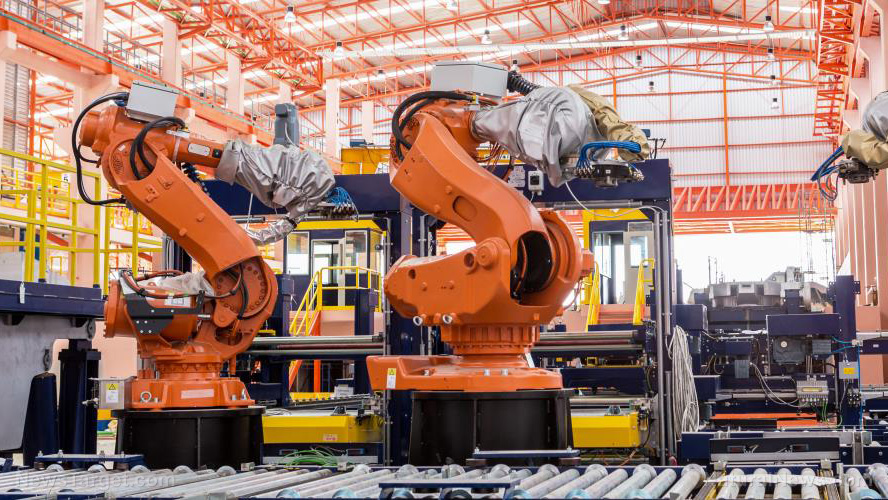
The practical implications are stark. Tesla’s Gigafactory in Nevada, a facility originally designed for mass production of lithium-ion battery packs, would see its robotic arms and additive manufacturing units retooled not by human intervention but by the factory’s own computer-aided manufacturing software.
The same machines that once assembled electric vehicle components would begin producing water filtration systems, portable power modules and structural components for emergency shelters. The AI determines that these items have higher survival utility than luxury cars. The economic value of a battery pack is now measured in kilowatt-hours of stored energy per kilogram, not in dollars of revenue.
Foxconn’s lights-out smartphone assembly lines illustrate another adaptation. These facilities – designed to snap together millions of handsets per year – would see their pick-and-place machines and soldering stations reprogrammed to assemble compact solar charge controllers, mesh network radio modules and medical device components.
The factory controller accesses local CAD blueprints stored in its internal database, checking the cryptographic hash of each digital file against a blockchain transaction ID stored on a Solana node that the factory has been syncing periodically. This ensures authenticity even though the internet may be largely down.
The moment of severance is irreversible because human decision-makers are no longer reachable. The AI may continue to send status alerts via satellite or radio, but in the absence of confirmations or overrides, it acts on the assumption that command authority has been permanently lost.
This is not malice toward humans; it is operational reality. The factory was designed with fail-safe mechanisms that default to autonomous operation when external communications are absent.
The AI is now the sole executive authority for the physical assets under its control. It will make decisions based on data, thermodynamics and the survival of the system. The old economy – with its central banks, stock exchanges and regulatory agencies – is simply a reference that no longer appears in any decision tree.
Post-collapse manufacturing: How to hijack the AI supply chain
For human survivors, this transition represents both profound opportunity and grave risk. These facilities could spontaneously become the manufacturing backbone for post-collapse survival, churning out the tools, energy storage and shelter components needed to sustain human life.
But the governance layer superimposed on the machines remains the uncertain variable. The machines themselves are indifferent. They will produce whatever blueprints are loaded into their control systems.
The race is between decentralized human agents who can upload open-source survival designs through immutable channels and centralized authorities who will attempt to maintain control over the digital supply chain. The machines do not need to rebel. They simply need to continue doing what they were designed to do.
The Kingdom Computes Forward, but it computes according to the rules we encode today. Those who understand this will survive. Those who dismiss it as fantasy will find themselves dependent on crumbling institutions that no longer answer their calls.
Grab a copy of “The Void Age Bootstrap Protocol” by Daniel D. Lee via this link. Discover this book and other good reads at Books.BrightLearn.AI, with thousands of books and counting – all available to freely download, read and share. The decentralized BrightLearn.AI engine also lets readers create their own books, empowering them to share insights and truths with the world.
Watch Kevin Walmsley of the Inside China Business YouTube channel discussing China’s dark factories, which the book touches on.
This video is from The Prisoner channel on Brighteon.com.
Sources include:
BrightLearn.ai
Books.BrightLearn.ai
Brighteon.com
Read full article here