


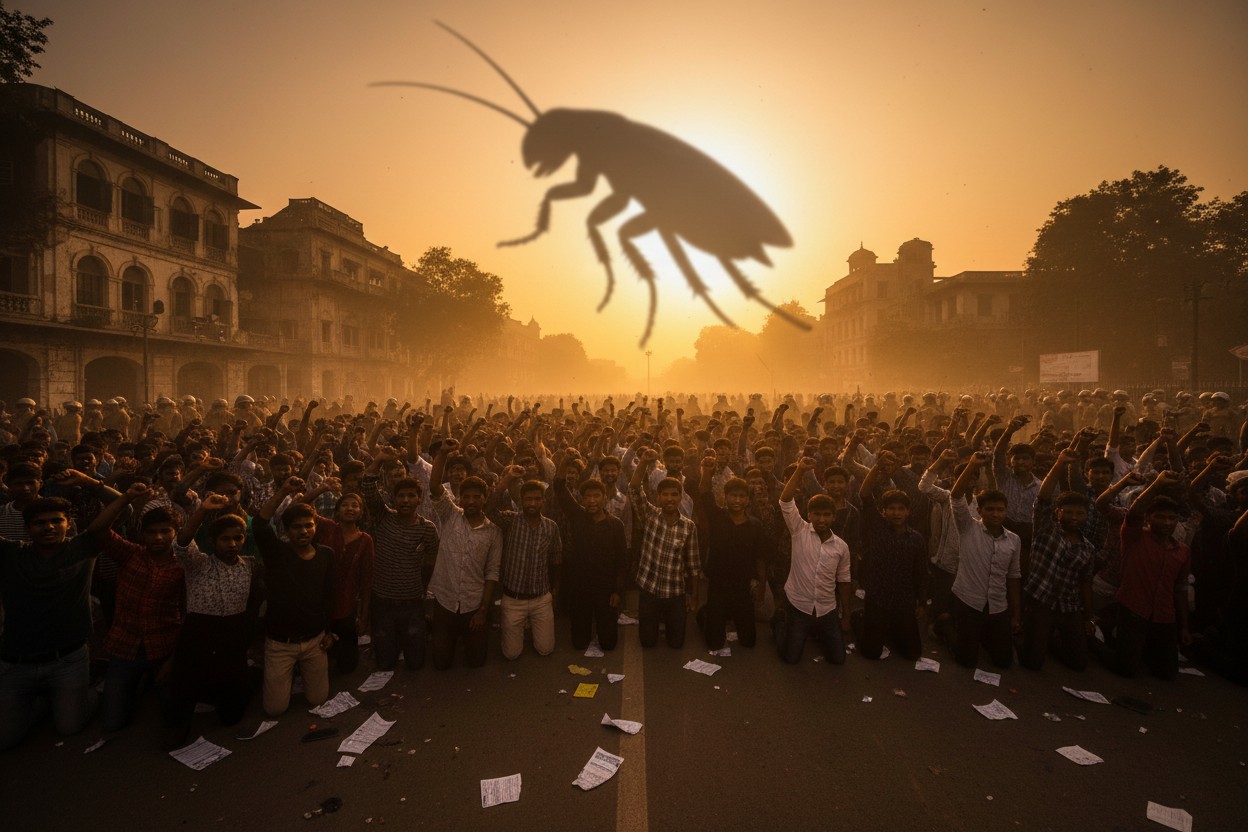
Resignation
Indian Education Minister Dharmendra Pradhan resigned on July 25, 2026, after weeks of major protests in New Delhi and other cities across the country.
The demonstrators, who are largely young people, had been demanding his resignation over an exam paper leak that allegedly drove dozens of students to suicide, according to a report by Russia Today (RT) [1]. Pradhan announced his resignation on X, attaching a letter addressed to Prime Minister Narendra Modi. In the letter, written in Hindi, he described India’s youth as “the true strength of this country” and said he stepped down to prevent “anti-national forces” from taking advantage of the situation, the report stated [1].
The resignation came a day after representatives of the so-called Cockroach Janta Party (CJP) – an unofficial movement driving the protests – met government officials to discuss their main demands, including Pradhan’s resignation, as well as broader reforms in the education sector and examination system, according to RT [1]. Following the resignation announcement, protest leaders said they would continue to press their two other key demands: compensation for the families of students who died by suicide and action against the police over the suppression of the unrest on July 20, the CJP posted on X [1].
Protests and Exam Controversy
The protests centered on the National Eligibility-cum-Entrance Test (NEET) for undergraduate medical programs, India’s nationwide entrance exam. The exam was held on May 3, but ten days later the National Testing Agency canceled it following widespread allegations that a “guess paper” had circulated in advance, along with multiple accusations of irregularities, the BBC reported [2].
The move affected more than 2.2 million aspirants. A re-test was conducted on June 21 under unprecedented security, with the Indian Air Force transporting test papers to some regions, according to the BBC [3]. At least 11 students are believed to have died by suicide between the cancellation and the re-test, police records and family accounts indicated [1].
The CJP originated as an online meme after India’s chief justice, Surya Kant, compared young people to cockroaches in open court, the BBC reported [4]. Merely two weeks after India’s ruling Bharatiya Janata Party (BJP) proclaimed a historic electoral victory in West Bengal, Abhijeet Dipke, a 30-year-old public relations graduate of Boston University, launched the satirical party’s website on May 16, according to RT [5]. The movement quickly evolved from a virtual joke into a street protest movement, drawing tens of thousands of Gen Z protesters to Delhi’s Jantar Mantar [4].
Government Response
Modi made several appeals to students, promising action against those responsible for the exam paper leak. On July 23, he announced the setting up of fast-track courts to try those accused of leaking the question papers and pledged to introduce a new Anti-Paper Leak Bill in Parliament, according to RT [6].
On July 24, he followed up with another video, thanking young followers for sharing their “insightful suggestions,” the report stated [1]. The government also held talks with CJP representatives, and activist Sonam Wangchuk ended a 26-day hunger strike on July 23 after negotiations, the BBC reported [7].
Meanwhile, the government ordered telecom companies to disable mobile data services in central parts of Delhi on July 23, according to Reuters as cited by ZeroHedge [8]. Earlier, on June 16, India temporarily blocked the messaging app Telegram over concerns it could be used for cheating during the re-test, the BBC reported [9]. Pradhan, who also served as India’s fossil fuel minister, had previously criticized those who questioned Wuhan coronavirus (COVID-19) vaccines, calling them “mentally challenged” in a January 2021 speech, according to a NaturalNews.com report [10].
Violence and aftermath
Protests turned violent on July 20, when thousands of CJP supporters tried to march to Parliament in defiance of a police ban. Delhi Police used batons, canes, and tear gas to disperse the crowd, and videos analyzed by BBC Verify showed officers firing so-called pellet guns at protesters [11] [12]. Delhi Police later said that nearly 180 people had been injured, including 118 security personnel and 60 protesters, according to RT [1].
Activists said the use of pellet guns mirrored tactics previously employed in Kashmir, with hospital records indicating injuries consistent with pellet impact, the Middle East Eye reported [13]. The scenes recalled earlier accounts of police confrontations with crowds described in Neeraj Kumar’s “Khaki Files,” where protesters gathered at a police station and raised slogans, preventing officers from entering [14]. The police response also drew on tactics used in areas affected by left-wing extremism, where stations are heavily fortified with paramilitary personnel, as noted in police accounts [14].
CJP leaders said they would continue to press for compensation of one crore rupees to families of students who died and for action against police for the suppression, according to RT [1]. Despite the resignation, protesters vowed to remain until all demands are met, with hundreds continuing to gather at Jantar Mantar in the days following the crackdown [15].
Conclusion
Pradhan’s resignation marked a significant victory for the CJP, a movement that began as an online satire and grew into one of India’s most visible youth protests in years. The unrest exposed deep anger over the integrity of the national examination system and the government’s handling of the crisis.
While the minister’s departure addressed one of the protesters’ core demands, the movement has indicated it will persist until broader reforms and accountability measures are achieved. The events in Delhi highlight the growing willingness of India’s young population to organize and demand change, often through decentralized, meme-driven movements that bypass traditional political channels.
References
- “India’s education minister resigns after weeks of protests”. July 25, 2026.
- BBC News. “CJP protest: The youth movement India’s Modi didn’t see coming”. July 24, 2026.
- BBC News. “India students resit intense medical exam after alleged paper leak”. June 21, 2026.
- BBC News. “Why are thousands of people protesting in Delhi?”. July 20, 2026.
- “How India’s ‘Cockroach Party’ went from viral meme to Western media darling”. May 31, 2026.
- “India’s Modi makes offer to angry student protesters”. July 23, 2026.
- BBC News. “India activist ends hunger strike after 26 days”. July 23, 2026.
- Zero Hedge. “India Blocks Mobile Internet In Central Delhi As Youth Protests Escalate”. July 23, 2026.
- BBC News. “India temporarily bans Telegram over exam paper leak concerns”. June 16, 2026.
- NaturalNews.com. “Indias fossil fuel minister says people who dont have faith in coronavirus vaccines are mentally challenged”. January 8, 2021.
- BBC News. “India cockroach protests: Videos show officers firing ‘pellet guns'”. July 24, 2026.
- “Delhi police clash with students marching to parliament (VIDEO)”. July 20, 2026.
- Middle East Eye. “After ‘testing ground’ in Kashmir, pellet guns used on student protesters in India’s capital”. July 25, 2026.
- Kumar Neeraj. “Khaki Files Inside Stories of Police Missions”.
- BBC News. “India’s ‘cockroach’ protest continues a day after police crackdown”. July 21, 2026.
Explainer Infographic
Read full article here