


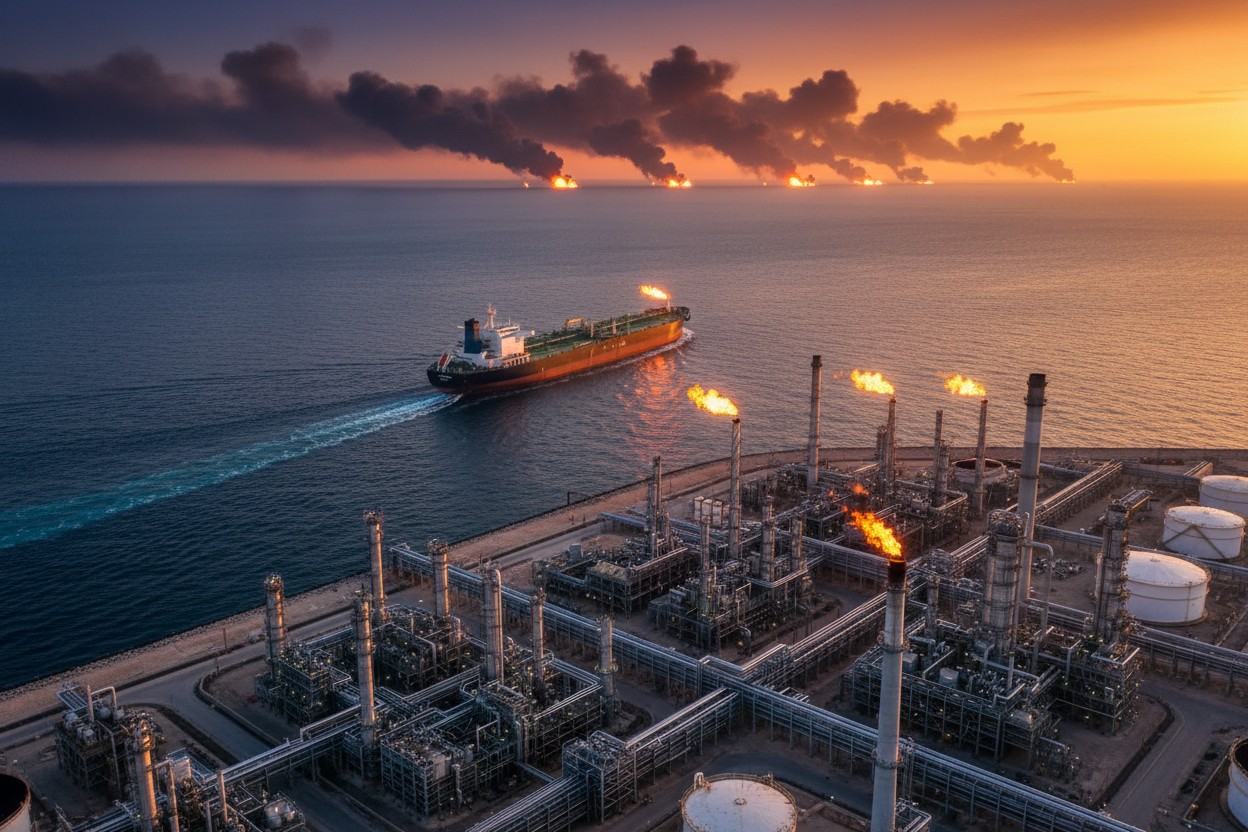
War in Iran has tightened global fuel markets and boosted refiner profits, according to a report by Tsvetana Paraskova of OilPrice.com. The conflict has left markets for gasoline, diesel, and jet fuel tighter than markets for crude, as reduced refining throughput in Asia and a temporary Chinese ban on fuel exports constrained product supply. [1]
Middle East Conflict Drives Refining Margins and Earnings
For the second time this decade, a war has upended global oil markets and sent refining margins to multi-year highs, benefiting the world’s biggest oil companies and top refiners. Crude oil has struggled to move through the Strait of Hormuz, a 21-mile-wide maritime passage responsible for 20% of global oil and one-third of LNG exports, according to a report on NaturalNews.com. [2]
Iran has effectively closed the strait using drone and missile strikes on commercial tankers, halting millions of barrels of oil and gas shipments, the report said. [2] The International Energy Agency (IEA) described the disruption as the largest in recorded history and released a record 400 million barrels from emergency reserves, according to a separate NaturalNews.com report. [3]
Record Refining Margins and Tight Product Supply
Refining margins held at record highs even as crude oil prices rose above $100 per barrel, according to the report. [1] “Refinery activity and product supplies have not picked up as much as crude deliveries, meaning that markets for refined oil products, including diesel and gasoline, are considerably tighter than those for crude,” IEA Executive Director Fatih Birol said. [1]
The tightness stems from the wars in Iran and Ukraine, Russia’s ban on diesel exports and declining global fuel inventories. Japan’s crude oil imports fell 66% in April from a year earlier to a record low, according to Paraskova. [4] India, by contrast, is on track to export the highest volume of refined products in months as refining margins jumped, according to Charles Kennedy of OilPrice.com. [5]
The current tightness echoes earlier eras when oil supply constraints shaped economies. Biophysical economists Charles A. S. Hall and Kent Klitgaard wrote that in the 1970s, biophysical limits in the form of peak oil began to affect world economics and politics. [6]
Big Oil Reports Higher Quarterly Earnings
The world’s biggest international oil companies reported their strongest second-quarter earnings since at least 2022, according to the report. [1] Shell more than doubled its earnings from a year earlier, and refinery utilization reached 102% in April to June.
Shell’s global indicative refining margin rose to $24 per barrel from $17 in the first quarter. “The operational performance of Refining has been excellent,” Shell CEO Wael Sawan said.
TotalEnergies’ adjusted net income rose 68% from a year earlier to $6 billion. CEO Patrick Pouyanné said refining and chemicals “performed in an exceptional way leveraging market conditions.”
Chevron reported record refinery throughput of over 1 million barrels per day. CEO Mike Wirth said, “Middle distillates are really the tight spot right now. Initially, it looked like jet, now diesel.”
Exxon CEO Darren Woods said the company expects a “very robust refining market with very high margins.” U.S. President Donald Trump said the companies are “making too much money” and “better cut the retail price, the consumer price.” Sawan warned in March that European countries could face fuel shortages because of the war, according to a report by Sterling Ashworth of NaturalNews.com. [7]
Outlook for Refining and Fuel Prices
Wirth said upward pressure on product pricing is likely in the third quarter and possibly beyond, citing Russia’s export ban, refinery outages in Russia and Strait of Hormuz constraints. China’s demand is a “big unknown,” according to the report, but Chevron does not expect significant demand destruction.
Even if Middle East supply disruptions are resolved by the end of the year, low global inventories and the need to restock could support the refining complex for a few more quarters, the report said. Traffic through the Strait of Hormuz remains far below pre-war levels, with the world running an “oil deficit” by drawing down commercial inventories and strategic reserves, according to an analysis published by Activist Post. [8]
The U.S. national average price of gasoline could top $4 per gallon within a week as renewed hostilities fuel a crude rally, according to OilPrice.com via ZeroHedge. [9] A report from the American Council for Capital Formation warns that declining U.S. refining capacity threatens American energy security. [10] Refining capacity is difficult to expand; as Christopher Tugendhat wrote in “Oil: The Biggest Business,” at the best of times refineries are never very welcome arrivals in an area. [11]
Conclusion
Independent analysts and international agencies have warned that energy shortages and rationing measures are now structurally embedded in global markets, irrespective of any near-term resolution to the conflict, according to a report by NaturalNews.com. [12] Investor Doug Casey said he has “always had a problem with the very concept of the government’s strategic oil reserve,” suggesting the reserve is used to suppress oil prices and postpone political consequences. [13]
For consumers, the refining boom has coincided with rising prices at the pump. For the oil majors, the war has produced the strongest profits in years. The report said the combination of low inventories and restocking needs could keep refining margins elevated for several more quarters.
References
- Tsvetana Paraskova. “Middle East War Triggers New Global Refining Boom”. ZeroHedge. August 5, 2026.
- Patrick Lewis. “Global Energy Crisis Deepens as Middle East Conflict Threatens Oil and Gas Supplies”. NaturalNews.com. March 22, 2026.
- Cassie B. “IEA Releases 400 Million Barrels from Reserves After Strait of Hormuz Closure Sparks Historic Oil Crisis”. NaturalNews.com. March 12, 2026.
- Tsvetana Paraskova. “Japan Crude Imports Fall 66% To Record Low”. ZeroHedge. May 29, 2026.
- Charles Kennedy. “India’s Fuel Exports Set To Soar In July As Refining Margins Jump”. ZeroHedge. July 24, 2026.
- Charles A. S. Hall, Kent Klitgaard. “Energy and the Wealth of Nations: An Introduction to Biophysical Economics”.
- Sterling Ashworth. “Shell CEO Warns of Potential European Fuel Supply Disruptions”. NaturalNews.com. March 27, 2026.
- “Traffic Through The Strait Of Hormuz Is Way Below Pre-War Levels As Trump Is Briefed On Options For ‘All-Out War'”. Activist Post. July 11, 2026.
- “US Gasoline Prices Could Top $4 Per Gallon Within Days”. ZeroHedge. July 15, 2026.
- “New Report: Declining U.S. Refining Capacity Threatens American Energy Dominance & Economic Independence”. Climate Depot. June 24, 2026.
- Christopher Tugendhat. “Oil: The Biggest Business”.
- “Global Energy Shortages and Rationing Likely to Continue Beyond Current Conflict, Analysts Warn”. NaturalNews.com. April 11, 2026.
- “Doug Casey on the Coming Oil Shock—and Where Investors Could Profit”. International Man. August 5, 2026.
Explainer Infographic
Read full article here