


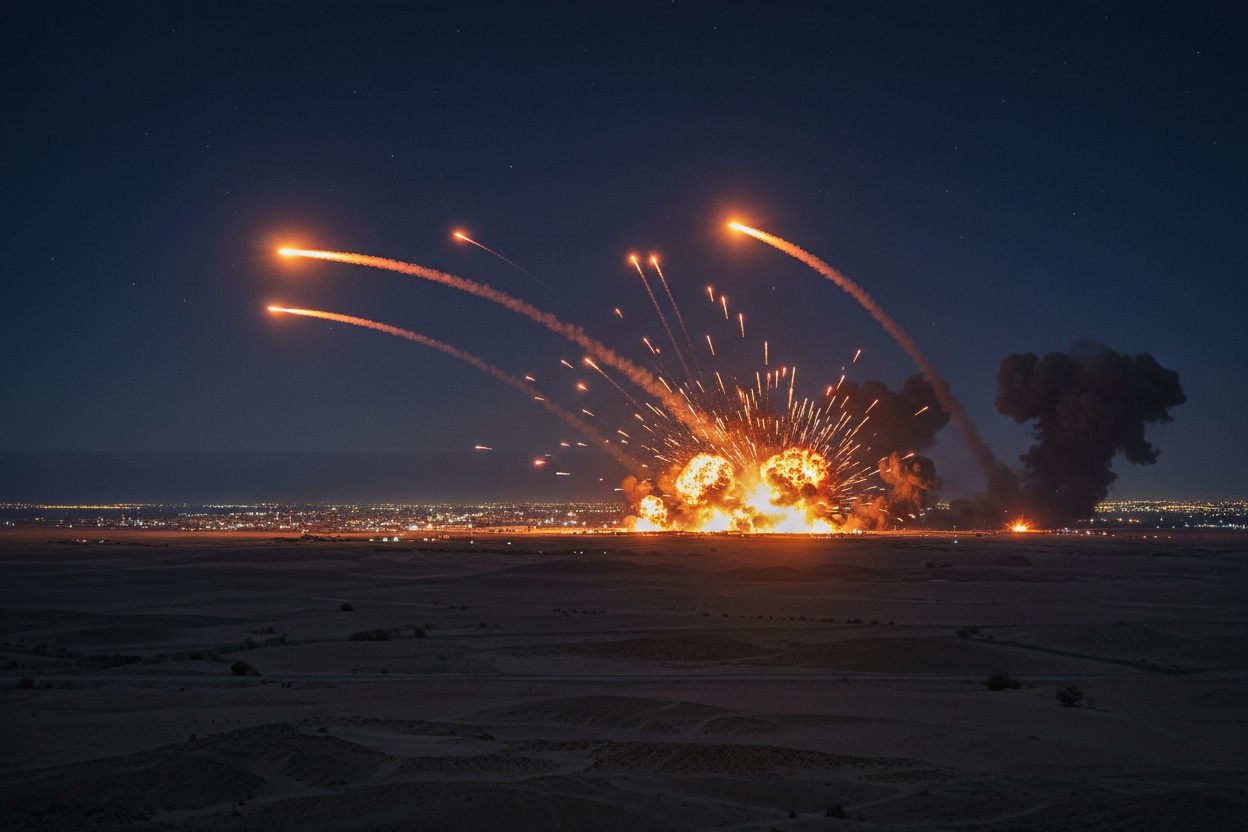
Iranian Missiles Strike U.S. Military Sites in Jordan’s Aqaba
Iran launched missiles and drones at Jordan on Wednesday, targeting the Red Sea port city of Aqaba and its airport, according to reports from Jordanian authorities and regional media. The attack occurred around midday local time and prompted air defense interceptions, with explosions audible in the neighboring Israeli city of Eilat. [1] [2]
The Jordanian military said it intercepted four Iranian missiles, while two others fell in unpopulated areas, according to a statement carried by state media. The U.S. Embassy in Amman had issued an extraordinary security alert days earlier, warning Americans to avoid Aqaba’s international airport and seaport due to a “specific and credible threat.” [3] The Israeli Defense Forces launched Iron Dome interceptors over Eilat to counter potential debris from the missile strikes, though no sirens were activated. [4]
IRGC Claims Responsibility for Strikes on U.S. Targets in Kuwait, Jordan, Bahrain
Iran’s Islamic Revolutionary Guard Corps (IRGC) claimed responsibility for the strikes, stating that it targeted U.S. aircraft stationed at Jordan’s Aqaba airport as well as American military facilities at Kuwait’s Al-Adiri camp, Ali Al Salem Air Base, and in Syria. [5] The IRGC said the attacks were carried out with ballistic missiles and drones, and that they struck U.S. radar systems and air defense installations across the region. [6]
According to Iranian military statements, the operation also hit accommodation, welfare, and equipment storage at Muwaffaq Salti Air Base in Jordan, where two U.S. service members were killed days earlier. [7] The IRGC additionally claimed that Arash loitering drones targeted warehouses and hangars at Sheikh Isa Air Base in Bahrain. The coordinated barrage marked one of the most extensive Iranian retaliatory operations since renewed hostilities began in early July. [8]
U.S. Central Command Reports 11th Consecutive Night of Strikes in Iran
The United States military completed its 11th consecutive night of strikes on Iran early Wednesday, according to U.S. Central Command (CENTCOM). The attacks targeted military operations centers, maritime capabilities, aircraft hangars, drone storage sites, and logistics infrastructure, CENTCOM said. [9] The strikes came hours before the Iranian missile attack on Aqaba and were part of a broader campaign to degrade Iran’s ability to threaten commercial shipping in the Strait of Hormuz. [10]
The Pentagon reported that the bombing campaign, which began after the collapse of a fragile 60-day ceasefire signed in June, had expanded to include targets near Tehran and other northern areas. [11] Iranian state media reported explosions in Tabriz, Sirik, Bushehr, and areas around the capital, with air defenses activated but no direct hits on Tehran, according to authorities. [10] The renewed fighting has effectively shredded the interim deal aimed at ending the war that began in late February. [12]
Iranian Military Issues Warning on Potential Expanded Conflict
In response to escalating U.S. threats, Iran’s Khatam al-Anbiya Central Command issued a warning that any American strikes on Iranian nuclear or power infrastructure would be treated as an expansion of the war. The statement said all U.S. interests and those of its allies would become legitimate targets for Iran, according to Iranian state media. [13] This warning followed U.S. President Donald Trump’s threat to “hit very heavily” Iran’s Pickaxe Mountain nuclear site. [14]
The Iranian military’s posture reflects a calculated strategy described as “blind, deplete, and overwhelm,” designed to render U.S. defenses obsolete through sustained volleys of missiles and drones. [15] Former intelligence officials noted that Iran has become more adept at evading U.S. air defense systems, firing missiles that travel at extremely high speeds and maneuver during descent. [8] The warning signals that the conflict could further escalate if either side targets critical infrastructure.
Escalation Continues With Repeated Targeting of Aqaba
Aqaba, which hosts key U.S. military infrastructure including an airport and seaport used for logistics and troop movements, has been targeted multiple times in recent weeks. [3] The July 22 strike followed earlier attacks on Jordan’s Azraq air base, where Iran fired ten ballistic missiles on July 9, and Muwaffaq Salti Air Base, where two U.S. soldiers were killed on July 18. [16] [17] The Pentagon confirmed that nearly 100 U.S. service members had sustained injuries from Iranian strikes across the region. [18]
Satellite imagery analysis showed that Iranian strikes have damaged or destroyed at least 228 structures or pieces of equipment at U.S. military sites in the Middle East since late February, including hangars, barracks, and vehicles. [19] The IRGC claimed that its recent strikes on Jordanian bases were aided by “accurate information” from local residents. [20] As both sides continue to trade fire, diplomatic efforts led by Pakistani mediators have failed to secure a ceasefire, with Iranian President Masoud Pezeshkian telling citizens that the country is engaged in a “full-scale war.” [21]
References
- Times of Israel. “Iranian missiles target Jordan, interception explosions boom over Eilat.” July 22, 2026.
- Middle East Eye. “Iran targets Jordan’s Aqaba with missiles.” July 22, 2026.
- 100percentfedup.com. “BREAKING: U.S. Embassy Warns Americans Away From Jordan Airport And Seaport Over ‘Specific And Credible Threat’.” July 19, 2026.
- Times of Israel. “IDF fires interceptors over Eilat as Iranian missiles target nearby Aqaba in Jordan.” July 19, 2026.
- The Epoch Times. “Iran Targets Gulf States, Reports Tankers Disabled in Hormuz.” July 20, 2026.
- Middle East Eye. “Iran hits US bases in Bahrain, Kuwait and Jordan after 10 nights of US attacks.” July 21, 2026.
- 100percentfedup.com. “BREAKING: Pentagon Identifies Two U.S. Service Members Killed In Jordan.” July 20, 2026.
- NaturalNews.com. “U.S. Air Defenses Face Challenges Against Iranian Missiles, Officials Say.” July 21, 2026.
- NTD. “US Military Completes 11th Night of Strikes on Iran.” July 22, 2026.
- BBC News. “US renews strikes on Iran as Trump threatens to attack Pickaxe Mountain.” July 22, 2026.
- Times of Israel. “Israel remains on sidelines of US-Iran fight, which for Jerusalem is just fine for now.” July 21, 2026.
- Times of Israel. “US expands strikes into Tehran area as Iran threatens to ‘resist until the end’.” July 16, 2026.
- Cassie B. “U.S. Tops 8,000 Targets Struck in Iran as Tehran Vows to Fight Fire with Fire over Power Plant Ultimatum.” NaturalNews.com. March 23, 2026.
- The Epoch Times. “Trump Says US Will Strike Iran’s Pickaxe Mountain Nuclear Site ‘Very Heavily’.” July 21, 2026.
- NaturalNews.com. “Iran’s War Strategy: Blind, Deplete and Overwhelm – The Calculated Plan to Render U.S. Defenses Obsolete.” March 2, 2026.
- Middle East Eye. “Iran fired ten ballistic missiles on Jordan’s Azraq military base.” July 9, 2026.
- The War Zone. “Two U.S. Troops Killed In Iranian Barrage On Base In Jordan.” July 18, 2026.
- Middle East Eye. “Nearly 100 US troops injured by Iran strikes, Pentagon says.” July 21, 2026.
- Garrison Vance. “Satellite Imagery Shows Extensive Damage to U.S. Assets in Middle East From Iranian Strikes.” NaturalNews.com. May 7, 2026.
- Zerohedge.com. “Iranian Strikes On US Bases In Jordan Aided By ‘Accurate Intel’ From Locals, IRGC Says.” July 20, 2026.
- Zerohedge.com. “Mediators Float 10-Day Ceasefire As Pezeshkian Tells Citizens Iran Engaged In ‘Full-Scale War’.” July 20, 2026.
- Robert H. Scales. “Certain victory.”
Read full article here