


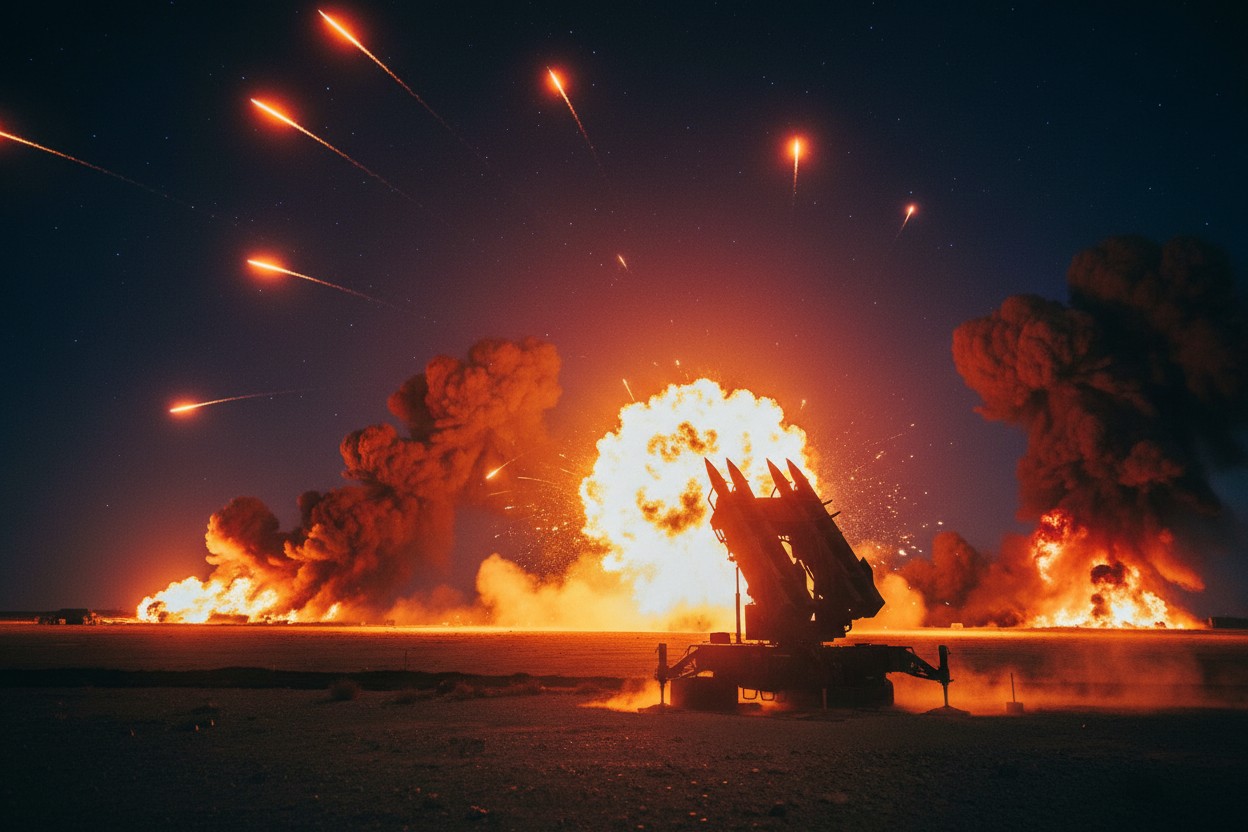
C-RAM Radar Destroyed in Kuwait: Iran’s Eighth Wave Strikes at the Heart of US Military Force Projection
The Islamic Revolutionary Guard Corps announced Sunday that its combined Navy and Aerospace Force units have successfully struck and destroyed the C-RAM early-warning radar system at Ali Al Salem Air Base in Kuwait, marking the eighth wave of Operation Nasr 2 and delivering a direct message to Washington that American military bases across the Middle East are no longer sanctuaries. The attack, which also targeted a location where US troops were reportedly gathered, represents an escalation that forces a reckoning with decades of American military overreach. As the United States finds itself entangled in yet another Congressionally undeclared and illegal Middle Eastern war, the words of former congressman Ron Paul echo with prophetic clarity: a nation that maintains 900 military bases in 130 countries while claiming bankruptcy cannot claim wisdom in foreign policy. In 2011, Paul opposed then sanctions to Iran, because they represented “the initial step to war.” Now the US finds its Middle Eastern military bases taking significant damage with US troops being killed in retaliation.
Key points:
- Iran’s IRGC destroyed the C-RAM early-warning radar system at Ali Al Salem Air Base in Kuwait during the eighth wave of Operation Nasr 2.
- C-RAM systems are mobile land-based defense networks that detect, track, and destroy incoming rockets, mortars, missiles, and drones.
- Iran explicitly warned that aggression launched from regional bases will face continued retaliation.
- The attack occurred in response to overnight strikes on Iran’s southern coast and cities.
- Ron Paul’s 2011 call to close foreign military bases and prioritize diplomacy over force has proven prescient.
Understanding the C-RAM system and why Iran targeted it
The Counter-Rocket, Artillery, and Mortar system, known as C-RAM, is not simply another piece of military hardware. It is the technological backbone of force protection for American troops stationed in hostile environments. The system operates through an integrated network that begins with early warning radar constantly scanning the airspace surrounding a base. When the radar identifies an incoming projectile, the command and control computer processes the data in fractions of a second, calculating the trajectory and predicting the impact point. If the threat is projected to strike a defended area, an automated Gatling gun fires thousands of rounds per minute to destroy the projectile in mid-air.
At Ali Al Salem Air Base in Kuwait, these radar and C-RAM networks function as a critical layer of protection for US troops and infrastructure against regional threats. By destroying this radar, Iran has effectively blinded the American defensive network at that base, creating vulnerabilities that extend far beyond a single installation. The C-RAM’s early warning radars are frequently primary targets during regional escalations precisely because of their importance in protecting US assets. When Iran claims responsibility for this strike, it is telling the world that it understands American military vulnerabilities and is willing to exploit them.
The broader implications for US bases surrounding Iran
Iran’s warning that American aggression launched from regional bases will continue to face retaliation should chill any military planner in Washington. The United States maintains significant troop presence across Iraq, Afghanistan, Kuwait, and other Middle Eastern countries, with over 50,000 personnel stationed in the region. These bases host command centers like the Fifth Fleet and serve as launching points for operations against Iran. What Iran has demonstrated with this strike is that no base is safe, no radar is untouchable, and no warning system can protect against a determined adversary.
The strategic calculus has shifted. Nations hosting US bases must now confront the reality that their territory becomes a legitimate target in any conflict between Washington and Tehran. Kuwait, which hosts Ali Al Salem Air Base, finds itself in an impossible position. Its sovereignty has been compromised by American military operations launched from its soil, and its civilian population now faces potential retaliation for decisions made in Washington. This is the fundamental problem with forward-deployed military bases: they turn host nations into targets while providing the illusion of security.
Ron Paul’s foresight and the path not taken
In 2011, when Ron Paul appeared on CBS’s “Face the Nation,” he articulated a vision of American foreign policy that seems almost radical in its common sense. “I think a submarine is a very worthwhile weapon. I believe we can defend ourselves with submarines and all our troops back at home. This whole idea that we have to be in 130 countries and 900 bases is an old fashioned idea,” Paul said. “It makes no sense at all. Besides, we’re bankrupt. We can’t afford it any longer.”
Paul understood something that Washington’s foreign policy establishment refused to acknowledge: overseas military bases do not make America safer. They provoke enemies, drain the treasury, and create endless cycles of retaliation. “Those troops overseas aggravate our enemies, motivate our enemies. I think it’s a danger to our national defense,” Paul warned. He called for diplomacy over military force, noting that the Cuban Missile Crisis was resolved through negotiation between Kennedy and Khrushchev, not through military strikes.
Had the United States followed Paul’s advice and closed foreign military bases, brought troops home, and focused on defense rather than global intervention, the nation would be financially stronger and more respected internationally. The money saved from maintaining 900 bases could have been invested in American infrastructure, healthcare, and education. The lives of American service members would not have been placed in harm’s way in foreign conflicts that do not serve core national interests. And most critically, the United States would have avoided the illegal war against Iran that now threatens to escalate into cascading catastrophes.
The attack on C-RAM radar in Kuwait is not an isolated incident. It is a symptom of a foreign policy that has failed. Iran has demonstrated that it can strike American defensive systems with precision. The next attack may target something more critical. The question is whether Washington will learn from Ron Paul’s wisdom or continue down the path of endless war.
Sources include:
SputnikGlobe.com
Politico.com
MissileDefenseAdvocacy.org
Read full article here