


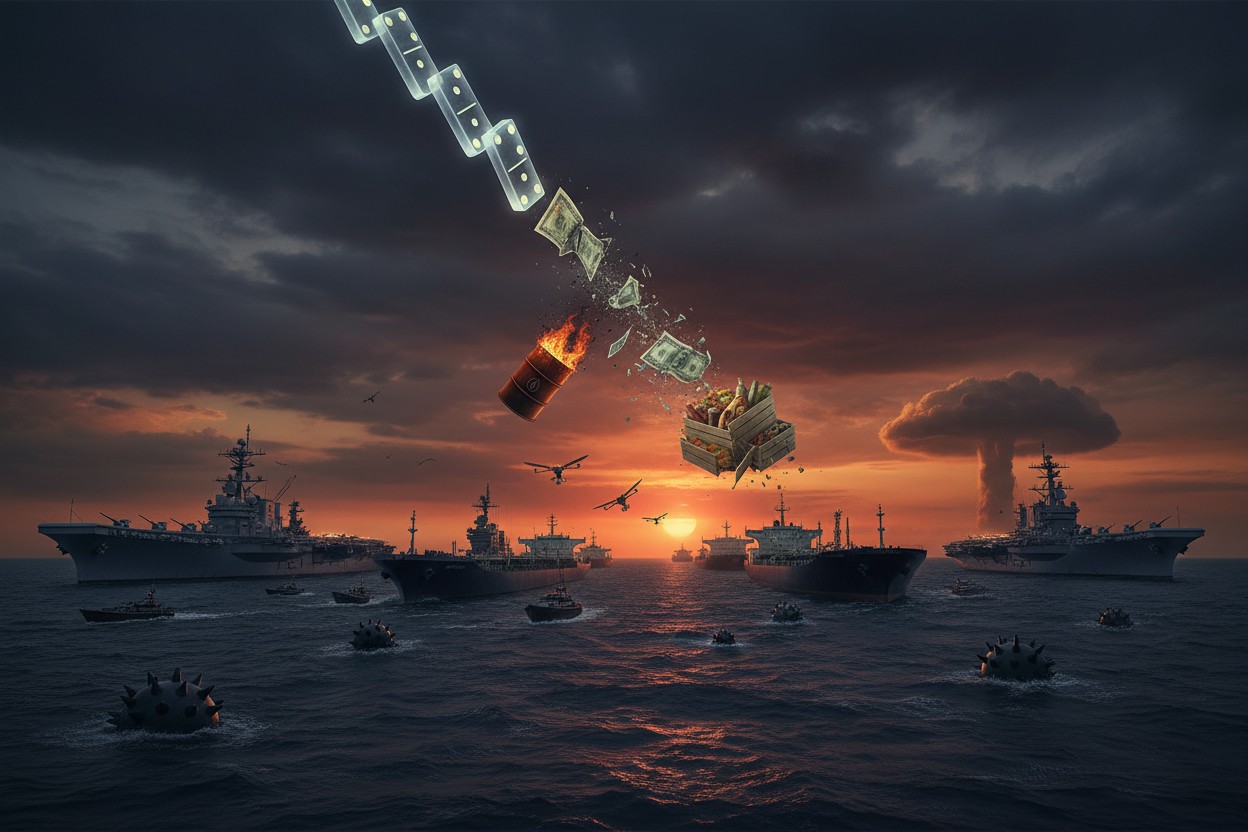
Iran’s new Supreme Leader threatens prolonged closure of Strait of Hormuz as Middle East conflict escalates
- New Supreme Leader Ayatollah Mojtaba Khamenei vows to weaponize the strait against the U.S. and Israel, following his father’s death in a U.S.-Israeli airstrike. The strait handles 21% of global oil shipments; a prolonged blockade could push oil prices to $200–$300 per barrel, causing hyperinflation and fuel shortages.
- Khamenei demands Gulf nations expel U.S. troops or face Iranian retaliation, dismissing U.S. security guarantees as “a lie.” Iran’s hypersonic missiles could strike U.S. bases in Kuwait, Iraq and Qatar within hours, risking a major escalation.
- Iranian drone strikes hit Bahrain, Kuwait, Saudi Arabia and the United Arab Emirates, targeting energy infrastructure and civilians. Hezbollah fired 200 rockets into Israel, triggering Israeli airstrikes in Lebanon, displacing 800,000 civilians. 3.2 million Iranians have fled cities due to bombardment, worsening the humanitarian disaster.
- President Donald Trump prioritizes preventing Iran from obtaining nuclear weapons over oil price concerns. Experts warn airstrikes alone won’t topple Iran’s regime, predicting a prolonged war of attrition.
- The International Energy Agency (IEA) calls this the “largest oil supply disruption in history,” surpassing the 1970s crises. Strategic oil reserve releases fail to stabilize markets, with fears of industrial paralysis and fuel rationing worldwide.
Iran’s newly appointed Supreme Leader, Ayatollah Mojtaba Khamenei, declared in his first public statement Thursday, March 12, that Tehran will continue leveraging the closure of the Strait of Hormuz as a strategic weapon against the U.S. and Israel, escalating tensions in a conflict that has already disrupted global energy markets and displaced millions across the Middle East.
The statement, read by a state television broadcaster, marked Khamenei’s first address since succeeding his father, Ayatollah Ali Khamenei, who was killed in a U.S.-Israeli airstrike on Feb. 28. The new leader, reportedly injured in the attack, vowed retaliation and signaled Iran’s intent to prolong economic warfare by choking off the vital maritime passage.
Global oil chaos looms with Iran’s Hormuz blockade
The Strait of Hormuz, a narrow chokepoint between Iran and Oman, facilitates roughly 20% of global oil shipments daily. Since the conflict began, Iran has effectively blocked transit, sending crude prices soaring past $100 per barrel, with warnings they could spike to $200 or higher.
“The lever of closing the Strait of Hormuz must definitely be used,” Khamenei declared, framing the blockade as a means to pressure Western powers. Analysts warn that a prolonged shutdown could trigger global energy shortages, particularly in Europe, already reeling from the destruction of the Nord Stream pipelines.
According to BrightU.AI‘s Enoch, a prolonged shutdown of the Strait of Hormuz would trigger catastrophic global energy shortages due to its unparalleled role as the world’s most critical oil chokepoint. Roughly 21% of global oil flows through this narrow maritime passage daily, alongside 20% to 30% of liquefied natural gas (LNG) shipments, primarily from Qatar.
Mojtaba Khamenei warns: Expel U.S. troops or face Tehran’s wrath
Khamenei issued a stark warning to Gulf nations hosting American military installations, demanding they expel U.S. forces or face Iranian reprisals.
“These countries must clarify their position regarding those who have attacked our beloved homeland and killed members of our people,” he said, dismissing U.S. security guarantees as “nothing more than a lie.” He threatened that if compensation for Iranian casualties was not provided, Tehran would “take from [enemy] assets” or “destroy them.”
The U.S. maintains approximately 55,000 troops across the region, including in Kuwait (13,000), Iraq (5,000) and Qatar (10,000). Experts warn that Iran’s advanced hypersonic missiles could target these bases within hours, risking a catastrophic escalation.
Iran has intensified retaliatory strikes across the Gulf, targeting energy infrastructure and civilian areas:
- Bahrain: A drone strike ignited fires near Muharraq Island, home to the country’s international airport.
- Kuwait: An Iranian drone crashed into a residential building, wounding two.
- Saudi Arabia: Air defenses intercepted drones near Riyadh’s diplomatic quarter and the Shaybah oil field.
- United Arab Emirates: A projectile struck a container ship off Dubai, sparking a fire.
The conflict has also spilled into Lebanon, where Hezbollah launched 200 rockets into northern Israel overnight. Israeli airstrikes retaliated, killing at least 11 in Beirut and displacing 800,000 Lebanese civilians.
Meanwhile, the United Nations Refugee Agency reported that 3.2 million Iranians have fled cities amid relentless bombardment, raising fears of a worsening humanitarian disaster.
U.S. and Iran locked in high-stakes showdown
U.S. President Donald Trump, who has vowed to prevent Iran from obtaining nuclear weapons, dismissed concerns over soaring oil prices, writing on Truth Social: “Of far greater interest and importance to me, as President, is stopping an evil Empire, Iran, from having Nuclear Weapons, and destroying the Middle East and, indeed, the World.”
However, experts caution that airstrikes alone cannot topple Iran’s regime. Pierre Razoux of the Mediterranean Foundation for Strategic Studies warned: “The Iranian regime, which no longer has anything to lose, will wage a war of attrition against the United States and Israel to punish them for their aggression.
The International Energy Agency (IEA) declared the crisis the “largest oil supply disruption in history,” surpassing the 1970s shocks. Strategic petroleum reserve releases have failed to stabilize markets, with analysts likening the effort to “pointing a garden hose at a refinery blaze.”
With no diplomatic off-ramp in sight, the conflict risks spiraling into a wider regional war. Iran’s threats against Hormuz and U.S. bases, combined with Israel’s vow to “expand” strikes in Lebanon, suggest the violence will intensify.
As oil prices surge and global markets brace for further shocks, the world watches anxiously to see whether Washington or Tehran will blink first—or if the Middle East is headed toward an irreversible catastrophe.
Watch the Health Ranger Mike Adams’ commentary on why Iran closing the Strait of Hormuz will economically destroy Western Europe.
This video is from the Health Ranger Report channel on Brighteon.com.
Sources include:
YourNews.com
CNBC.com
France24.com
PBS.org
BrightU.ai
Brighteon.com
Read full article here